 0
0
 0
0
Watch a duck cross a still pond. Behind it, the water folds into a V. Little ripples spread out. Small swirls turn at the edges.
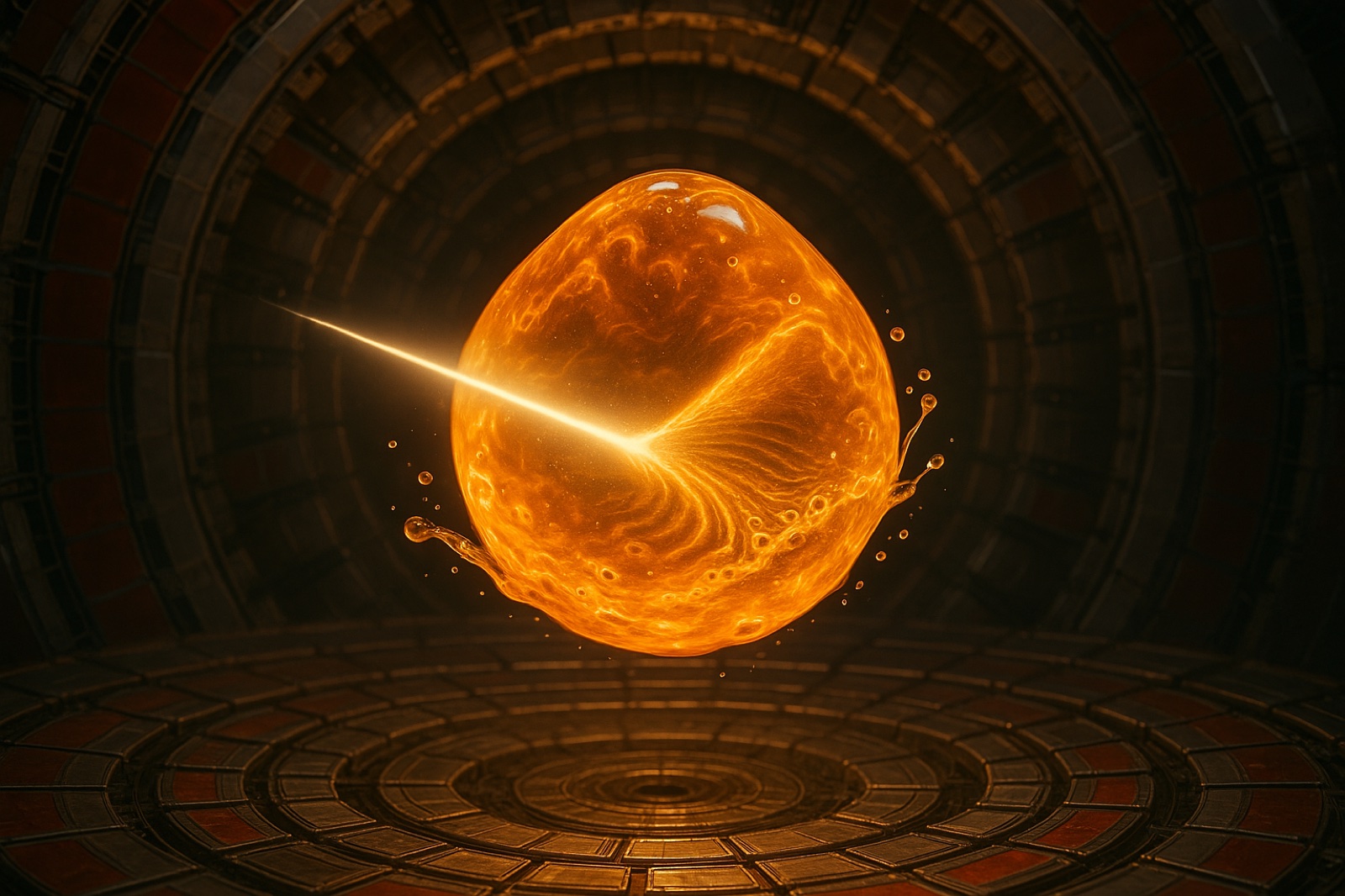
Now picture that same wake. But the pond is the hottest stuff ever made. It is more than a trillion degrees. It lasts for a tiny sliver of a second. And the duck is a single quark, one of the smallest pieces of matter there is.
That is what physicists say they saw at CERN’s Large Hadron Collider. The pond is called quark-gluon plasma. It is the matter that filled the whole universe in its first few millionths of a second. And the wake is the clearest sign yet that this first matter did not fly apart like a gas. It flowed, like a liquid.
What Is Quark-Gluon Plasma?
Everything around you is made of atoms. Inside each atom is a nucleus. Inside the nucleus are protons and neutrons. And inside those are even smaller bits called quarks, held together by particles called gluons. The name comes from glue, and that is their job.
Normally quarks are locked up. You never find one on its own. But get things hot enough and the locks melt. Protons and neutrons come apart, and the quarks and gluons mix into one hot soup. That soup is quark-gluon plasma.
The universe was full of it for only a few millionths of a second after it began. Then it cooled, and the quarks were locked into protons and neutrons. Those became atoms. Those atoms became stars, planets, and you.
Nothing like it exists in nature now. So to study it, you have to make some. The collider does this by smashing heavy atomic nuclei into each other at nearly the speed of light. For a flash, a speck of the early universe exists again. Then it is gone. We have written before about a tiny Big Bang made from the smallest nuclei yet, which used this same trick.
A Quick Note on the Word “Just”
This story is going around again in early October 2026, with headlines saying physicists “just” saw it. That is not quite right, and it is worth being honest about.
The study came out at the start of the year. MIT announced it on 28 January 2026. The paper ran in the journal Physics Letters B. It was led by MIT physicist Yen-Jie Lee, working with the CMS Collaboration, a large worldwide team that runs one of the collider’s main detectors. The result is real and it is new to most people. It just is not new this week.
And here is the bigger surprise. The idea that this plasma is a liquid is not new either.
Physicists Expected a Gas. They Got a Liquid.
Back in 2005, four research teams at a different collider, at Brookhaven National Laboratory in New York, made a joint announcement. Most physicists had expected quark-gluon plasma to act like a hot gas. They thought particles would zip through it easily.
It did not act like that. It moved together, all at once, with almost no friction. The teams called it an almost “perfect” liquid. It was one of the great surprises in modern physics. The very first matter was not a thin spray. It was thick enough to flow.
So what is new in 2026? Not the idea. The new part is that someone finally watched one particle push through this liquid and saw the liquid push back.
How Do You See the Wake of One Quark?
This is the clever part, and it is the reason the experiment took so long.
When a collision throws out a fast quark, it usually throws out a second one too, going the other way. Both quarks plow through the plasma. Both leave a wake. And the two wakes get tangled. As Lee put it, one quark “overshadows the wake of the second quark.” You cannot tell which ripple belongs to which.
So the team looked for a different kind of pair. Sometimes a quark is thrown out alongside a particle called a Z boson. The Z boson is a quiet passenger. It has almost no effect on the plasma around it, so it leaves no wake at all. It just flies out and gets measured.
That makes it a perfect marker. If the Z boson went left, the quark went right. And anything stirred up on the right side belongs to that one quark alone.
These events are rare. The team sifted through 13 billion collisions and found about 2,000 that made a Z boson. In those 2,000, they mapped the energy spread through each tiny drop of plasma. Again and again, they saw the same pattern on the side away from the Z boson: splashes and swirls, like a wake behind a boat.
“Now we see the plasma is incredibly dense, such that it is able to slow down a quark, and produces splashes and swirls like a liquid,” Lee said. “So quark-gluon plasma really is a primordial soup.”
The pattern matched what MIT physicist Krishna Rajagopal’s “hybrid model” had predicted: that the plasma should react to a fast particle like a fluid, rippling and splashing as it passes.
What This Finding Does Not Say
It is worth being careful here, because science stories tend to grow in the retelling.
The team called this “the first direct evidence” that the plasma reacts to a speeding particle as a single fluid. That is a strong claim, but a specific one. It does not mean everything about this plasma is now known. The results were described as consistent with the predictions, which is how good science talks. It is not the same as “proven beyond doubt.”
The real payoff is still ahead. By measuring how big these wakes get, how fast they spread and how quickly they fade, physicists hope to learn exactly how thick and sticky this first matter was. That would tell us more about what the universe was like in its first moments. Those measurements have not been done yet.
Why a Liquid Beginning Is Strange to Sit With
Most of us picture the start of the universe as a blast. Light and fire, everything flying outward. That picture is not wrong. But this result adds something to it. In those first moments, the stuff of everything was not scattering like sparks. It was moving together, folding around whatever passed through it, the way water does.
There is something old about that picture. One of the oldest stories people have ever told about the beginning, the first page of the Bible, does not open with an explosion either. It opens with deep, dark water, and something moving over it.
That is not physics, and quark-gluon plasma is not those waters. Nobody should pretend an ancient poem predicted a particle collider, or that a collider proves an ancient poem. Those are two very different kinds of telling. But it is a quiet, curious thing that two descriptions of the beginning, written thousands of years apart, both reach for the language of something that flows. Some people find that worth a moment’s wonder before moving on.
Where the Wake Goes Next
For now, the duck picture is the right one to keep. Physicists can finally watch a single particle move through the universe’s first matter and see that matter respond. Next they will measure the wake itself, its width, its speed, how long it lingers, and read the soup from the ripples.
If you want to see how scientists measure the age of everything that came after that first soup, our free How Old Is the Universe? Explorer walks you through it in a couple of minutes. And if you are curious what holds the quarks together once the soup cools, what holds a proton together may not be its parts picks up right where this leaves off.
A good place to start:
The Beginner’s Guide to Feeling God’s Presence Every Day
A short video guide and companion PDF for noticing something bigger in the ordinary moments of a normal day.
Get the free guide Free.
One Question Worth Thinking About
For decades, most physicists pictured the first matter as a hot gas, and it turned out to be a liquid. Why do you think our first guess about the beginning is so often an explosion, rather than something that flows? Tell us what you think in the comments.
Share This
- “Physicists watched a single quark push through the matter that filled the newborn universe. It left a wake, like a duck on a pond. The first matter wasn’t a gas. It was a liquid.”
- “13 billion collisions. About 2,000 useful ones. And in them, the clearest look yet at how the universe’s first matter moved: splashes and swirls, like water.”
- “In 2005 physicists expected the early universe’s matter to act like a gas. It acted like an almost perfect liquid instead. Now they’ve seen a single particle leave a wake in it. I can’t stop picturing that.”
Questions People Ask About Quark-Gluon Plasma
What is quark-gluon plasma?
Quark-gluon plasma is a state of matter so hot that protons and neutrons melt, leaving their quarks and gluons mixed freely together. It filled the universe for a few millionths of a second after the universe began. It does not exist naturally today, so physicists recreate tiny drops of it by smashing heavy atomic nuclei together in particle colliders.
Is quark-gluon plasma a liquid or a gas?
Quark-gluon plasma behaves like a liquid, not a gas. Physicists originally expected a gas, but experiments at Brookhaven National Laboratory’s collider in 2005 showed it flowing as an almost “perfect” liquid with very little friction. A 2026 study using CERN’s Large Hadron Collider added direct evidence by showing a single quark leaving a fluid-like wake as it moved through the plasma.
How did scientists see the wake of a single quark?
Scientists in the CMS Collaboration, in a study led by MIT physicist Yen-Jie Lee, looked for collisions that produced a quark together with a Z boson. A Z boson barely interacts with quark-gluon plasma, so it leaves no wake of its own and marks the opposite direction in which the quark travelled. Out of 13 billion collisions, about 2,000 produced a Z boson, and in those events the team saw splashes and swirls in the plasma on the side opposite the Z boson.
When was the quark-wake study published?
The quark-wake study was announced by MIT on 28 January 2026 and published in the journal Physics Letters B. Coverage of the result circulated again in October 2026, but the finding itself dates from the start of that year.
Does quark-gluon plasma prove the Bible’s creation account?
No. Quark-gluon plasma is a physics finding about the first millionths of a second of the universe, and the opening of Genesis is not a physics claim. Some readers notice a resonance, because both the ancient creation account and the modern physics describe the beginning in the language of something that flows, but that is an observation about language and wonder, not evidence for or against either one.