 0
0
 0
0
Maybe you know the feeling. You drifted. Not in one big step, but in a hundred small ones. You stopped praying. You stopped showing up. Then one day you looked up and could not see the way back. And the worst part was not the distance. It was the thought that if you ever wanted to come home, you would have to walk every step of it yourself, and face everyone when you got there.
The parable of the lost sheep was told to people in exactly that spot. And it says something about the way home that almost nobody expects. The sheep never walks it.
Who Jesus Was Talking To When He Told the Parable of the Lost Sheep
Luke 15 opens with a complaint. Tax collectors and people with bad reputations were crowding in to hear Jesus. The religious leaders did not like it. Luke writes: “And the Pharisees and scribes murmured, saying, This man receiveth sinners, and eateth with them” (Luke 15:2).
That was meant as an insult. Jesus treated it as a job description. Instead of arguing, He told a story. In fact, He told three. The lost sheep comes first, then a lost coin, then a lost son. But the sheep is the one where the lost thing does nothing at all.
What the Parable Actually Says
Here is the whole story, in Jesus’ own words:
“What man of you, having an hundred sheep, if he lose one of them, doth not leave the ninety and nine in the wilderness, and go after that which is lost, until he find it? And when he hath found it, he layeth it on his shoulders, rejoicing. And when he cometh home, he calleth together his friends and neighbours, saying unto them, Rejoice with me; for I have found my sheep which was lost.” (Luke 15:4-6)
Read it again and watch who does what. The shepherd leaves. The shepherd goes after. The shepherd finds. The shepherd lifts. The shepherd carries. The shepherd throws the party.
The sheep? It gets lost. That is its entire contribution to the story.
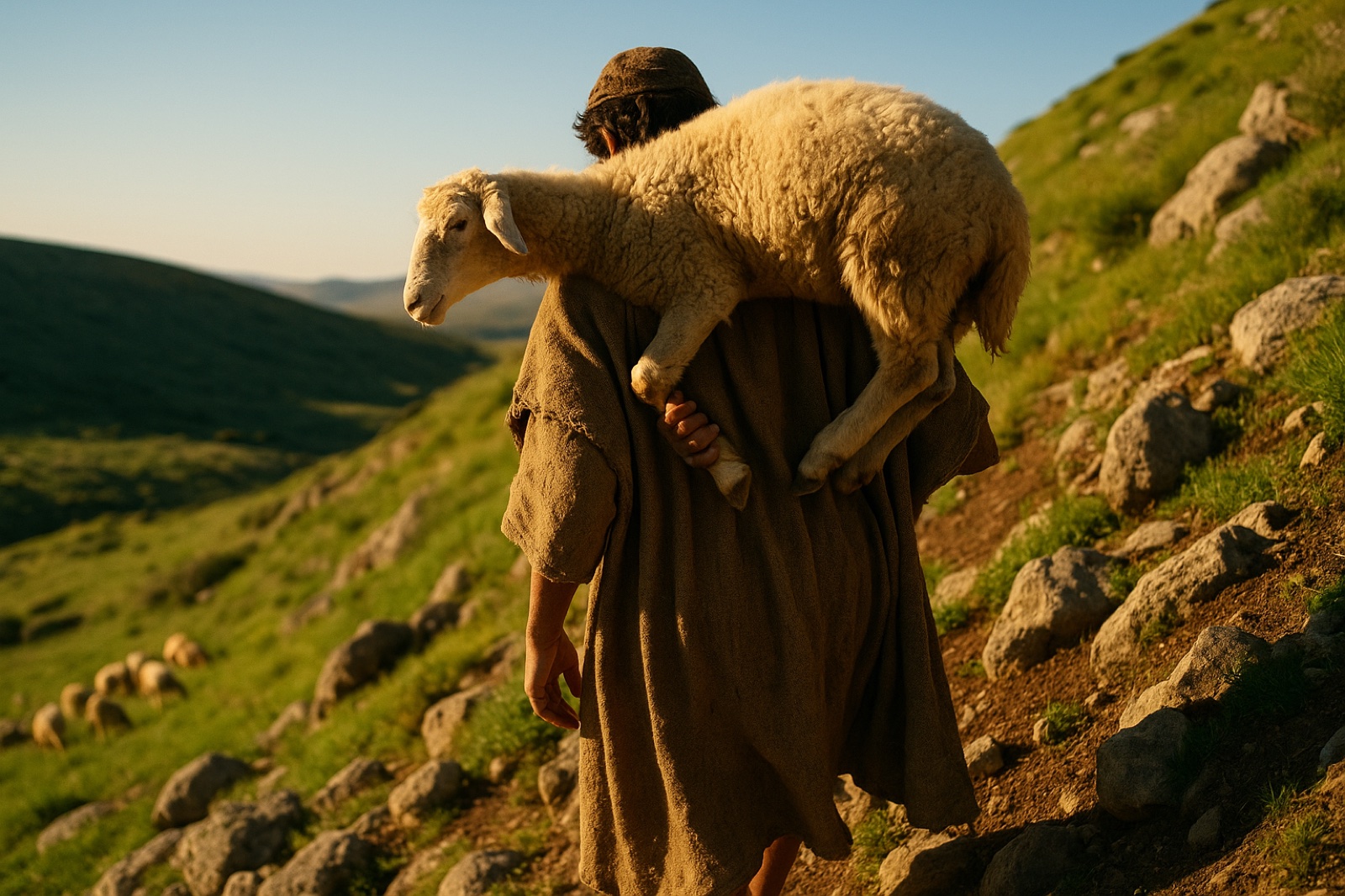
It does not bleat loudly enough to be found. It does not retrace its steps. It does not even walk back on its own four legs once it is found. Verse 5 says the shepherd “layeth it on his shoulders.” A sheep that has been wandering is often too tired, too hurt or too frightened to walk. So it rides.
Three Small Details Most People Read Past
1. “Until he find it”
Jesus does not say the shepherd looks for a while. He says the shepherd goes “until he find it.” There is no time limit in that sentence. The search ends when the sheep is found, not when the shepherd gets tired.
Matthew tells the same story in Matthew 18:12-14, to a different audience and with slightly different words. There, Jesus is talking about “little ones” who are easy to look down on, and He says “if so be that he find it.” Matthew’s telling stresses how much the finding matters. Luke’s telling stresses that the shepherd does not quit. Put them side by side and you get both: the search is certain, and the joy at the end is huge.
2. The ninety and nine are left “in the wilderness”
Not in a pen. Not in a barn. The shepherd leaves ninety-nine sheep in open country to go after one. Any farmer would call that a bad trade. Jesus tells it as if it is obvious. “What man of you… doth not?” He expects His listeners to nod along. That is the point. The one that is missing is worth the risk.
3. “Which need no repentance”
Jesus ends with this: “joy shall be in heaven over one sinner that repenteth, more than over ninety and nine just persons, which need no repentance” (Luke 15:7). Remember who He is talking to. The people grumbling at the door are the ones who felt they needed no repentance. Many readers hear a gentle nudge in that line. The party is for the lost one. The people standing outside complaining are missing it.
The Complaint Came Back, and So Did the Answer
Luke uses a strong word for the leaders’ grumbling in Luke 15:2. He uses that same word only one other time in his Gospel. It is at the house of Zacchaeus, a tax collector, four chapters later: “And when they saw it, they all murmured, saying, That he was gone to be guest with a man that is a sinner” (Luke 19:7).
Same complaint. Same kind of meal. And this time Jesus answers in plain words, no story needed: “For the Son of man is come to seek and to save that which was lost” (Luke 19:10).
Seek and save. That is the shepherd from the parable, standing in a real house, eating real food with a real lost man. The parable was never just a nice picture. It was Jesus explaining what He was doing at the table.
Jesus Was Borrowing a Promise God Had Already Made
The picture was not new. Hundreds of years earlier, through the prophet Ezekiel, God spoke against leaders who let the flock scatter, and then made a promise: “Behold, I, even I, will both search my sheep, and seek them out” (Ezekiel 34:11). A few verses later: “I will seek that which was lost, and bring again that which was driven away, and will bind up that which was broken” (Ezekiel 34:16).
So when Jesus told a story about a shepherd who searches, finds and carries, the listeners who knew their Scriptures would have heard the echo. God had said God would do this personally. Now a man at a table full of sinners was doing it.
It is no accident that one of the oldest known paintings of Jesus, found near Nicaea and about 1,700 years old, shows Him not on a throne but with a sheep across His shoulders. That is the picture the early Christians chose. Carried, not scolded.
Shame Says Walk Back. The Parable Says Get Carried
Here is where this story stops being about sheep.
Shame has one message, and it repeats it: you got yourself here, so you get yourself back. Fix it first. Clean up first. Prove you are sorry first. Then maybe come home.
The parable of the lost sheep flatly disagrees. The sheep does not find the way. It does not earn the trip. It does not even walk. It is found, lifted and carried, and the shepherd is the one rejoicing on the way home.
That means the distance you feel between you and God is not a distance you have to close. It is a distance God is already crossing. Your part is smaller than shame has told you. It is to stop running, let yourself be found, and let yourself be carried.
The sheep never found its way home. It got carried.
If you have ever worried that your way back has to be impressive enough to count, it may help to see what Jesus’ critics accidentally admitted about that in this prayer to accept Jesus, which starts with their complaint. And if you are not sure how far you have drifted, our free How Close Am I to God? assessment takes a few minutes and gives you an honest place to start.
A good place to start:
The Beginner’s Guide to Feeling God’s Presence Every Day (Free)
A simple guide to noticing God in ordinary moments, even on the days you feel a long way off.
Get the free guide. Free.
What Being Found Looks Like Today
The sheep’s only job was to stop running. Here is what that can look like in the next ten minutes, easiest first.
- Say one honest sentence to God right now. Not a cleaned-up one. Something like, “I wandered, and I am tired.” That is the sheep letting itself be found.
- Tell one safe person. A short message is enough: “I have been far from God for a while and I want to come back.” You do not have to explain. Shame hates the light, and one sentence out loud loosens its grip.
- Go back to the place you left. If it was a church, a small group or a friend who prays, show up once this week, exactly as you are. You do not walk back to earn the welcome. You walk back to be carried into it.
Questions to Sit With
- Where in your life do you feel “a great way off” right now, and when did you first notice the distance?
- When you imagine God looking for you, what face do you picture? Where did that picture come from?
- What would change this week if you believed the search ends when you are found, not when you have fixed yourself?
A Prayer for When You Feel Lost
God, I do not know how I got this far from You, and I do not have the strength to walk all the way back. I have been hiding because I was ashamed. Jesus said You come looking until You find. So here I am. Find me, lift me, carry me home, and let me hear the rejoicing instead of the lecture I was expecting. Amen.
One Question for You
Which do you think is harder for most people: believing God will actually come looking, or letting themselves be carried instead of walking back on their own? Share your view in the comments.
Share This
- “I always thought I had to find my own way back to God. Luke 15 says the sheep never walks home. It gets carried.”
- “Jesus told the parable of the lost sheep to people complaining about who He ate with. That was His answer. I needed that today.”
- “‘Until he find it.’ No time limit. No deadline. Luke 15:4 is the verse I did not know I needed.”
Questions People Ask About the Parable of the Lost Sheep
What is the parable of the lost sheep about?
The parable of the lost sheep is a short story Jesus told about a shepherd with one hundred sheep who leaves ninety-nine in open country to search for the one that wandered off. He searches until he finds it, carries it home on his shoulders, and calls his neighbours to celebrate. Jesus said it shows the joy in heaven over one person who turns back to God.
Where is the parable of the lost sheep in the Bible?
The parable of the lost sheep appears in Luke 15:1-7 and, in a shorter form, in Matthew 18:12-14. In Luke it is the first of three parables about lost things, followed by the lost coin and the lost son. In Matthew it comes in a passage about not looking down on “little ones.”
Why did Jesus tell the parable of the lost sheep?
Jesus told the parable of the lost sheep in answer to religious leaders who complained that He welcomed sinners and ate with them (Luke 15:2). The story explains why He did it: a shepherd goes after the one sheep that is lost, and the whole point of His ministry was to seek and save the lost (Luke 19:10).
What does the lost sheep represent?
In the parable of the lost sheep, the lost sheep stands for any person who has wandered away from God. The shepherd stands for God, who searches, finds, and carries that person home. The sheep does nothing to get back on its own, which is the heart of the story’s message about grace.
Why does the shepherd leave the ninety-nine sheep?
In Luke 15:4 the shepherd leaves ninety-nine sheep in the wilderness to go after one that is lost. Jesus tells it as something any shepherd would obviously do, which makes the point that a single missing person matters enough to God to be worth the search and the risk.