 0
0
 0
0
Anyone who has grown carrots knows the worst job in the garden. The seeds come up thick. Then you have to kneel down and pull out healthy seedlings, one after another, so the rest have room. It feels like waste every single time.
In the late 1980s, foresters in Australia did the same thing on a giant scale. In a forest thinning trial in the state of Victoria, they cut out between half and 70 percent of the trees in parts of a tall mountain ash forest. They measured it for some years. Then the attention moved on. The road in grew over. The project sign fell down.
The trees kept growing. When scientists went back, about thirty years after the cut, the forest gave a different answer from the one in the early reports.
What the forest thinning experiment was
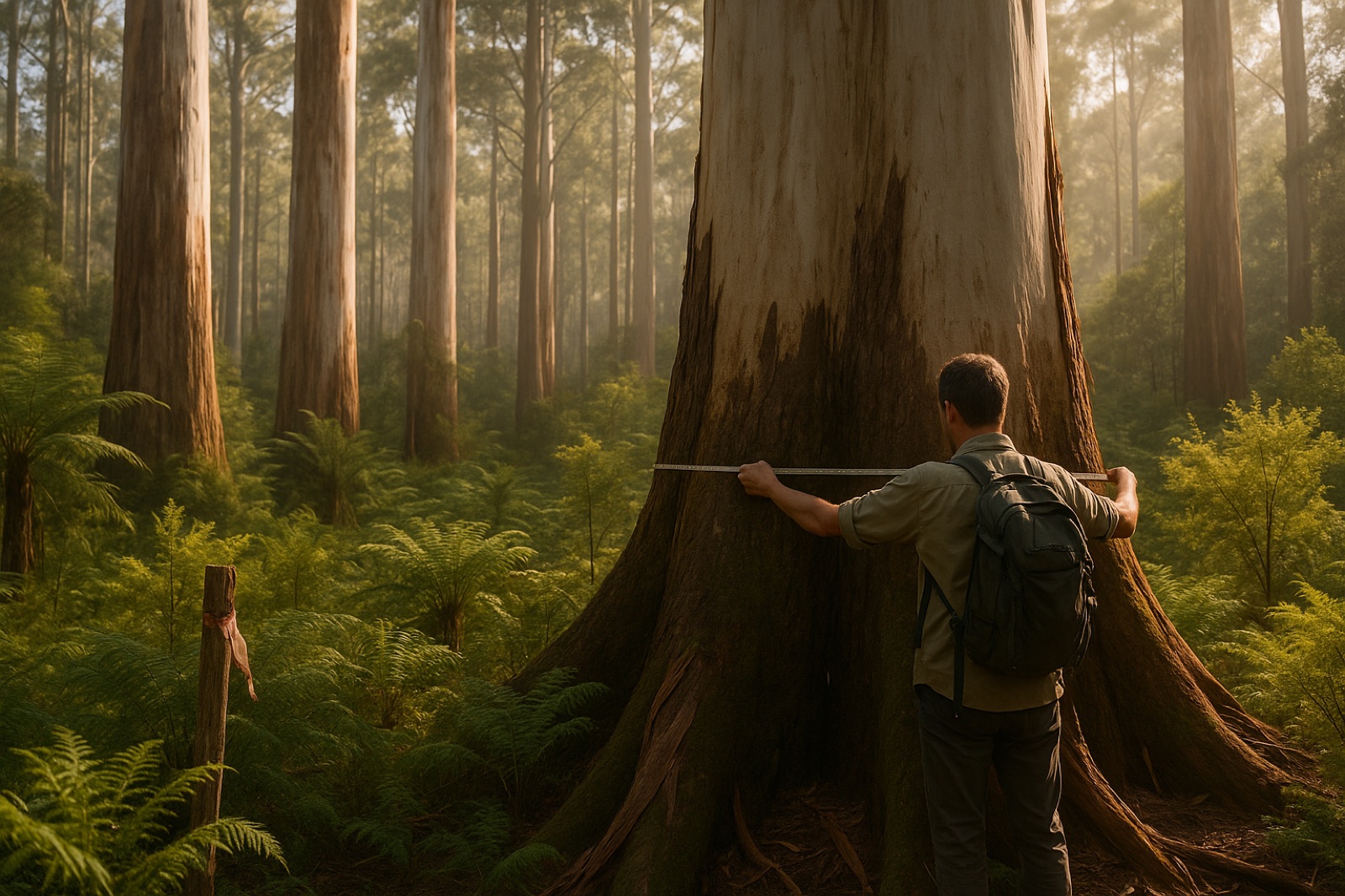
Mountain ash is not a small tree. It is a kind of eucalypt, and it is the tallest flowering plant in the world. The forest at one of the two test sites, a place called Tanjil Bren, was all about the same age. It had come up together, thick and crowded, after huge bushfires burned through Victoria in 1939.
The usual way to log this kind of forest was clearfelling: cut everything in a patch, burn what is left, and sow new seed. In the mid-1980s the state government paid for a big test of other ways to do it. The scientists who later went back put the cost at about 26 million Australian dollars in today’s money.
Between 1987 and 1989, crews set the trial up at Tanjil Bren and at a second site called Cabbage Tree Creek. They tried different cuts side by side:
- Large clearfells, 250 to 350 metres wide, with every tree taken.
- Small cleared patches, 50 to 140 metres wide.
- Heavy thinning, where 50 to 70 percent of the trees were cut and the rest were left standing.
- Untouched forest, left alone so there was something to compare against.
Hundreds of survey plots were marked out, and thousands of seedlings were tracked.
The first answer: clearfelling looked best
By the early 2000s the results were written up. The thing being measured was simple. After each kind of cut, how well do new mountain ash trees come back?
On that measure, clearfelling won. Mountain ash is a tree shaped by big fires. It comes back strongest where the ground has been opened right up, and a clearfell does something similar. Where tall trees were left standing, or where the cleared patches were small, a different plant took over the ground: acacia, a smaller tree that is common under these forests.
So the thinned plots were not the stars of the first report. After that, the measuring stopped. The experiment dropped out of sight for years.
What scientists found 30 years later
In 2014, a group from the University of Melbourne took forestry students to Tanjil Bren. A colleague named Simon Murphy, who had helped set the trial up, suggested they go and see how it had turned out.
The team then measured the forest again. Their study came out in July 2026 in the journal Forest Science. It covers 53 plots, checked thirty years after the cutting. The team also wrote a plain-language account of what they found.
The heavily thinned stands were the surprise.
- The trees left standing were about 80 years old. The largest of them averaged well over a metre across at chest height. Some were more than 1.5 metres across.
- They were about 20 percent bigger in diameter than the trees in the untouched forest.
- The thinned stands held as much carbon in their wood as the untouched stands, or more.
Read that last one again. Half or more of the trees had been taken away. Thirty years on, the forest had grown back all the carbon that was removed. Then it had added as much again as the untouched forest added over the same years. Fewer trees were carrying the same load.
The reason is not a mystery. The scientists say the thinning gave the remaining trees more space and more resources, and the trees responded. In a crowded stand, every tree shares with its neighbours. In a thinned one, there is more to go around.
The parts that are easy to read past
The acacia. In the early results, acacia was the plant that came up instead of young mountain ash. If your goal is the next crop of mountain ash, that looks like a mark against a treatment. But acacia is also where Leadbeater’s possum feeds and moves through the forest. This is a small, rare animal that lives in these trees. When the team looked for possums, they found them in every treated plot they surveyed, and in none of the untouched ones.
That needs care. A survey shows where the possums were. It does not show why, and it is not proof that cutting trees helps possums. It is still not what most people would have guessed.
The big trees. Bigger trees stand up better to fire, so more of them are likely to live through the next one. They are also more likely to form hollows, and hollows are homes for possums and gliders.
What did not grow the biggest trees. The plots that lost the most were the clearfells. They came back thick with healthy young mountain ash, but those are young trees. The small cleared patches ended up with small mountain ash and a lot of acacia. The biggest trees in the whole experiment grew in the plots where most of the stand was cut and the rest were left standing with room around them.
So the finding is narrower than “cutting is good.” Losing everything did one thing. Losing most, and keeping some, did another.
What forest thinning does not prove
The scientists are careful here, and it is worth being careful with them. They say thinning cannot be done everywhere, and should not be. They say there is no single fix for managing forests. Their point is smaller: there are more choices than clearfelling.
This was one kind of forest, at two sites, in one corner of Australia. Other forests may answer differently. The carbon counted is the carbon in the wood of the trees. And a trial like this cannot settle whether a given forest should be logged at all. People argue about that for good reasons. A very large study in the Amazon, for one, found that protecting a standing forest beats replanting one.
Why less can become more
Back to the carrots. A gardener who thins a row is not being careless with the seedlings. The cut is the care. Fruit growers do it with young fruit. Vine growers do it hardest of all, cutting a vine back to a small part of itself every winter.
There is a very old picture built on exactly that. It describes God as a vine grower who does something strange: cuts back the branches that are already bearing fruit. Not as a punishment, and not because they failed. So they can bear more. For anyone who has had something good taken out of a full life, that has always been a hard picture to believe. A forest in Victoria does not prove it. But it does show the shape is real. Something can be cut back by half or more, look second-best for years on the measure everyone is using, and end up holding just as much in a stronger form.
The honest part is the difference between being cut down and being cut back. The clearfelled plots started over from nothing. The thinned plots kept standing trees and were given room. Those are not the same thing. Not every loss is a pruning, and nobody in the middle of one should be told that it is. Some are, though. And from inside the early years, it is very hard to tell which one you are in. (If the question under that is a personal one, we tried to answer it straight in why does God remove people from your life?)
A good place to start:
The Beginner’s Guide to Feeling God’s Presence Every Day
A simple guide to noticing God in ordinary moments, even in a garden row on a slow morning.
Get the free guide
Free.
The thirty-year part
This experiment gave two answers. In the early 2000s, thinning looked like the weaker choice. Thirty years after the cut, it looked very different. Nobody changed the forest in between. For a long stretch, nobody was even watching it. The trees did the work at the end of a road that had grown over.
Most of us measure too early. A few months into a hard change, we count what is gone and call that the result. This forest says an early count and a late count can disagree. (If waiting is the hard part for you, our free How Patient Am I? test takes a few minutes.)
So the next time you are kneeling over a row of seedlings, pulling out good plants to make room, you will know you are doing a small version of something that worked on the tallest flowering trees on Earth. Leave room. Then give it longer than feels reasonable before you decide what the cut meant.
Discussion question
A heavy cut left this forest with fewer trees, but bigger ones. Is that a better forest, or just a different one? What would you want measured before you decided? Tell us in the comments.
Share this
- Foresters cut out up to 70% of a forest in the 1980s, then everyone forgot the experiment. 30 years later the trees left standing were 20% bigger. https://bgodinspired.com/index.php/nature-and-creation/forest-thinning-30-year-experiment/
- I thin my carrots every year and hate it. Turns out the same idea was tested on the tallest flowering trees on Earth, and it took 30 years to see the result. https://bgodinspired.com/index.php/nature-and-creation/forest-thinning-30-year-experiment/
- The early report said one thing. The 30-year report said another. Good read on a forgotten forest experiment and on how often we measure too early. https://bgodinspired.com/index.php/nature-and-creation/forest-thinning-30-year-experiment/
Questions and answers
What is forest thinning?
Forest thinning means cutting some of the trees in a crowded stand and leaving the rest standing, so the remaining trees have more space and resources. It is different from clearfelling, where every tree in a patch is cut. In a long-running trial in mountain ash forest in Victoria, Australia, heavy thinning meant removing 50 to 70 percent of the trees.
Does forest thinning make the remaining trees grow bigger?
In a 30-year trial in mountain ash forest in Victoria, Australia, it did. Trees left standing after heavy thinning were about 20 percent bigger in diameter than trees in nearby untouched forest. The largest averaged well over one metre across at chest height, and some were more than 1.5 metres across, at about 80 years old. The result comes from one forest type at two sites, so other forests may respond differently.
Does thinning a forest reduce the carbon it stores?
Not in the long run, in one well-studied case. In a trial set up between 1987 and 1989 in mountain ash forest in Victoria, Australia, stands where 50 to 70 percent of the trees were cut held as much carbon in their wood thirty years later as untouched stands, or more. The researchers, writing in the journal Forest Science in 2026, also say thinning cannot and should not be done everywhere.
What was the Silvicultural Systems Project in Victoria?
The Silvicultural Systems Project was a government-funded forestry experiment set up between 1987 and 1989 at Tanjil Bren and Cabbage Tree Creek in Victoria, Australia. It compared large clearfells, small cleared patches, heavy thinning and untouched forest in tall mountain ash forest. Early results were published in the early 2000s, and the sites were then largely forgotten until University of Melbourne researchers returned and measured them again.
Is forest thinning better than clearfelling?
It depends on what is being measured. In the Victorian mountain ash trial, clearfelled areas grew the most new young mountain ash, while heavily thinned areas grew the largest trees and stored as much carbon as untouched forest after thirty years. Leadbeater’s possums were found in every treated plot surveyed and in none of the untouched ones. The researchers say there is no single best method, only more options than clearfelling alone.