 0
0
 0
0
Someone backs their car into a post. Someone pushes hard on a door marked “pull.” And a friend shakes their head and says, “Nice one, nimrod.”
If you grew up with that word, you know what it means: a fool. So it can be a shock to open the Bible and find Nimrod there, and to find that he is no fool at all. The first nimrod meaning was close to the opposite. For hundreds of years, calling someone a Nimrod meant they were a great hunter.
So how did a mighty hunter turn into an insult? The usual answer is “Bugs Bunny did it.” That answer is close, but not quite right. And the true story has something to say about every name you have ever been called.
Nimrod Meaning in the Bible: A Mighty Hunter and a King
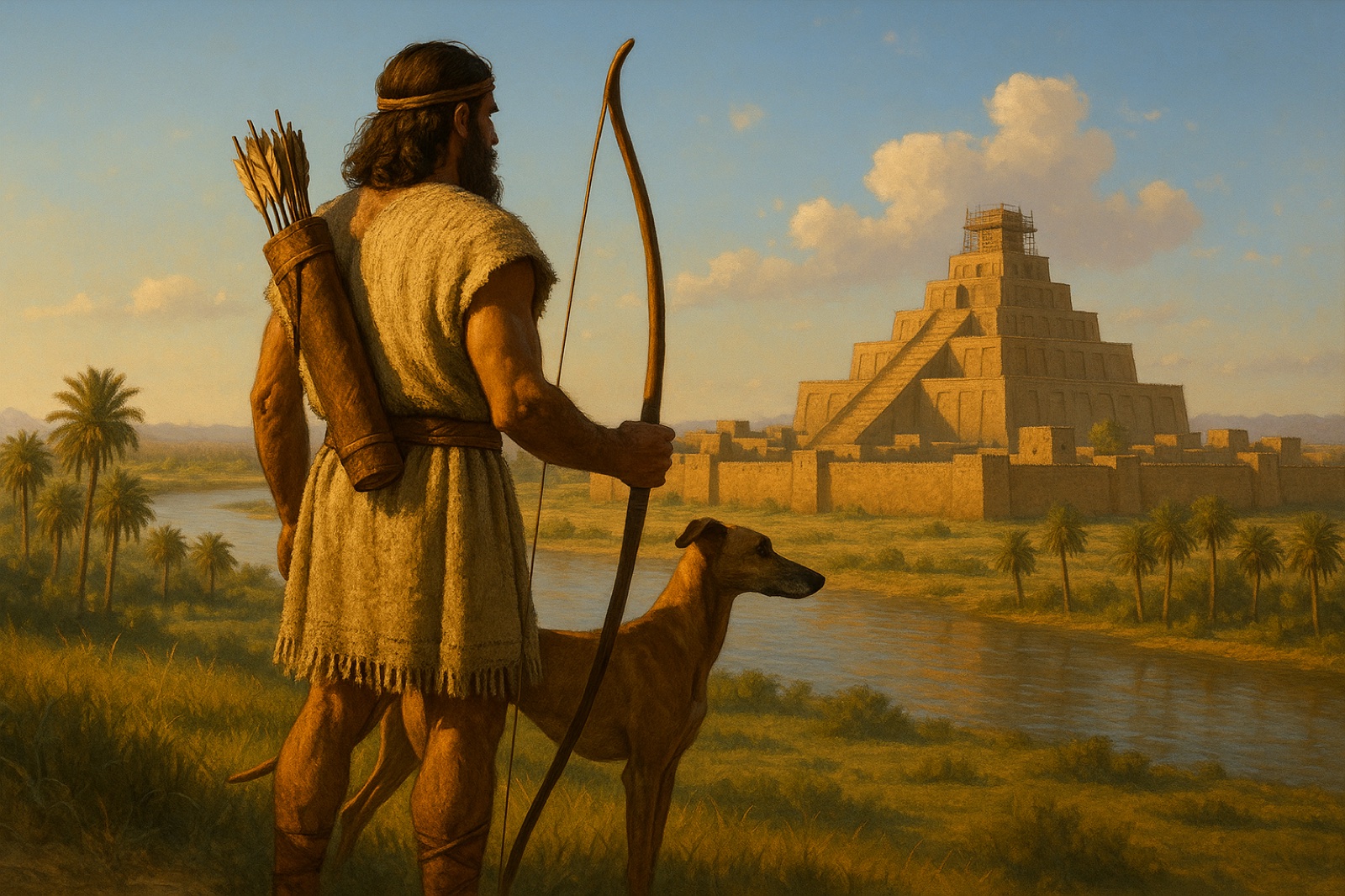
Nimrod shows up in Genesis 10, in a long family list after the flood. He is the son of Cush, the grandson of Ham, and the great-grandson of Noah. Most names in that list get a few words. Nimrod gets five verses. Here are the first two:
“And Cush begat Nimrod: he began to be a mighty one in the earth. He was a mighty hunter before the LORD: wherefore it is said, Even as Nimrod the mighty hunter before the LORD.” (Genesis 10:8-9, KJV)
Then Genesis tells us he was a king: “And the beginning of his kingdom was Babel, and Erech, and Accad, and Calneh, in the land of Shinar” (Genesis 10:10). Shinar is an old name for the land between the rivers, in what is now Iraq.
He comes up only two more times. 1 Chronicles 1:10 repeats the line about him. And the prophet Micah, long afterward, still uses “the land of Nimrod” as a name for that part of the world (Micah 5:6). That is the whole record.
Now look closely at the middle of verse 9: “wherefore it is said.” Genesis is quoting a saying. By the time this was written down, people were already using Nimrod’s name as a figure of speech. If someone was a great hunter, you said they were “even as Nimrod.” His name had become a word before the Bible was even finished.
What the Bible Does Not Say About Nimrod
If you have heard of Nimrod in church, you may have heard that he was a wicked king who built the Tower of Babel and led the world against God. Read Genesis 10 again. None of that is on the page. The text never calls him evil. And the Tower of Babel story in Genesis 11 never says his name.
So where did the villain come from? From later readers, who put two clues together. First, Nimrod’s kingdom began at Babel, and the tower was built at Babel. Second, in Hebrew his name sounds like the word marad, which means “to rebel.” (Scholars are not sure that is where the name really comes from. It may not have started as a Hebrew name at all.)
Josephus, a Jewish historian writing in the first century, said Nimrod talked people into trusting their own strength in place of God, and pushed them to build the tower. A few hundred years later, Augustine read the verse as “a mighty hunter against the Lord.” The idea stuck. By the 1500s, English writers were using “Nimrod” as a word for a tyrant.
Maybe those readers were right about him. Maybe not. The honest answer is that Genesis does not tell us. “Before the LORD” can be read as praise, as a warning, or as a plain way of saying “the greatest there was.” What we can say is this: Nimrod’s name had already been rewritten once, long before any cartoon.
He is not the only one. Bible names have a way of turning into labels, like the “Jezebel spirit,” a phrase the Bible never uses.
How Nimrod Became an Insult (It Wasn’t Quite Bugs Bunny)
In English, the hunter meaning lasted a long time. A poem from 1623 already uses Nimrod as a picture of a hunter. In 1899 the composer Edward Elgar named one of his best-loved pieces of music “Nimrod” as a play on the name of his friend August Jaeger, because Jäger is the German word for hunter. The explorer Ernest Shackleton sailed to Antarctica on a ship called the Nimrod. It was a name you gave to something strong.
Then came the joke. The story most people tell is that Bugs Bunny called the clumsy hunter Elmer Fudd a “nimrod,” children did not catch the Bible reference, and they thought it just meant “idiot.”
Word historian David Wilton went looking for the proof, and what he found is a little different:
- 1933: A stage play called The Great Magoo uses “the same old Nimrod” as a sneer at a man who will not leave a woman alone. It is sarcastic, but it still means “hunter.”
- 1948: A newspaper advertisement in Pennsylvania jokes about “Knucklehead Newt, the nit-wit nimrod.” The insult is in “nit-wit.” Nimrod still means hunter.
- 1948: In the cartoon What Makes Daffy Duck, it is Daffy Duck, not Bugs, who says to Elmer Fudd: “Precisely what I was wondering, my little nimrod.”
- 1951: Bugs Bunny does say it, in Rabbit Every Monday. But he says it about Yosemite Sam, not Elmer: “Nah, I couldn’t do that to the little Nimrod.”
So the joke was always the same one: call a bad hunter by the name of the greatest hunter. It is like calling the slowest runner “Speedy.” Wilton’s conclusion is that Daffy Duck did not invent the insult, but the cartoons spread it and made it stick. Children who had never read Genesis 10 heard the tone, missed the reference, and kept the word. By the late 1970s it shows up in print as a plain insult, with no hunting anywhere in sight. Today the insult is mostly North American slang, and that is the nimrod meaning many people learn first.
Think about what that means. Nobody decided to change the word. Nobody voted. It took a sarcastic line, a laugh, and a great many people who did not know the first meaning. That was enough.
The Name You Make and the Name You Are Given
Now go back to Babel, the city where Nimrod’s kingdom began. In the very next chapter, the people building there say why they are doing it:
“And they said, Go to, let us build us a city and a tower, whose top may reach unto heaven; and let us make us a name, lest we be scattered abroad upon the face of the whole earth.” (Genesis 11:4, KJV)
“Let us make us a name.” That was the goal. Be so great that nobody could ever forget you or get you wrong.
Nimrod is the best test of that plan we have. He did it. He was mighty. His kingdom held great cities. His name became a saying in the ancient world, and it has lasted for thousands of years. And look what happened to it. Later readers turned it into “tyrant.” Then a cartoon duck turned it into “fool.”
Here is the part that is easy to miss. A name you make for yourself is never fully yours. It lives in other people’s mouths. They can turn it into anything, and you do not get a say.
Then turn one page. In Genesis 12, God speaks to a man named Abram, who has built no city and no tower, and says, “I will bless thee, and make thy name great” (Genesis 12:2). The same idea, one chapter apart. In Genesis 11, people say, “let us make us a name.” In Genesis 12, God says the name will be a gift. One name is built. The other is given. (The word for “name” in both places is shem, and it means far more than a label. We look at it closely in the Hebrew word for name.)
Much later, through the prophet Isaiah, God says it to a whole people who felt forgotten:
“But now thus saith the LORD that created thee, O Jacob, and he that formed thee, O Israel, Fear not: for I have redeemed thee, I have called thee by thy name; thou art mine.” (Isaiah 43:1, KJV)
This is where an old word story lands in your own life. You have been called things too. Maybe “lazy.” Maybe “too much,” or “the difficult one,” or “stupid.” Maybe somebody said it once as a joke, the way Daffy did, and it stuck for years. Maybe you had a good name once, and someone twisted it.
You cannot control that. Nimrod could not, and he was a king. But the name people gave you is not the one that holds. The One who made you says, “I have called thee by thy name; thou art mine.” That name was never in the crowd’s hands, so the crowd cannot change it.
A good place to start:
The Beginner’s Guide to Feeling God’s Presence Every Day
A simple guide to sensing that God is near and knows you by name, in the middle of an ordinary day.
Get the free guide. Free.
Actions to Take Today
- Read Genesis 10:8-12 slowly. It takes about a minute. Notice what the Bible really says about Nimrod, and how much of what “everybody knows” about him is not on the page.
- Write down one name that stuck to you. Put the word on paper, the label someone gave you that you still carry. Under it, write these words from Isaiah 43:1: “I have called thee by thy name; thou art mine.” Read both out loud, and read the second one last.
- Give someone their name back. Think of one person you have turned into a label: “the lazy one,” “the loud one,” “that fool at work.” Today, use their real name, and tell them one true, good thing you have seen in them.
If old labels have worn down the way you see yourself, our free How Healthy Is My Self-Esteem? test takes about two minutes and can help you see where you stand.
Journaling Prompts
- What name or label were you given that you still carry? Who said it first?
- Where are you working hard to “make a name” for yourself right now? What are you afraid will happen if you stop?
- If you fully believed the words “thou art mine” were said to you, what would you stop trying to prove?
A Prayer for When a Name Has Stuck to You
God, I have been called things I can’t seem to shake, and some days I believe them. I have also worked so hard to make a name for myself, and I am tired. Thank You for knowing my name before anyone twisted it. Help me hear Your voice louder than theirs today. And help me give other people their real names back too. Amen.
Discussion Question
Which do you think shapes a person more: the name they make for themselves, or the names other people give them? Share your thoughts in the comments below.
Share This
- “Nimrod” meant a mighty hunter for centuries. Then a cartoon duck said it with a sneer and it became “fool.” You can’t control what people do with your name. Good thing God says, “I have called thee by thy name; thou art mine.” (Isaiah 43:1)
- I always heard that Bugs Bunny turned “nimrod” into an insult. It was really Daffy Duck in 1948, and the joke was older than that. Also, the Bible never calls Nimrod a fool. It doesn’t even call him a villain.
- Genesis 11: “let us make us a name.” Genesis 12: God says, “I will bless thee, and make thy name great.” One chapter apart. One name is built. The other is given.
Questions People Ask About the Meaning of Nimrod
What does nimrod mean?
Nimrod has two meanings. The older meaning is a skilled hunter, taken from Nimrod in Genesis 10:9, who is called “a mighty hunter before the LORD.” The newer meaning, mostly in North American slang, is a foolish or clumsy person. The slang meaning grew out of sarcastic jokes about bad hunters in the 1900s, including lines in Looney Tunes cartoons.
Who was Nimrod in the Bible?
Nimrod in the Bible was the son of Cush and the great-grandson of Noah. Genesis 10:8-12 calls Nimrod “a mighty one in the earth” and “a mighty hunter before the LORD,” and says the beginning of his kingdom was Babel, Erech, Accad and Calneh in the land of Shinar. Nimrod is also named in 1 Chronicles 1:10 and Micah 5:6.
Did Bugs Bunny make nimrod an insult?
Not exactly. The cartoon line word historians point to belongs to Daffy Duck, who calls the hunter Elmer Fudd “my little nimrod” in What Makes Daffy Duck (1948). Bugs Bunny used the word in 1951 about Yosemite Sam in Rabbit Every Monday. Word historian David Wilton found sarcastic uses of nimrod before the cartoons, and concludes that the cartoons spread the insult but did not invent it.
Was Nimrod evil in the Bible?
The Bible does not say that Nimrod was evil. Genesis 10 calls Nimrod a mighty hunter and a king, and the Tower of Babel story in Genesis 11 never names him. The picture of Nimrod as a rebel against God comes from later writers such as Josephus and Augustine, who linked Nimrod’s kingdom at Babel with the tower built there.
Did Nimrod build the Tower of Babel?
Genesis does not say that Nimrod built the Tower of Babel. Genesis 10:10 says the beginning of Nimrod’s kingdom was Babel, and Genesis 11 tells the tower story without naming any builder. The idea that Nimrod led the building of the tower comes from later tradition, including the first-century historian Josephus.