 0
0
 0
0
“Look on my Works, ye Mighty, and despair!”
You may have met that line in a school book. You may have heard it read aloud in a TV show, or seen it on a poster under a picture of a ruin. It is one of the most famous lines in English poetry.
It comes from “Ozymandias,” a sonnet by Percy Bysshe Shelley. It is only fourteen lines long. If you came for the Ozymandias poem meaning, you will get it here: the full text, what each part says, and who the king really was.
But there is something else worth knowing. The words on that statue were not Shelley’s idea. A real king’s boast was written down more than two thousand years ago, and it said something very different. Shelley changed one thing. That one change is the whole poem.
Ozymandias by Percy Bysshe Shelley: Full Text
The poem is long out of copyright, so here it is in full.
I met a traveller from an antique land,
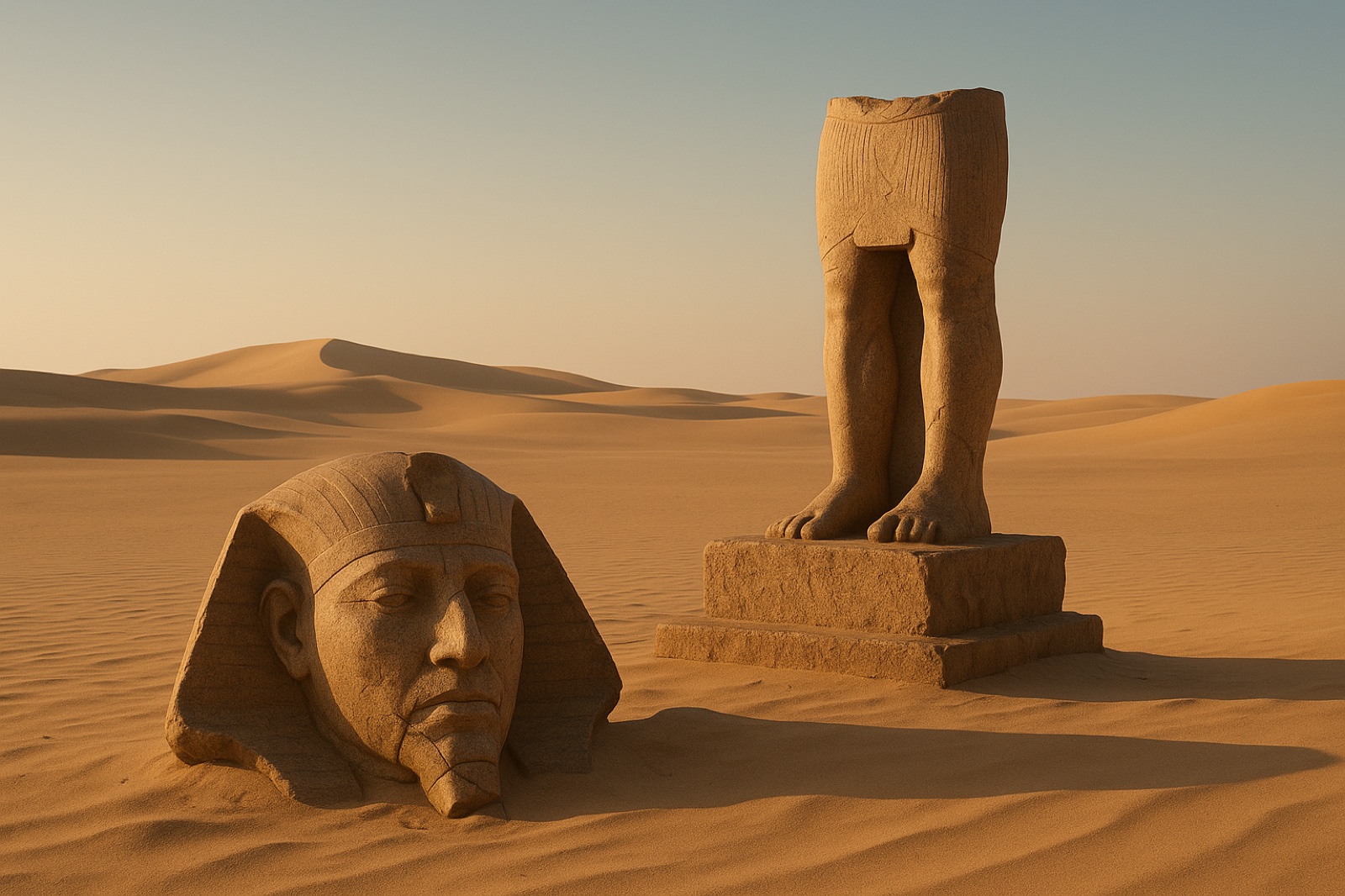
Who said—”Two vast and trunkless legs of stone
Stand in the desert. . . . Near them, on the sand,
Half sunk a shattered visage lies, whose frown,
And wrinkled lip, and sneer of cold command,
Tell that its sculptor well those passions read
Which yet survive, stamped on these lifeless things,
The hand that mocked them, and the heart that fed;
And on the pedestal, these words appear:
My name is Ozymandias, King of Kings;
Look on my Works, ye Mighty, and despair!
Nothing beside remains. Round the decay
Of that colossal Wreck, boundless and bare
The lone and level sands stretch far away.”
In plain words: someone back from a faraway place tells of a giant broken statue in the desert. The legs still stand. The face lies in the sand, still scowling. On the base, the king brags that his works are so great you should give up hope of matching them. But there are no works. There is only sand, as far as you can see.
What the Ozymandias Poem Means, Line by Line
Lines 1 to 2. “Antique” means very old. The speaker did not see the statue. A traveller told him. So the whole poem is a story about a story. Keep that in mind. It matters later.
Lines 2 to 5. “Trunkless” means without a body. “Visage” means face. The face is broken, but you can still read the mood on it: a frown, a curled lip, a “sneer of cold command.” This was a man used to giving orders.
Lines 6 to 8. This is the hardest part, and the most important. The sculptor “well those passions read.” He understood the king’s pride. He carved it so well that it is still there, “stamped on these lifeless things.” Then comes “the hand that mocked them, and the heart that fed.” The hand is the sculptor’s. “Mocked” here means copied, and also made fun of. The heart is the king’s. It “fed” on that pride.
Lines 9 to 11. The boast. “King of Kings” means ruler over other rulers. “Ye Mighty” means you powerful people. He is talking to every other king who ever lives: look at what I built and give up.
Lines 12 to 14. “Nothing beside remains.” Nothing else is left. Just a wreck, and sand that is “lone and level,” flat and empty, stretching “far away.”
Who Was Ozymandias?
Ozymandias was a real king. The name is the old Greek way of saying User-maat-re, one of the official names of the Egyptian pharaoh Ramesses II.
Ramesses II ruled Egypt more than 3,000 years ago, for over sixty years. He was one of the greatest builders Egypt ever had. Temples, cities, and huge statues of himself. Many of them are still standing.
That is part of the joke. Ramesses did not vanish. You can visit his temples today. What the poem says is gone is not his stone. It is his power. Nobody fears him. Nobody obeys him. The man who gave orders is now a tourist stop.
The Boast Was Really a Dare
Shelley did not make up the words on the statue. He found them in an old book.
About two thousand years ago, a Greek writer named Diodorus Siculus wrote a history of the world. In it he describes a giant statue in Egypt with words carved on it. In C. H. Oldfather’s English translation, they read:
“King of Kings Ozymandias am I. If any want to know how great I am and where I lie, let him outdo me in my work.”
Read that again. The real boast was a challenge. Beat me if you can. It is the voice of a man sure he will be measured against, and sure he will win.
Shelley kept “King of Kings.” He kept the pride. But he swapped the ending. “Outdo me” became “despair.”
And here is the clever part. On the statue, “despair” is meant one way: give up, you will never build anything this big. But read it standing in the empty sand, and it means something else: give up, because this is how your works will end too. The king’s own words turn around and point at him. It is the kind of pride the Greeks had a word for, hubris, and this is what it looks like after a few thousand years of wind.
Shelley Never Saw the Statue
Many people think Shelley wrote the poem after looking at a statue in a museum. He didn’t.
There is a real giant stone head of Ramesses II in London’s British Museum. It is often called the Younger Memnon. It came from the king’s great temple at Thebes, and in 1816 an explorer named Giovanni Belzoni had it dragged out of the ruins and floated down the Nile.
But when Shelley’s poem was printed, the head was still on its way to England. It was news. People were talking about it. It was only put on show at the museum after the poem was printed. Shelley never laid eyes on it, and he never went to Egypt. His desert came from an old book and the talk of the town.
Which brings us back to line one. “I met a traveller.” Shelley put a storyteller between himself and the statue on purpose. All he had was a story. So that is what he gave us.
A Friendly Contest Between Two Friends
The poem was born from a game. Late in 1817, Shelley and his friend Horace Smith, a banker who also wrote poems, agreed to each write a sonnet on the same subject. Both used the same old story.
Shelley’s came out first, in a London paper called The Examiner on 11 January 1818. He signed it with a made-up name, “Glirastes.” Smith’s came out a few weeks later, on 1 February, signed “H.S.”
Almost nobody reads Smith’s now. But it ends in a way that is worth knowing. He pictures a hunter, far in the future, walking through a wild place “where London stood.” The hunter finds a huge broken stone and stops to guess “what wonderful, but unrecorded, race / Once dwelt in that annihilated place.”
Smith turned the mirror on his own city. London, the great capital of its day, would one day be someone else’s ruin. Shelley never says that out loud. He doesn’t have to. “Ye Mighty” already includes us.
The Atheist Who Wrote It
Here is the surprising part. Shelley did not believe in God. He said so loudly, and it cost him.
In 1811, as a student at Oxford, he and his friend Thomas Jefferson Hogg printed a short pamphlet called The Necessity of Atheism and sent it to church leaders and heads of colleges. They were called in and asked if they wrote it. They would not answer. On 25 March 1811, both were thrown out.
He did not change his mind. In July 1816, at a hotel in Chamonix, in the French Alps, he wrote in the guest book, in Greek, that he was a lover of humanity, a democrat, and an atheist. The page was torn out and lost for nearly 200 years before it turned up again.
So “Ozymandias” was not written by a preacher. It was written by a young man who wanted nothing to do with church. And that is exactly why it hits so hard. He was not trying to teach a lesson. He was just being honest about what he saw. Kings fall. Empires fall. Sand wins.
Some people take that and stop there, and decide nothing means anything. That road has a name too, nihilism. But read the poem closely and you will see Shelley didn’t quite say that.
The One Thing in the Poem That Lasted
Go back to lines six to eight. Something did survive. “Those passions … which yet survive.”
The king’s power is gone. His city is gone. His orders are gone. But the truth about him is still there, carved into the stone by a sculptor who saw right through him. The sneer lasted. The honest look at a proud heart lasted. The boast fell over. The truth stayed standing.
That is the part people miss. “Ozymandias” is not only a poem about everything ending. It is a poem about what doesn’t. Power fades. What is true about us does not.
People have been noticing this for a very long time. There is an old saying, far older than Shelley, older even than Diodorus. It says that people are like grass, and their glory is like a wildflower. The grass dries up. The flower drops. Anyone who has stood in a desert knows that much. But the saying doesn’t stop there. It adds one more line: the word of God stands forever.
Shelley got as far as the grass. He was honest enough to get that far, which is further than most kings ever get. The question the poem leaves open is the one the old saying answers. If nothing we build lasts, is there anything that does?
A good place to start: The Beginner’s Guide to Feeling God’s Presence Every Day. A short video guide and PDF that shows you a simple rhythm for noticing God in ordinary moments, even on the days that feel like sand. Get the free guide. Free.
Why Ozymandias Still Matters
The poem is more than 200 years old, and people still reach for it whenever a powerful person or a big company starts to talk as if they will last forever. It keeps working because it never names a villain you can feel safe from. “Ye Mighty” is anyone who has ever built something and hoped it would make them matter.
Which, if we are honest, is most of us. The job title. The house. The follower count. The name on the door.
Shelley’s poem doesn’t say those things are bad. It says they are sand. It is a little like another famous poem written in a hard place, Invictus, which says “I am the captain of my soul.” Ozymandias is what happens when a captain thinks he is also the sea.
So maybe the best way to read it is not as a warning but as a kind of freedom. You don’t have to build something that lasts forever. Nobody can. You can build honest things, kind things, true things, and let the sand do what sand does. The stone falls. What was true about the hand that carved it stays.
A Question to Think About
If someone found the ruins of our world a thousand years from now, what do you think they would guess we cared about most? Tell us in the comments. We’d really like to hear your take.
Share This
Post 1: The real words on the Ozymandias statue weren’t “despair.” The old record says the king wrote “let him outdo me in my work.” A dare. Shelley changed one word and turned the boast against him. https://bgodinspired.com/?p=117983
Post 2: Shelley never saw the statue that inspired Ozymandias. It was still on its way to London when the poem came out. The whole thing started as a contest between two friends: https://bgodinspired.com/?p=117983
Post 3: I always read Ozymandias as “nothing lasts.” Then I noticed the line about the sculptor. The king’s power is gone, but the honest truth about him is still carved in the stone. That changed the whole poem for me. https://bgodinspired.com/?p=117983
Questions People Ask About Ozymandias
What is the meaning of the poem Ozymandias?
“Ozymandias” by Percy Bysshe Shelley is about how human power and pride do not last. A traveller describes a broken statue of a mighty king lying in an empty desert, with a boastful inscription telling other rulers to despair at his great works. Nothing of those works remains, only sand. The poem shows that even the strongest ruler’s power fades, while the truth about his proud character, carved by the sculptor, is what survives.
Who was Ozymandias in real life?
Ozymandias was the Egyptian pharaoh Ramesses II, who ruled Egypt for over sixty years more than 3,000 years ago. The name Ozymandias is the ancient Greek form of User-maat-re, one of Ramesses II’s royal names. He was one of the greatest builders in Egyptian history, and many of his temples and statues can still be visited today.
What does “Look on my works, ye Mighty, and despair” mean?
“Look on my works, ye Mighty, and despair” is the boast carved on the statue in Shelley’s poem “Ozymandias.” The king meant that other powerful rulers should give up hope of ever matching what he built. Because the works are now gone and only desert remains, the line takes on the opposite meaning: the powerful should despair because their own works will crumble too. The original inscription recorded by the Greek historian Diodorus Siculus ended with a dare, “let him outdo me in my work,” which Shelley changed to “despair.”
When was Ozymandias written and published?
Percy Bysshe Shelley wrote “Ozymandias” in late 1817 as part of a friendly sonnet contest with his friend Horace Smith. It was first published in the London paper The Examiner on 11 January 1818 under the pen name “Glirastes.” Smith’s sonnet on the same subject appeared in the same paper on 1 February 1818.
Did Shelley see the statue of Ramesses II?
No. Percy Bysshe Shelley never travelled to Egypt and never saw the statue that is linked with “Ozymandias.” A huge stone head of Ramesses II, known as the Younger Memnon, was being shipped to the British Museum around the time he wrote the poem, but it was not put on display until after the poem was published. Shelley based the poem on a description by the ancient Greek historian Diodorus Siculus.
Was Percy Bysshe Shelley an atheist?
Yes. Percy Bysshe Shelley openly called himself an atheist. In 1811 he was expelled from Oxford University after he and his friend Thomas Jefferson Hogg refused to say whether they had written a pamphlet called The Necessity of Atheism. In 1816 he wrote in a hotel guest book in Chamonix, in Greek, that he was a lover of humanity, a democrat, and an atheist.