 0
0
 0
0
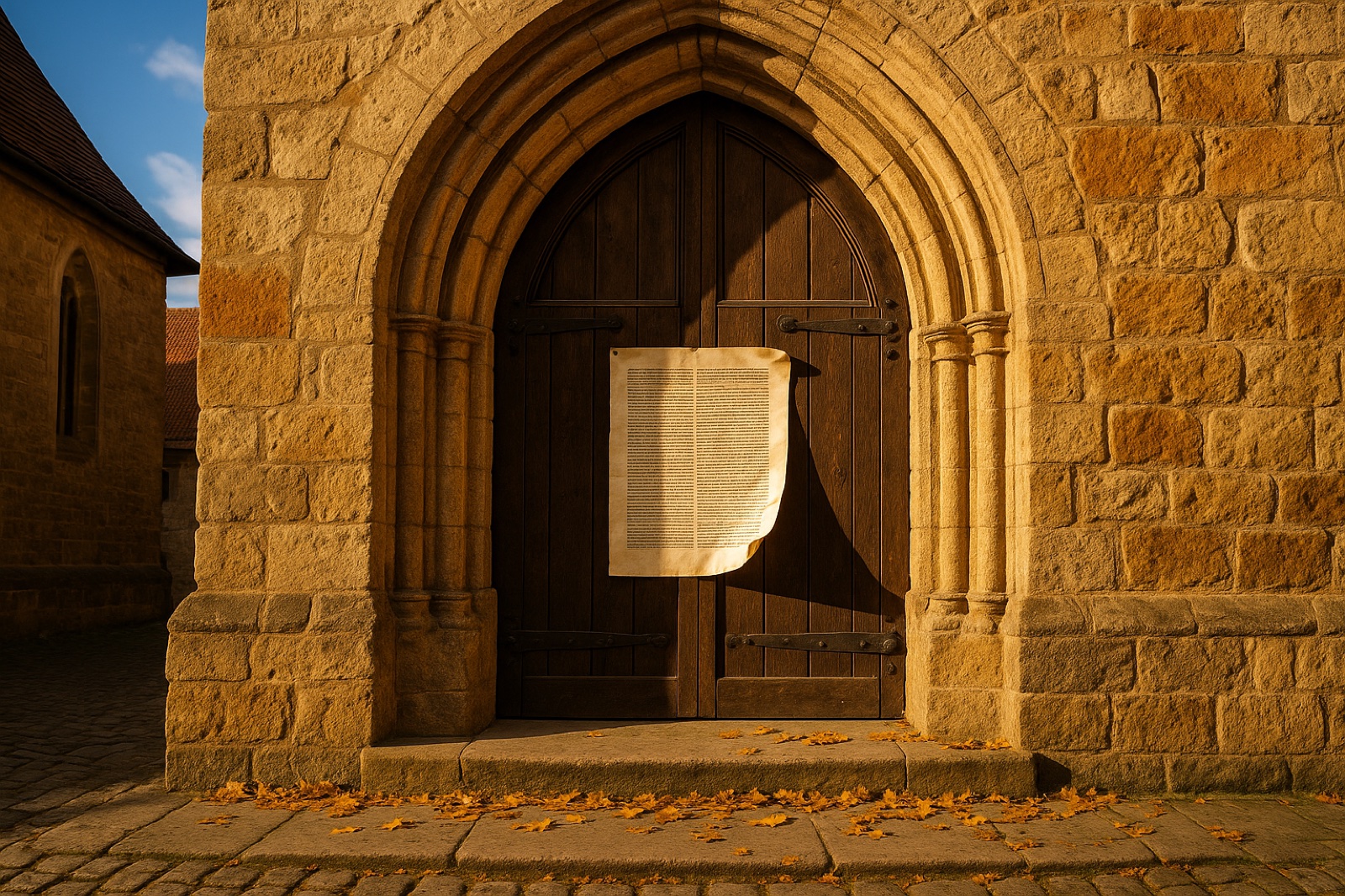
Every October, the same picture shows up. A monk in a dark robe. A hammer raised high. A sheet of paper on a big wooden church door. Bang, bang, bang. And the whole world changes.
Maybe you grew up with that picture. Maybe you only saw it this week and wondered, what is Reformation Day, anyway? Either way, here is something most people never hear: historians still argue about whether that hammer scene ever happened.
But there is one thing nobody argues about. It is the very first sentence Martin Luther wrote in those famous theses. And that sentence is not an angry protest. It is about one word Jesus said. A word that might change how you feel about God today.
What Is Reformation Day? The Short Answer
Reformation Day falls on 31 October. It remembers 31 October 1517, the day a German monk and university teacher named Martin Luther sent out a list of 95 statements for debate. They are called the Ninety-five Theses.
Luther was worried about something called indulgences. People were being told they could pay money to shorten the punishment for sins, for themselves or for loved ones who had died. Luther thought this was hurting ordinary people. It taught them that being right with God was something you could buy.
That list started a chain of events that grew into what we now call the Protestant Reformation. Many Lutheran and other Protestant churches still mark the day. In parts of Germany and in Slovenia, it is even a public holiday.
Here is the part worth knowing, though. Luther was not trying to start a new church that day. He was a Catholic monk and priest, writing in Latin, asking for a debate with other scholars. He wanted to fix something inside the church he loved.
Did Luther Really Nail the 95 Theses to the Door?
Here is what we know for sure. On 31 October 1517, Luther wrote a letter to Albrecht, the Archbishop of Mainz, and sent the theses with it. That letter still exists. So the date is solid.
The door is harder.
For a long time, the main written source for the nailing was Philip Melanchthon, Luther’s friend and co-worker. But Melanchthon wrote his account after Luther died in 1546. And Melanchthon did not arrive in Wittenberg until the following year, 1518. He was not there to see it.
In 1961, a Catholic historian named Erwin Iserloh published a careful argument that the theses were probably never posted at all. He believed Luther simply mailed them to church leaders. Many scholars took that seriously, and the debate went on for decades.
Then, in 2006, something turned up. Martin Treu, a researcher at the Luther Memorials Foundation, found a short handwritten note in a library in Jena, Germany. It was written by Georg Rörer, Luther’s own secretary, in a working copy of the New Testament from around 1540. The note said that on the evening before All Saints’ Day in 1517, Luther’s theses were posted on the doors of the churches in Wittenberg.
That note is the oldest known handwritten source for the story. But Rörer was not an eyewitness either. So here is the honest summary:
- Certain: Luther wrote the theses and sent them to the archbishop on 31 October 1517.
- Possible, maybe likely: copies were also posted on church doors in Wittenberg, which the university used like a notice board.
- Legend: the angry, crowd-watching, hammer-swinging scene from paintings and films. Nobody recorded that.
Historians can keep arguing about the door. That is fine. Because the door was never the point. The words on the paper were.
What Did Luther’s First Thesis Actually Say?
If you only read one of the 95, read the first. In Latin, it begins Dominus et magister noster Iesus Christus. In the common English translation it says:
“When our Lord and Master Jesus Christ said, ‘Repent,’ he willed the entire life of believers to be one of repentance.”
That is it. Before a single word about money, or popes, or indulgences, Luther started with Jesus. And not just anything Jesus said. The very first word of the first sermon Jesus ever preached, according to Matthew:
“From that time Jesus began to preach, and to say, Repent: for the kingdom of heaven is at hand.” (Matthew 4:17, KJV)
So the most famous protest list in history does not open with a complaint. It opens with a question: what did Jesus actually mean when he said “repent”?
The Word Luther Had Been Reading Wrong
This is the part almost nobody talks about on Reformation Day. And it is the best part.
For about a thousand years, the Bible used in Western churches was in Latin. In that Latin Bible, Jesus’s word “repent” was written as poenitentiam agite. Many people read that as “do penance.” In other words: perform the right actions to make up for your sins. Say certain prayers. Pay what you owe.
But the New Testament was not first written in Latin. It was written in Greek. And the Greek word Jesus’s call is recorded with is metanoeite, from metanoia. It is built from two small pieces: meta, meaning after or change, and nous, meaning mind. It is less about doing a task and more about a change of mind. A turning around on the inside.
Scholars in Luther’s time were going back to the Greek, and it changed how Luther read that verse. In 1518, a few months after the theses, he wrote a letter to his old teacher, Johann von Staupitz. In it he explained that he had learned from Greek scholars that the Latin word really stood for metanoia. And metanoia, he wrote, means “coming to one’s right mind.”
He also said something that is easy to miss. He wrote that people had been misled by the Latin phrase, because it sounded more like an action than a change of heart. We have written more about this word in our study of the Greek word for repentance, metanoia.
Think about what that means. If repent means “do penance,” then your whole life with God becomes a bill you can never quite pay off. But if repent means “come to your right mind,” then it sounds more like the lost son in Jesus’s story, who “came to himself” in a far country and started walking home (Luke 15:17).
Nobody sends a bill to a child who is walking home.
“The Entire Life” Is Good News, Not a Guilt Trip
When you first read Thesis 1, it can sound heavy. The entire life of believers is to be one of repentance? That sounds exhausting. Like feeling sorry forever.
But put the pieces together. If repentance means turning your mind back toward God, then “the entire life” means you never run out of chances to turn. It is not a one-time exam you pass or fail. It is a daily direction. Wake up. Notice where you drifted. Turn back. Do it again tomorrow.
And look at the rest of Jesus’s sentence in Matthew 4:17. “Repent: for the kingdom of heaven is at hand.” The reason to turn around is not a threat. It is that something good is close. The door is open. You turn because there is somewhere worth turning toward.
Luther knew what it felt like to live the other way. As a young monk, he confessed his sins for hours and still felt he was never clean enough. (If that sounds familiar, you might find our piece on scrupulosity, when every thought feels like a sin, helpful.) Coming to understand repentance as a change of mind, not an endless payment, was part of what set him free.
That is what Reformation Day is really about underneath the hammer and the door. Not winning an argument. Freedom.
Shared History, Not a Scoreboard
It would be easy to turn Reformation Day into “us versus them.” That would miss something beautiful.
On 31 October 1999, in Augsburg, Germany, the Lutheran World Federation and the Catholic Church signed a joint declaration on how a person is made right with God. They chose Reformation Day on purpose. Then, on 31 October 2016, Pope Francis travelled to Lund, Sweden, to pray alongside Lutheran leaders as the 500th anniversary began.
And remember who first raised serious doubts about the door story: a Catholic historian, doing honest work. The truth about this day has been found by people on both sides of it.
Whatever church you belong to, or none at all, the first thesis is an invitation you can accept. It does not belong to one team. It belongs to anyone who has ever needed to come to their right mind and turn toward home.
Reformation Day also sits right next to another day with a surprising history. If you have ever wondered about the night it shares, read is it a sin to celebrate Halloween. The name of that night points somewhere most people never expect.
Actions to Take Today
- Read Thesis 1 and Matthew 4:17 side by side. Say them out loud, one after the other. Notice that the first line of the Reformation is really just Jesus’s first sermon, asked about carefully.
- Do a two-minute “right mind” check. Set a timer. Ask yourself: where has my thinking drifted this week? Toward fear, resentment, or feeling like I have to earn my place? Write down one thing. Then write one sentence turning it back: “God, I don’t have to carry this.”
- Replace one “I should” with “I get to.” Pick one spiritual habit that has started to feel like a bill you owe. Today, do it once as a turning toward God instead of a payment. See if it feels different.
Journaling Prompts
- When you hear the word “repent,” what feeling comes first? Where do you think that feeling came from?
- Is there a part of your life where you have been trying to pay off a debt to God that Jesus never asked you to pay?
- What would “coming to your right mind” look like this week, in one specific relationship or habit?
A Prayer for Reformation Day
God, I have treated turning back to you like a bill I could never finish paying. Thank you that Jesus said “repent” as an invitation, because your kingdom is close, not far away. Help me come to my right mind today, and again tomorrow, and every day after. When I drift, let me turn around without fear, like someone walking home. Amen.
What Do You Think?
Which surprises you more: that nobody is sure the theses were nailed to the door, or that the first thesis was about one word Jesus said? Tell us in the comments. We would love to hear what caught your attention.
Share This
- “The very first of Luther’s 95 Theses wasn’t a protest. It was about one word Jesus said: ‘Repent.’ And it meant ‘come to your right mind,’ not ‘pay what you owe.'”
- “Historians still debate whether Luther ever nailed anything to a door. Nobody debates what Thesis 1 said. That’s the part worth remembering on Reformation Day.”
- “‘The entire life of believers is to be one of repentance’ used to sound exhausting to me. Now it sounds like good news: I never run out of chances to turn back toward God.”
Questions People Ask About Reformation Day
What is Reformation Day?
Reformation Day is observed on 31 October each year. It remembers 31 October 1517, when Martin Luther, a German monk and university professor, sent his Ninety-five Theses to Archbishop Albrecht of Mainz. The theses challenged the sale of indulgences and helped begin the Protestant Reformation. Many Lutheran and Protestant churches mark the day, and it is a public holiday in parts of Germany and in Slovenia.
Did Martin Luther really nail the 95 Theses to the church door?
Historians are not certain. It is known that Martin Luther sent the Ninety-five Theses to the Archbishop of Mainz with a letter dated 31 October 1517. The main traditional account of the theses being posted comes from Philip Melanchthon, who wrote it after Luther’s death and was not in Wittenberg in 1517. Catholic historian Erwin Iserloh argued in 1961 that the theses were never posted. In 2006, researcher Martin Treu found a note by Luther’s secretary Georg Rörer, written around 1540, stating that the theses were posted on the doors of Wittenberg’s churches. That note is the oldest known handwritten source, though Rörer was not an eyewitness.
What was the first of Luther’s 95 Theses?
The first of Martin Luther’s Ninety-five Theses states: “When our Lord and Master Jesus Christ said, ‘Repent,’ he willed the entire life of believers to be one of repentance.” It refers to Matthew 4:17, where Jesus begins preaching with the words, “Repent: for the kingdom of heaven is at hand.” Luther’s point was that repentance is a lifelong turning toward God, not a single act of penance.
What does “repent” mean in the Greek New Testament?
In the Greek New Testament, the word translated “repent” comes from metanoia, built from meta (change or after) and nous (mind). It describes a change of mind and inner turning, rather than performing an act of penance. In a 1518 letter to Johann von Staupitz, Martin Luther wrote that he had learned from Greek scholars that the Latin word used in the church’s Bible stood for metanoia, which he described as “coming to one’s right mind.”
Do Catholics and Lutherans still disagree about Reformation Day?
Catholics and Lutherans still have real differences, but relations have changed greatly. On 31 October 1999 in Augsburg, Germany, the Lutheran World Federation and the Catholic Church signed the Joint Declaration on the Doctrine of Justification, a shared statement on how a person is made right with God. On 31 October 2016, Pope Francis joined Lutheran leaders in Lund, Sweden, for a joint prayer service opening the 500th anniversary of the Reformation.