 0
0
 0
0
You stayed late all week. Someone else walked in on Friday, did one small thing, and got the same thanks you did. Maybe more.
Nobody took anything from you. You still feel robbed.
If you know that feeling, you already understand the story behind one of the most quoted lines Jesus ever said: “the last shall be first.” And you may be surprised by what the last shall be first meaning really is. It is not a promise that the losers finally win. It is about something much closer to home.
Where “The Last Shall Be First” Comes From
In the Gospel of Matthew, Jesus says it twice, a few verses apart. The first time is Matthew 19:30:
“But many that are first shall be last; and the last shall be first.” (Matthew 19:30, KJV)
Then Jesus tells a story. And at the end of the story, He says it again, in Matthew 20:16:
“So the last shall be first, and the first last: for many be called, but few chosen.” (Matthew 20:16, KJV)
Look closely at the order. The first time, it is “first … last … last … first.” The second time, it flips: “last … first … first … last.” The saying wraps around the story like two hands around a cup. Whatever the line means, the story in the middle is how Jesus explains it.
So if you pull the saying out of the story, you lose the meaning. Let’s put it back.
The Question That Started It
Just before the first “last shall be first,” Peter asks Jesus a very honest question:
“Behold, we have forsaken all, and followed thee; what shall we have therefore?” (Matthew 19:27, KJV)
In plain words: We gave up everything. What do we get?
Jesus does not scold him. He promises the disciples a real reward (Matthew 19:28-29). Then He adds the warning: many who are first will be last. And then He tells the story of the vineyard, to show what He means.
The Story of the Vineyard Workers
The story is in Matthew 20:1-15. Here it is, simply.
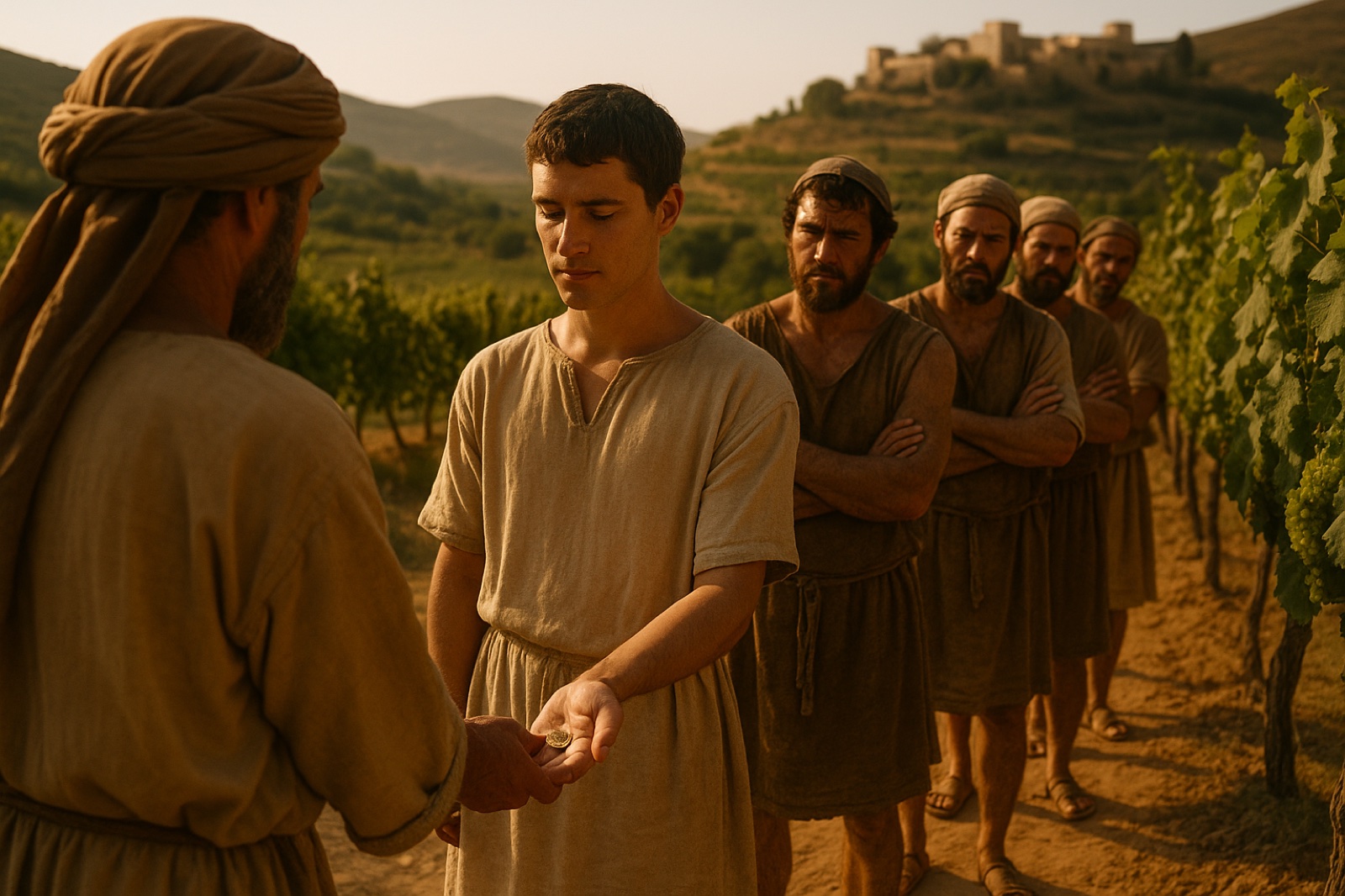
Early one morning, a landowner goes to the market to hire workers for his vineyard. He agrees to pay them “a penny a day,” the Bible’s word for a common day’s pay (Matthew 20:2). They go to work.
He goes back around the third hour, then the sixth, then the ninth, and hires more. Each time he says, “whatsoever is right I will give you” (Matthew 20:4).
Then, at the eleventh hour, with about one hour of daylight left, he finds more people still standing around. He asks why they are idle all day. Their answer is quiet and sad:
“Because no man hath hired us.” (Matthew 20:7, KJV)
They were not lazy. Nobody picked them. Anyone who has ever waited all day for work, or sent out job applications and heard nothing back, knows that feeling. The landowner sends them in too.
The Detail Everyone Reads Past
At the end of the day, the landowner tells his steward:
“Call the labourers, and give them their hire, beginning from the last unto the first.” (Matthew 20:8, KJV)
This one line is the whole setup. If the owner had paid the early workers first, they would have taken their full day’s pay and gone home happy. They never would have known what the others got.
But he pays the last ones first, in front of everyone. The one-hour workers each get a full day’s pay. And the all-day workers, still waiting in line, start doing math. If they got that for one hour, what will we get?
“They supposed that they should have received more” (Matthew 20:10). Then they get exactly what they agreed to. One penny each.
They Weren’t Cheated. They Were Offended.
Here is their complaint, word for word:
“These last have wrought but one hour, and thou hast made them equal unto us, which have borne the burden and heat of the day.” (Matthew 20:12, KJV)
Notice what they do not say. They don’t say, “You shorted us.” They can’t. They got every bit of what was promised.
What hurts is five small words: “thou hast made them equal.” The problem was not their pay. The problem was that someone else’s pay made their own feel smaller.
The landowner answers one of them:
“Friend, I do thee no wrong: didst not thou agree with me for a penny? Take that thine is, and go thy way: I will give unto this last, even as unto thee. Is it not lawful for me to do what I will with mine own? Is thine eye evil, because I am good?” (Matthew 20:13-15, KJV)
What “Is Thine Eye Evil” Means
“Is thine eye evil” sounds strange to us. But it was a common way to talk in the Bible, and it meant something specific: a stingy, grudging heart.
You can see it in the law of Moses. Deuteronomy warns about the person whose “eye be evil against thy poor brother, and thou givest him nought” (Deuteronomy 15:9, KJV). Proverbs says, “He that hasteth to be rich hath an evil eye” (Proverbs 28:22, KJV).
So the landowner is really asking: Are you stingy because I am generous? The workers are not angry at unfairness. They are upset by kindness, when it lands on someone else.
That is the sting of the story. Grace is hardest to watch when it is given to someone who, in our view, has not earned as much of it as we have.
One Word That Changes the Tone: “Friend”
The landowner calls the angry worker “Friend.” It is easy to read past. But in Matthew’s Gospel, this word of address shows up in only a few tense moments. The king uses it for the guest with no wedding clothes in Matthew 22:12. And Jesus uses it for Judas, at the moment of betrayal, in Matthew 26:50: “Friend, wherefore art thou come?”
Each time, it is warm and serious at once. It is not a door slammed shut. It is a hand still held out, to someone standing at a turning point. The grumbling worker is not thrown out of the vineyard. He is invited to stop counting.
(If you want to go deeper on Matthew 22, we looked at that wedding feast in Many Are Called, but Few Are Chosen: Everyone Got Invited. Some modern Bibles leave “for many be called, but few chosen” out of Matthew 20:16, because it is missing from the oldest copies of Matthew we have. The same words do appear in Matthew 22:14.)
What Happens Right After the Story
If you keep reading, the next scene is almost funny. Jesus tells the twelve, again, that He is going to Jerusalem to suffer and die and rise (Matthew 20:17-19).
And the very next thing? The mother of James and John comes and asks Jesus to give her two sons the best seats, “the one on thy right hand, and the other on the left, in thy kingdom” (Matthew 20:21).
They have just heard the story. And they are still standing in line, trying to be first.
Jesus answers: “whosoever will be great among you, let him be your minister; And whosoever will be chief among you, let him be your servant” (Matthew 20:26-27, KJV). This is not a scolding for wanting something good. It is a new way to measure what “first” even means.
So What Does “The Last Shall Be First” Mean?
Put it all back together, and the meaning is clear:
- It is not mainly a promise of revenge, where today’s winners get punished and today’s losers get their turn on top.
- It is a warning to people who think they are first. Jesus said it right after Peter asked, “What do we get?”
- It shows how God gives. God’s goodness is not a paycheck that grows with hours worked. It is a gift, and a gift can be given to anyone.
- It names a quiet danger: the person who has served the longest can be the one most offended when grace reaches a latecomer.
Luke records Jesus saying something similar in a different setting, about people coming from east and west to sit down in the kingdom: “there are last which shall be first, and there are first which shall be last” (Luke 13:30, KJV). There too, it is the insiders who get the surprise.
Where This Shows Up on a Normal Tuesday
Most of us are not afraid of being last. We are afraid of being made equal to someone we think did less.
It shows up when a younger brother or sister gets praise for doing once what you have done for years. When a new person at work gets the same thanks as the one who carried the team. When someone with a messy past comes to faith and gets a warm welcome, and a longtime believer feels a small, hot twist inside.
That twist is the “evil eye.” It is not always loud. Often it just sounds like, “Well, must be nice.”
Here is the turn the story offers: the all-day workers had something the late workers did not. They had a whole day of knowing they had work. A whole day of not standing in the market, wondering if anyone would pick them. The landowner’s question, “Friend, didn’t you agree?”, invites them to see that what they got was already good. It only felt small when they compared it.
If comparison and envy have been loud for you lately, our free Am I a Jealous Person? check can help you see it honestly. And if you have ever wondered why the Bible calls God jealous but never envious, Envy vs Jealousy walks through the difference.
Actions to Take
- Name the “made equal” moment. Think of one person whose good news bothered you lately. Say out loud, “Nothing was taken from me.” Notice how it feels to say it.
- Count your “whole day.” Write three things you have that you did not have to wait in the market for: a friend who stayed, a skill you learned early, a place you belong.
- Bless the latecomer. Send one short, honest message of congratulations to the person whose win stung. Don’t add a “but.” Just mean it.
Journaling Prompts
- Where in your life are you quietly keeping score of your hours, and who is on the other side of that score?
- When have you been the eleventh-hour worker, given more than you had earned? How did it feel to be on that side of grace?
- If God called you “Friend” in the middle of your frustration, what do you think God would want you to see?
A Prayer
God, I have been counting again. I looked at what someone else got and suddenly what I had felt small. Thank You for every day I did not have to stand in the market wondering if anyone wanted me. Open my eyes so they are glad, not grudging, when You are good to someone else. Teach me to be happy that the latecomers made it in, since I was once one of them too.
Discussion Question
Do you think the all-day workers had a fair point, or does the landowner’s answer settle it? Tell us in the comments. We’d love to hear how you read it.
Share This
- “The all-day workers weren’t cheated. They were offended that grace reached someone else. That one hit me.”
- “Most of us aren’t afraid of being last. We’re afraid of being made equal to someone we think did less. Matthew 20 gets honest about that.”
- “‘Is thine eye evil, because I am good?’ Reading the vineyard story again, and I think the question is for me.”
“Grace is hardest to watch when it lands on someone else.”
Questions About “The Last Shall Be First”
What does “the last shall be first” mean?
“The last shall be first” is a saying of Jesus in Matthew 19:30 and 20:16. It wraps around the parable of the vineyard workers, where a landowner pays workers hired at the last hour the same full day’s wage as those who worked all day. The saying means God’s goodness is a gift, not a wage that grows with effort, and it warns people who think they are “first” not to resent that grace given to others.
Where is “the last shall be first” in the Bible?
The saying appears in Matthew 19:30 and Matthew 20:16, before and after the parable of the workers in the vineyard. A similar saying appears in Mark 10:31, and in Luke 13:30 in a different setting about people coming from east and west into the kingdom of God.
Were the workers in the vineyard treated unfairly?
No. In Matthew 20, the workers hired early in the morning agreed to work for “a penny a day,” and they received exactly that. Their complaint in Matthew 20:12 is not that they were underpaid, but that the landowner “made them equal” to workers who came at the last hour. The landowner says, “Friend, I do thee no wrong.”
What does “Is thine eye evil, because I am good” mean?
In the Bible, an “evil eye” is a way of describing a stingy, grudging attitude, as in Deuteronomy 15:9 and Proverbs 28:22. When the landowner in Matthew 20:15 asks, “Is thine eye evil, because I am good?”, he is asking the complaining worker whether he has become resentful because the landowner chose to be generous to someone else.
Is “the last shall be first” about rich and poor people?
Not mainly. In Matthew, Jesus says “the last shall be first” right after Peter asks what the disciples will receive for leaving everything. The parable that follows is about how God gives grace freely, and about the danger of resenting that grace when it reaches people who seem to have done less.