 0
0
 0
0
Some days you do not need a pep talk. You need something to hold on to.
Maybe it is the day the job ends, or the phone call from the hospital, or the morning you realise the people you counted on are now angry at you. Everything you would normally lean on is gone at once. And a small, tired voice asks: where do I even get strength from now?
If you are looking for a prayer for strength, you will find one near the end of this page, written so you can pray it right away. But first, there is a story in the Bible that belongs to exactly this kind of day. It happens in a small town called Ziklag. And it hides a single Hebrew word that changes what “praying for strength” means.
A Prayer for Strength Starts With a Bad Day at Ziklag
Before David was king, he spent years running from King Saul. At one point he gave up on staying in Israel at all. The Bible records what he told himself:
“And David said in his heart, I shall now perish one day by the hand of Saul: there is nothing better for me than that I should speedily escape into the land of the Philistines.” (1 Samuel 27:1, KJV)
So he moved his men and their families into enemy country. A Philistine ruler gave him the town of Ziklag, and David lived there “a full year and four months” (1 Samuel 27:7).
Then one day David and his six hundred men marched out with the Philistine army. They were sent home before the battle. It took them until the third day to get back. And this is what they found:
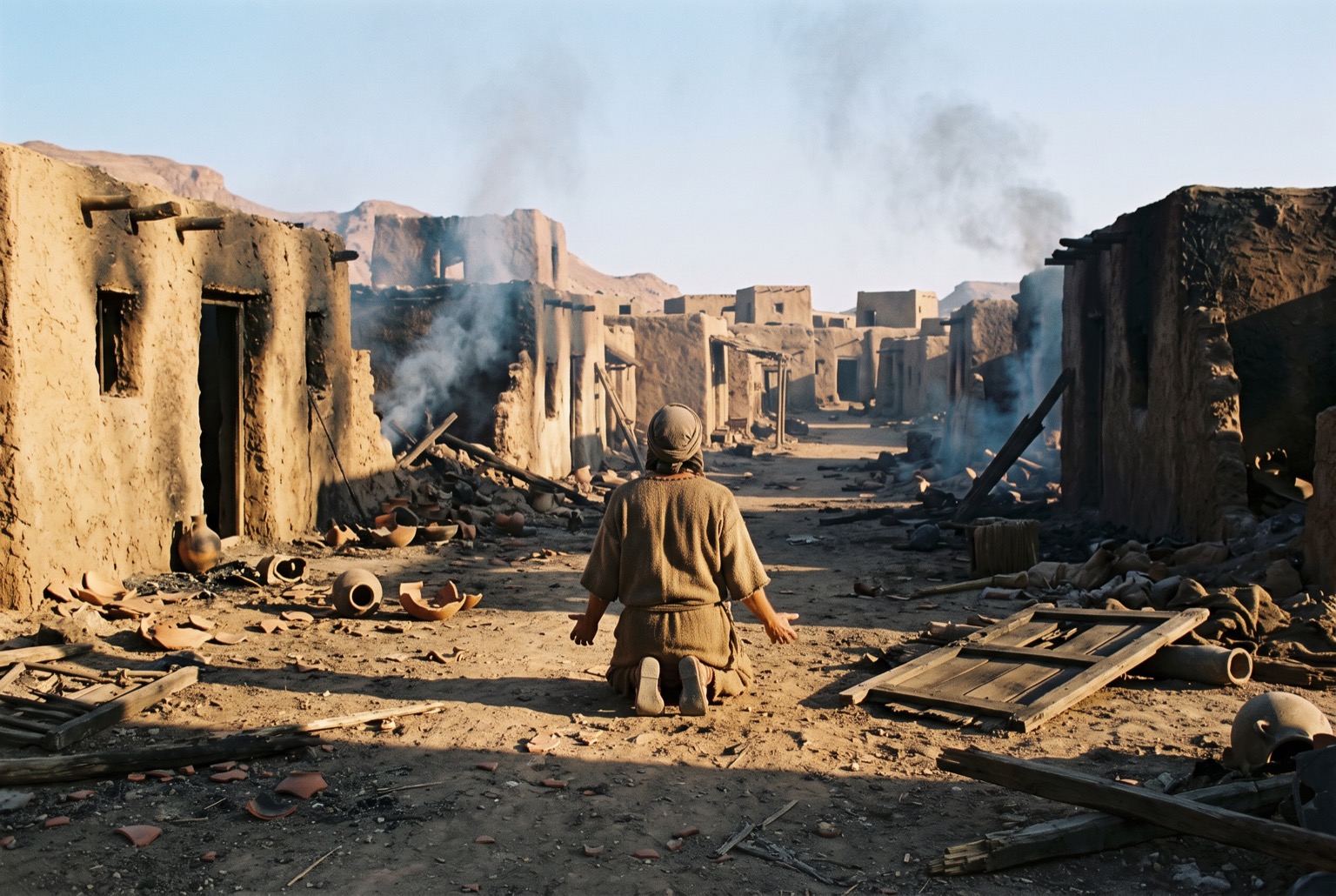
“And it came to pass, when David and his men were come to Ziklag on the third day, that the Amalekites had invaded the south, and Ziklag, and smitten Ziklag, and burned it with fire.” (1 Samuel 30:1, KJV)
Their homes were ash. Their wives, sons and daughters were gone, carried off. David’s own two wives were taken too.
The next line is one of the most honest in the Bible:
“Then David and the people that were with him lifted up their voice and wept, until they had no more power to weep.” (1 Samuel 30:4, KJV)
Notice that. Before any prayer, before any plan, they cried until there was nothing left. The Bible does not skip that part, so you do not have to skip it either.
Then It Got Worse
Grief turned into blame. The men looked at their leader, and they started talking about killing him.
“And David was greatly distressed; for the people spake of stoning him, because the soul of all the people was grieved, every man for his sons and for his daughters: but David encouraged himself in the LORD his God.” (1 Samuel 30:6, KJV)
Sit with how alone David is in that moment. His home is gone. His family is gone. His friends want him dead. There is no prophet in the room with a word from God. There is no answer yet about whether the families are even alive.
And then comes one small word: but.
The Hebrew Word Behind “Encouraged Himself”
In English, “encouraged himself” can sound soft, like a quick self-talk before a job interview. The Hebrew is stronger than that.
The verb comes from the root chazaq (Strong’s H2388). Its basic meaning is to be strong, to grow firm, to take hold and hold tight. In this verse it is in a reflexive form, which means David did it to himself. A plain translation is: David strengthened himself in the LORD his God.
That is the whole secret of this story, and it is easy to miss. David did not wait until he felt strong. He did not feel strong at all. He took hold of God with nothing else left to hold, and the holding on was where the strength came from.
The Detail Most Readers Miss: Someone Used to Do This for Him
The same Hebrew root shows up earlier in David’s story. Years before, when Saul was hunting him in the wilderness, his best friend came to find him:
“And Jonathan Saul’s son arose, and went to David into the wood, and strengthened his hand in God.” (1 Samuel 23:16, KJV)
Back then, Jonathan did it for him. Jonathan walked into the woods and put David’s hand back in God’s hand.
At Ziklag, there is no Jonathan. Nobody walks into the ruins to help. So David does for himself what his friend once did for him. And there is a painful twist in the timing: within days, the news would reach David that Jonathan had died in battle on Mount Gilboa (1 Samuel 31, 2 Samuel 1:1). The friend who once strengthened him was already gone, or about to be.
If you have ever lost the person who used to hold you up, this verse is for you. The strength they helped you find did not live in them. It lived in God. And you can still reach it.
What Strength Looked Like Next
Here is the part that surprised me most. David’s prayer for strength did not end in a feeling. It ended in a question. The very next thing he did was ask the priest to bring the ephod, a sacred garment used to seek God’s direction, and he asked:
“Shall I pursue after this troop? shall I overtake them?” (1 Samuel 30:8, KJV)
And the answer came: “Pursue: for thou shalt surely overtake them, and without fail recover all.”
Strength did not make David stop being in trouble. It made him able to take the next step. That is often what a real prayer for strength gives you: not a new mood, but enough footing to ask “what now?”
Even then, the road was not easy. Two hundred of his men were so worn out they could not cross the brook Besor. David went on with four hundred. And the answer to his prayer came from a place nobody would have looked. In a field, they found a young Egyptian slave, left behind by his Amalekite master because he got sick. He had not eaten or had water for three days and three nights. David’s men gave him bread, water, figs and raisins, and “his spirit came again to him” (1 Samuel 30:12). Then he led them straight to the raiders’ camp.
The help came through a person someone else had thrown away. Kindness to a stranger was part of how the prayer got answered.
The chapter ends with a sentence worth reading slowly:
“And there was nothing lacking to them, neither small nor great, neither sons nor daughters, neither spoil, nor any thing that they had taken to them: David recovered all.” (1 Samuel 30:19, KJV)
And one more thing. When some of the men said the two hundred who stayed behind should get nothing, David refused. “As his part is that goeth down to the battle, so shall his part be that tarrieth by the stuff: they shall part alike” (1 Samuel 30:24). The man who had just found strength in God made room for the men who had none left. Being too tired to go on did not make them lesser.
What This Means for Your Prayer for Strength Today
Most of us pray for strength like we are asking for a battery charge. “God, make me feel strong.” Then we wait for the feeling, and when it does not come, we think the prayer failed.
Ziklag shows a different kind of prayer. David was not strong, and then prayed. He prayed, and the praying was the act of getting strong. It was a grip, not a feeling.
That also means you do not need the right words, or a friend in the room, or proof that things will turn out fine. David had none of those. You only need to take hold. And if you are one of the two hundred today, too tired to even cross the brook, the same story says you still count. You still get your share.
If you are not sure which verse fits where you are right now, you can try our free Bible Verse for How I Feel tool. It takes a minute. And if what you need is quiet as much as strength, this prayer for peace and strength explores how the two go together.
It is also worth knowing that David was not always the strong one in his story. Years later, when he was running for his life again, an old man named Barzillai fed his exhausted army. Sometimes you strengthen yourself in God. Sometimes God sends someone with bread.
Actions to Take Today
- Say the word “but” out loud. Finish this sentence honestly: “Everything feels like ___, but God ___.” Say it once, even if you do not feel it yet. That is what David did in 1 Samuel 30:6.
- Ask one “what now?” question. Instead of asking God to fix everything, ask for the very next step. Write it down: “Show me the one thing I should do today.” Then do the smallest thing that comes to mind.
- Feed someone who got left behind. Send a message, share a meal, or check on one person who is struggling more quietly than you are. The help David needed came through a stranger he fed.
Journaling Prompts
- Who has been your “Jonathan”, the person who used to strengthen your hand in God? What did they actually do or say that helped?
- What are you waiting to feel before you let yourself hold on to God? What would it look like to hold on before the feeling comes?
- Are you one of the four hundred or one of the two hundred right now? What would you want the others to know about where you are?
A Prayer for Strength When Everything Has Fallen Apart
God, I do not feel strong right now. Honestly, I feel like I have cried until there is nothing left, and the things I used to lean on are gone. I am not asking to feel better first. I am just taking hold of You, the way David did at Ziklag, because I have nothing else to hold. Show me the one next step, send help through whoever You choose, and do not let go of me while I learn how to hold on. Amen.
Discussion Question
David found strength alone at Ziklag, but years earlier Jonathan had to come and find him. Which do you think matters more when life falls apart: learning to strengthen yourself in God, or having someone who shows up to do it with you? Share your thoughts in the comments below.
Share This
- “David encouraged himself in the LORD his God.” The Hebrew means he strengthened himself. Not because he felt strong. Because he had nothing else to hold. (1 Samuel 30:6)
- At Ziklag, David’s town burned and his men wanted to stone him. His prayer for strength did not end in a feeling. It ended in a question: “What now?” I think I needed that today.
- The two hundred who were too tired to go on still got an equal share. “They shall part alike.” (1 Samuel 30:24) If you are too tired today, you still count.
Questions and Answers About Praying for Strength
What does “David encouraged himself in the LORD” mean?
In 1 Samuel 30:6, the phrase “David encouraged himself in the LORD his God” uses a Hebrew verb from the root chazaq, which means to be strong or to take firm hold. The verb is reflexive, so a plain translation is “David strengthened himself in the LORD his God.” It describes David deliberately taking hold of God at a moment when his town had been burned, his family taken, and his own men were talking of stoning him.
What happened at Ziklag in the Bible?
Ziklag was a town the Philistine ruler Achish gave to David while David was hiding from King Saul. In 1 Samuel 30, David and his men returned to Ziklag and found that the Amalekites had burned it and taken their wives and children captive. David strengthened himself in God, asked God whether to pursue, followed the raiders with help from an abandoned Egyptian servant, and recovered everyone and everything that had been taken.
What is a good Bible verse to pray for strength?
1 Samuel 30:6 is a strong verse to pray for strength because it describes David finding strength in God at the lowest point of his life, with no friend or answer yet. It reads: “And David was greatly distressed; for the people spake of stoning him, because the soul of all the people was grieved, every man for his sons and for his daughters: but David encouraged himself in the LORD his God.” It shows that praying for strength can mean holding on to God before any feeling of strength arrives.
How do you pray for strength when you feel weak?
Praying for strength when you feel weak can start by being honest that you do not feel strong, then choosing to take hold of God anyway, the way David did at Ziklag in 1 Samuel 30. Instead of asking only for a better feeling, it helps to ask God for the next single step to take. David’s prayer for strength was followed straight away by the question “Shall I pursue after this troop?” and an answer that led him forward.
Did David get everything back at Ziklag?
Yes. According to 1 Samuel 30:18-19, David recovered everything the Amalekites had taken, including his two wives. The KJV says: “there was nothing lacking to them, neither small nor great, neither sons nor daughters, neither spoil, nor any thing that they had taken to them: David recovered all.” David also insisted that the 200 men who were too exhausted to continue the chase received an equal share of the spoil.