 0
0
 0
0
Ask a 13-year-old if trying something once is a big deal, and you already know the answer. Once is nothing. Once is how you find out. Everybody tries things once.
For almost everything in a teenager’s world, that logic mostly holds. For one drug, it doesn’t hold at all. And a large US survey just showed how many young teens have no idea.
When it comes to teens and fentanyl, more than half of 13- and 14-year-olds in the survey did not see great risk in trying it once or twice. That is not a small gap. It is the gap between a bad night and no morning at all.
What the Survey Found About Teens and Fentanyl
The numbers come from Monitoring the Future, a long-running survey of American students run by the University of Michigan. In 2025, 3,820 students in 8th, 10th and 12th grade (roughly ages 13 to 18) answered questions about fentanyl. Researcher Richard Miech and colleagues published the results in JAMA Network Open in July 2026.
Here is what they found:
- 52.2% of 8th graders (ages 13 to 14) did not see great risk in trying fentanyl once or twice.
- 33.5% of 8th graders did not see great risk even in using it regularly.
- Among 12th graders, 30.2% did not see great risk in trying it once or twice, and 15.2% did not see great risk in regular use.
- Between about 9% and 17% of students, depending on grade, said they didn’t know enough about fentanyl to answer at all.
Older students did better. But even at the end of high school, nearly one in three did not see trying fentanyl as a serious danger.
That matters because fentanyl is not a middle-of-the-road drug. It is a man-made opioid up to 50 times stronger than heroin. The researchers note it is involved in at least three out of every four overdose deaths among US teens.
Why “Just Once” Feels Safe
Look at how the survey asks the question. It asks about risk at three levels: trying it once or twice, using it sometimes, and using it regularly. For most substances, that ladder makes sense. One cigarette is not the same as a pack a day. One drink is not the same as drinking every night.
Teens have heard that message for years, in one form or another. The danger is the habit. The danger is getting hooked. Once is not the problem.
Fentanyl breaks that ladder. The US Drug Enforcement Administration says about 2 milligrams of fentanyl can be a deadly dose. That is an amount small enough to fit on the tip of a pencil. There is no slow slide. There is no “I’ll stop before it gets bad.” The first time can be the only time.
So when a young teen says trying something once isn’t risky, they are not being reckless. They are applying a rule that has worked for them everywhere else. They just don’t know it stops working here.
The Warning That Doesn’t Land
This is the part of the study that is easy to miss, and it may be the most important.
Many teens who die from fentanyl never meant to take fentanyl at all. Much of it reaches young people hidden inside fake pills made to look exactly like real medicine: painkillers, anxiety pills, study pills. In DEA lab testing of fentanyl-laced fake pills seized in 2022, six out of ten contained a potentially deadly dose.
So the main warning adults give is some version of: “Don’t take a pill from a friend. It could have fentanyl in it.”
But think about what that warning assumes. It only works if the word “fentanyl” already means “this can kill me.” For a teen who thinks fentanyl is about as risky as trying a beer once, the warning sounds like: “That pill could have something mildly bad in it.” That is not a reason to say no. That is barely a reason to pause.
The researchers made this same point. Warnings about fake pills laced with fentanyl will not do much if students don’t understand how dangerous fentanyl is in the first place. Everyone has been warning kids about the container. Many kids never learned what is inside it.
Not a Lack of Fear. A Missing Fact.
It is tempting to read these numbers and decide that young teens are careless. The study points somewhere else.
A third of 8th graders didn’t see great risk even in regular fentanyl use. That is not a kid bravely deciding to gamble. That is a kid who simply hasn’t been told. The problem isn’t that they heard the truth and ignored it. It’s that the truth never reached them.
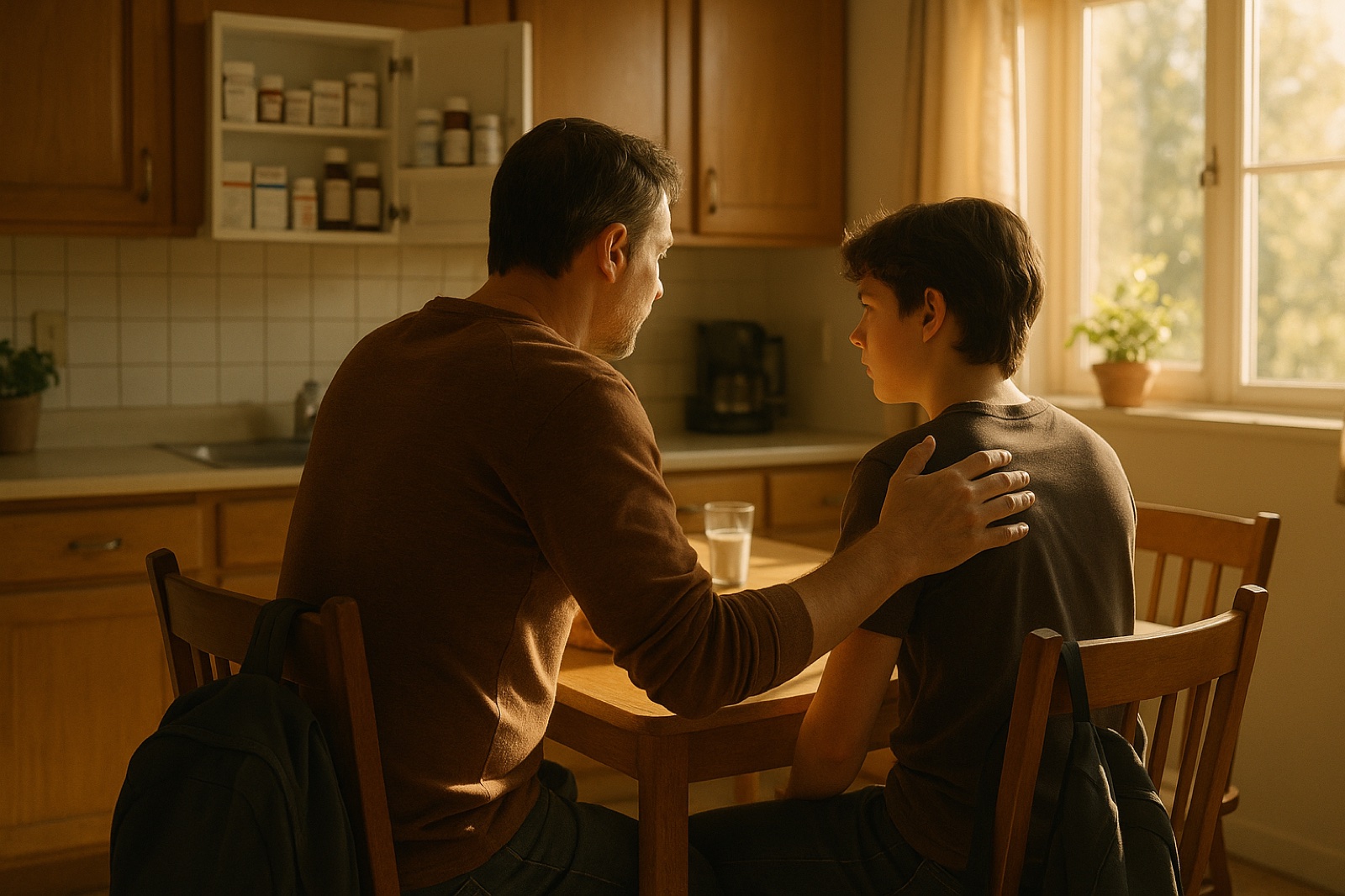
That is actually good news, in a hard way. Defiance is difficult to change. A missing fact is not. A missing fact can be handed over in one honest conversation at a kitchen table.
How to Talk to Your Teen About Fentanyl
You don’t need a script, a counselor, or any money. You need a few minutes and a calm voice. Here are some simple places to start:
- Say the one fact plainly. “Fentanyl can kill you the first time. Not after a habit. The first time.” Say it once, clearly, without a lecture around it.
- Talk about pills, not just “drugs.” Many teens picture drugs as powders and needles. Tell them fake pills can look exactly like real medicine. The simple rule: only take medicine that comes from a pharmacy, a doctor, or a trusted adult at home.
- Start younger than feels necessary. The survey found the biggest gap among 13- and 14-year-olds. If you are waiting until the later teen years, you may be waiting too long.
- Give them a way out. Agree on a text or code word that means “come get me, no questions tonight.” A teen with an exit is far safer than a teen who is afraid of getting in trouble.
- Keep the door open. Ask what they have heard. Listen more than you talk. The goal is not one perfect speech. It is being the voice they come back to.
If your family is carrying something harder than a warning, and someone you love is already struggling, this piece on helping without enabling may be a gentle next read.
The Oldest Parenting Advice on Record
There is something striking about how old this problem is.
One of the oldest collections of wisdom writing in the world is written almost entirely as a parent talking to a child. And its biggest worry is not the rebel. It is the naive one: the young person who walks toward danger without knowing what it will cost, because nobody told them. The old answer was not fear or punishment. It was a trusted voice, speaking early, handing over hard-won wisdom as a gift before the moment arrived.
Those ancient writers believed that kind of wisdom ultimately comes from God, and that it is given freely to anyone who asks. Thousands of years later, the survey is saying something close to the same thing. The danger is not what our kids refuse to hear. It is what they have never been told.
One Conversation Can Change the Numbers
Research like this can make a parent feel helpless. It shouldn’t. Every percentage in this study is made of kids who simply hadn’t heard one clear sentence yet.
That sentence is yours to give. Tonight, over dinner, in the car, or while walking somewhere together. Not a speech. Just the fact, said with love, by someone they trust.
You may never know which conversation mattered. That is how most good seeds work.
If you’re thinking about the wider world your kids are growing up in, you might also find value in what eight years of data revealed about screen time and kids, and in why kratom poisonings have climbed so sharply over the past decade.
Teens and Fentanyl: Common Questions
Do teenagers understand how dangerous fentanyl is?
Many do not. In the 2025 Monitoring the Future survey of 3,820 US students, published in JAMA Network Open in July 2026, 52.2% of 8th graders (ages 13 to 14) did not see great risk in trying fentanyl once or twice, and 33.5% did not see great risk even in regular use. Among 12th graders, 30.2% did not see great risk in trying it once or twice.
Can you die from trying fentanyl one time?
Yes. Fentanyl is a man-made opioid up to 50 times stronger than heroin, and the US Drug Enforcement Administration says about 2 milligrams, an amount that could fit on the tip of a pencil, can be a deadly dose. Unlike many substances where danger builds with repeated use, fentanyl can cause a fatal overdose the first time someone takes it.
How do teens end up taking fentanyl without knowing it?
Much of the fentanyl reaching young people is hidden in fake pills made to look like real prescription medicine, such as painkillers or anxiety pills. In DEA lab testing of fentanyl-laced fake pills seized in 2022, six out of ten contained a potentially deadly dose. A teen may believe they are taking an ordinary pill from a friend and have no idea it contains fentanyl.
What is the best way to talk to a teenager about fentanyl?
Start early, around ages 12 to 14, because young teens show the biggest gap in understanding the danger. State the key fact plainly: fentanyl can kill the first time. Explain that fake pills can look exactly like real medicine, and set a simple rule to only take medicine from a pharmacy, a doctor, or a trusted adult. Offer a code word the teen can text to be picked up with no questions asked, and keep the conversation open rather than giving one lecture.
Join the Conversation
Do you think teens today hear too many drug warnings and tune them out, or too few clear facts? What worked when you were young, and what would you change now? Share your thoughts in the comments below.
Share This
Post 1: Over half of 13- and 14-year-olds in a big US survey didn’t think trying fentanyl once was a big risk. It can kill the first time. That’s one sentence worth saying at dinner tonight. https://bgodinspired.com/index.php/relationships-and-family/teens-and-fentanyl-risk/
Post 2: We keep telling kids “that pill could have fentanyl in it.” But if they don’t know fentanyl can kill on the first try, that warning means almost nothing. This article made me rethink how I talk to my kids: https://bgodinspired.com/index.php/relationships-and-family/teens-and-fentanyl-risk/
Post 3: The scariest part of this new teen survey isn’t rebellion. It’s that a third of 8th graders didn’t see great risk in fentanyl even with regular use. They just haven’t been told. We can fix that. https://bgodinspired.com/index.php/relationships-and-family/teens-and-fentanyl-risk/