 0
0
 0
0
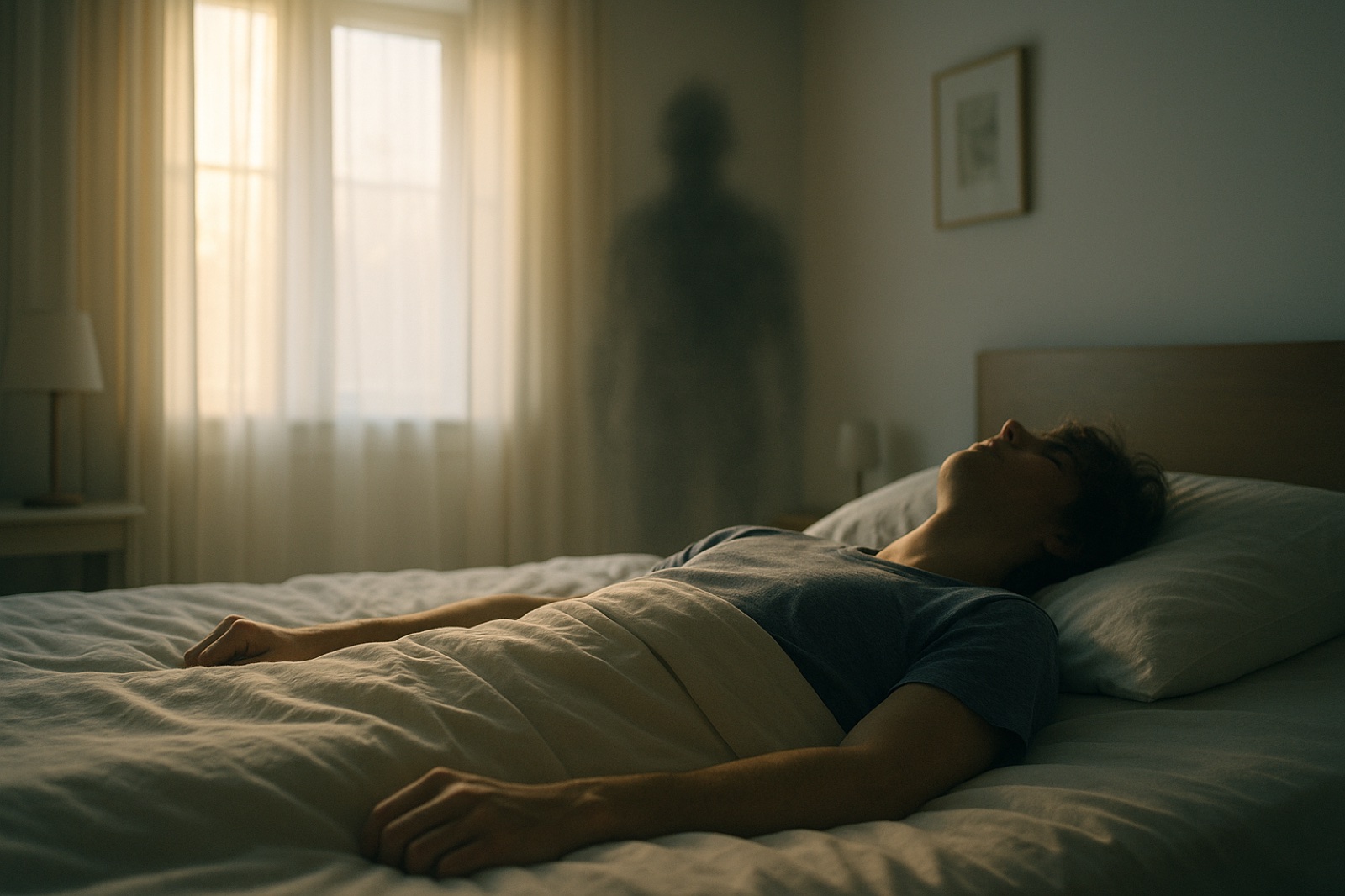
You wake up. Your eyes are open. You can see your room, your window, the shape of the door.
But you cannot move. Not a finger. You try to shout and nothing comes out. Your chest feels heavy, like something is sitting on it. And you are sure, completely sure, that something is in the room with you.
If that has happened to you, you are not alone, and you are not losing your mind. People have a name for that shape in the corner. They call it the sleep paralysis demon. Every month, tens of thousands of people type those exact words into a search bar, usually in the middle of the night, usually still shaking.
Here is what is really going on in your body. And here is something most people never hear: one of the oldest written accounts of a night like this may sit in the Bible, in the book of Job. The Bible does not treat that night visitor as a messenger from God. It says the message was wrong.
What Is Sleep Paralysis?
Sleep paralysis is when your mind wakes up before your body does.
Every night, during the stage of sleep when you dream most (called REM sleep), your brain turns off most of your muscles. That is a good thing. It keeps you from acting out your dreams and falling out of bed.
Normally that switch flips back on before you wake. In sleep paralysis, you wake up while it is still off. You are aware. Your eyes work. But your body is still in “dream mode,” so it will not move. And the dream itself can leak into the waking room. That is why people see shapes, hear footsteps, or feel a presence that is not there.
It usually lasts from a few seconds to a couple of minutes. It feels much longer. On its own, it is not dangerous.
It is also more common than most people think. A 2011 review in the journal Sleep Medicine Reviews, by Brian Sharpless and Jacques Barber, pulled together dozens of studies covering more than 36,000 people. It found that about 7.6% of people in the general population have had at least one episode in their life. Among students the figure was about 28%. So if it happened to you, you are in very large company.
Things that can make it more likely include not getting enough sleep, a messy sleep schedule, stress, and, for some people, sleeping flat on their back. If your nights are already short or broken, it can help to look at what is quietly stealing your deep sleep. Even caffeine can make sleep shallower when you feel fine.
Why the Sleep Paralysis Demon Feels So Real
The scariest part is not the stuck body. It is the visitor.
Many people say the same things: a dark figure by the door or at the foot of the bed. A weight pressing on the chest. A feeling of being watched by something that means harm. A form you can almost see but cannot quite make out.
People have described this for a very long time, in very different places. The English word “nightmare” itself comes from an old word, “mare,” for a spirit that was believed to sit on sleepers’ chests. In Newfoundland, Canada, people called it “the Old Hag.” A researcher named David Hufford collected those stories in a 1982 book called The Terror That Comes in the Night, and he noticed something striking: people who had never heard of each other described almost the same scene.
That tells us two things. First, the fear is real, even if the figure is not. Second, the human brain, frozen between dreaming and waking, tends to fill a dark room with the same kind of shape.
Which brings us to a man named Eliphaz.
The Night Visitor in Job 4
The book of Job is about a good man who loses almost everything. Three friends come to sit with him. The first one to speak is Eliphaz. And to prove his point, Eliphaz tells Job about a night he could not forget:
“Now a thing was secretly brought to me, and mine ear received a little thereof. In thoughts from the visions of the night, when deep sleep falleth on men, Fear came upon me, and trembling, which made all my bones to shake. Then a spirit passed before my face; the hair of my flesh stood up: It stood still, but I could not discern the form thereof: an image was before mine eyes, there was silence, and I heard a voice, saying,”
Job 4:12-16 (KJV)
Read that slowly. Night. Deep sleep. Sudden fear. Shaking. Hair standing up. Something standing still in front of him. A shape he could not make out. Silence. Then a voice.
It is hard to read that today and not think of sleep paralysis. Many readers have noticed the resemblance. We cannot diagnose a man from thousands of years ago, and the text does not say he was unable to move. But almost every other detail is there, in order.
Two small words in the original Hebrew make it even more interesting.
The “deep sleep” in verse 13 is the Hebrew word tardemah. It is not ordinary sleep. It is the same word used when “a deep sleep fell upon Abram; and, lo, an horror of great darkness fell upon him” (Genesis 15:12). A heavy, strange sleep that comes with dread.
And the “spirit” that passed before his face in verse 15 is the Hebrew word ruach. It can mean spirit. But it is also the everyday word for wind or breath. The text leaves room for something as small as a breath of air across the face in the dark, blown up by fear into a visitor.
Notice one more detail, at the very start: “mine ear received a little thereof.” Eliphaz admits he only caught part of it. A whisper. A little. That is worth remembering, because of what he did with it next.
What the Visitor Said, and Why It Was Wrong
Here is the message Eliphaz heard:
“Shall mortal man be more just than God? shall a man be more pure than his maker? Behold, he put no trust in his servants; and his angels he charged with folly:”
Job 4:17-18 (KJV)
It sounds holy. That is what makes it dangerous. The first line is fine. Nobody is more just than God. But the second line paints a God who trusts no one. A God who looks at even the most faithful servant and sees only failure.
Eliphaz used that night message to tell Job what his suffering meant. Just a few verses earlier he had asked, “who ever perished, being innocent?” (Job 4:7). In other words: Job, you must have done something to deserve this.
Now look at how the book of Job opens. Before any of the suffering, God speaks about Job with open pride:
“Hast thou considered my servant Job, that there is none like him in the earth, a perfect and an upright man, one that feareth God, and escheweth evil?”
Job 1:8 (KJV)
“He put no trust in his servants,” said the voice in the night. “My servant Job,” says God, with delight. Those two cannot both be the true picture of God. The reader knows which one is.
And at the very end of the book, God settles it:
“the LORD said to Eliphaz the Temanite, My wrath is kindled against thee, and against thy two friends: for ye have not spoken of me the thing that is right, as my servant Job hath.”
Job 42:7 (KJV)
To be fair and exact: God’s verdict covers everything Eliphaz and his friends said, not only the night vision. But the vision was the foundation Eliphaz built on. It was his proof. And the book ends by saying that what Eliphaz told Job about God was not right. The terrifying voice in the night did not get the last word. God did. And God’s last word about Job was the same as God’s first: “my servant.”
What This Means When You Wake Up Frozen
Here is the part most people never hear.
When something terrifying happens in the night, it is natural to ask, “What does this mean about me?” Am I cursed? Am I being punished? Is something wrong with my soul? Is God angry with me?
The Bible itself, in one of its oldest books, records a man who asked the same kind of question after a terrifying night, and got the answer wrong. He took a frightening experience, heard a message that made God sound cold and suspicious, and then used it to crush a friend who was already broken.
And God said no.
A terrifying night is not a verdict. A shape in the dark does not get to tell you who God is, or who you are to God. Job himself had nights like this. He said to God, “thou scarest me with dreams, and terrifiest me through visions” (Job 7:14). And still, at the end, God called him “my servant Job,” four times in two verses.
Some Christians believe these night experiences can be spiritual attack. Others see them as a body and brain doing something strange but harmless. You do not have to settle that question tonight to hold onto this: whatever you saw or felt, fear in the dark is not a message about your worth. Peace is. As Jesus put it, “Peace I leave with you, my peace I give unto you… Let not your heart be troubled, neither let it be afraid” (John 14:27).
If you have more questions about what the Bible says on this, you can even explore them with our free Bible Answers AI assistant (it opens in ChatGPT).
What to Do During and After an Episode
During it: Don’t fight your whole body at once. Try to move one small thing, like a toe or a finger. Small movements often break the freeze faster than big ones. Breathe slowly through your nose. Tell yourself, even silently: “This is my body waking up. It will pass.” It always does.
After it: Turn on a light if you can. Sit up. Drink some water. Many people find it helps to say a short prayer out loud, simply because it puts a true voice back into a quiet room.
Over time: Keep your sleep and wake times as steady as you can, even on days off. Protect your total sleep. If you notice it happens more when you sleep flat on your back, try sleeping on your side. If poor sleep is part of the picture, our free Why Can’t I Sleep? assessment can help you spot what is getting in the way.
When to see a doctor: If episodes happen often, if they are ruining your sleep, or if you also fall asleep suddenly during the day or feel your muscles go weak when you laugh or feel strong emotion, talk to a doctor or clinic. Sleep paralysis can sometimes come with a sleep condition called narcolepsy, and that is worth checking.
Actions to Take
- Pick your “small move” now. Decide tonight which finger or toe you will try to wiggle if it happens again. Having the plan ready before the fear comes makes it much easier to use.
- Write one sentence on a card and put it by your bed. Something like: “This is my body waking up. Fear in the dark is not a verdict.” Read it once before you sleep.
- Set one steady wake-up time for the next seven days. Same time, every day, even if the night was rough. A steady clock is one of the simplest ways to calm a restless sleep cycle.
Journaling Prompts
- When you have been afraid at night, what did the fear tell you about yourself? Write down the exact words it seemed to say.
- Now read Job 1:8 again. How would God describe you, in words that sound more like “my servant” than “he put no trust”?
A Prayer for When the Night Is Frightening
God, I woke up scared, and I could not move, and I felt something in the room that I could not name. I don’t fully understand what happened, but I don’t want fear to be the voice that tells me who you are. Let your peace be louder than anything I see or feel in the dark. Help me rest in the truth that I am yours, even at 3 a.m. Thank you that the night does not get the last word. Amen.
Over to You
Why do you think so many people, across so many cultures, describe almost the same “night visitor” during sleep paralysis? Share your thoughts in the comments below. We would love to hear what you think.
Share This
“Sleep paralysis is when your mind wakes up before your body does. And the ‘demon’ in the corner? Even the Bible records a man who saw one, and got God wrong because of it.” https://bgodinspired.com/index.php/health-and-wellness/sleep-paralysis-demon/
“I didn’t know Job 4 describes something that sounds just like sleep paralysis. And the book ends with God saying the man who told that story had not spoken rightly. A terrifying night is not a verdict. https://bgodinspired.com/index.php/health-and-wellness/sleep-paralysis-demon/”
“If you’ve ever woken up frozen and felt something in the room, read this. It explains what’s happening in your body, and why that fear doesn’t get to define you. https://bgodinspired.com/index.php/health-and-wellness/sleep-paralysis-demon/”
Sleep Paralysis: Questions and Answers
What is a sleep paralysis demon?
A “sleep paralysis demon” is the name people give to the frightening figure or presence many people sense during sleep paralysis. Sleep paralysis happens when a person wakes up while the brain is still keeping the muscles switched off, as it does during dreaming (REM) sleep. The person is aware but cannot move, and dream images can blend into the real room, creating the sense of a dark figure, a weight on the chest, or someone watching.
Is sleep paralysis dangerous?
Sleep paralysis on its own is not considered dangerous, even though it can feel terrifying. An episode usually lasts from a few seconds to a couple of minutes and ends by itself. A person who has frequent episodes, or who also falls asleep suddenly during the day or feels muscles go weak with strong emotion, should speak to a doctor, because sleep paralysis can sometimes come with narcolepsy.
How common is sleep paralysis?
Sleep paralysis is common. A 2011 systematic review by Brian Sharpless and Jacques Barber in Sleep Medicine Reviews, covering more than 36,000 people, found that about 7.6% of the general population had experienced at least one episode in their lifetime, and about 28% of students had.
Does the Bible talk about sleep paralysis?
The Bible does not use the term sleep paralysis, but Job 4:12-16 describes an experience that closely resembles it. Eliphaz, one of Job’s friends, describes a night of “deep sleep” when fear and trembling shook his bones, his hair stood up, and a spirit stood before him in a form he “could not discern” before a voice spoke. Many readers have noticed the resemblance, though no one can diagnose a person from an ancient text.
Was the spirit Eliphaz saw in Job 4 from God?
The book of Job gives strong reasons to doubt it. The voice in Job 4:18 claimed that God “put no trust in his servants,” yet in Job 1:8 God speaks proudly of “my servant Job.” At the end of the book, in Job 42:7, God tells Eliphaz that he and his friends “have not spoken of me the thing that is right.” That verdict covers everything the friends said, and Eliphaz’s night vision was the foundation of his argument that Job was being punished.