 0
0
 0
0
You have prayed about something for a long time. Maybe months. And somewhere along the way a quiet question showed up that you do not like saying out loud: Is any of this actually doing anything? If God already knows how it ends, and God never changes, then what are all these words for?
That is really what people are asking when they ask “does God change?” It is not a puzzle for a classroom. It is the question of whether you are talking to Someone who can be moved, or to a wall that already decided.
There is one chapter in the Bible that answers both sides of that question within a few minutes of each other. And the answer is not hidden in a word study. It is hidden in what a king did with his hands.
Does God Change? The Chapter That Answers Twice
First Samuel 15 is the chapter where King Saul loses the kingdom. God told Saul to do one thing. Saul did most of it, kept the best parts for himself, and then built a monument to himself on the way home.
Here is how the chapter opens, with God speaking to the prophet Samuel:
“It repenteth me that I have set up Saul to be king: for he is turned back from following me, and hath not performed my commandments. And it grieved Samuel; and he cried unto the LORD all night.” — 1 Samuel 15:11
Eighteen verses later, Samuel says this to Saul’s face:
“And also the Strength of Israel will not lie nor repent: for he is not a man, that he should repent.” — 1 Samuel 15:29
And the chapter’s very last line goes straight back again: “and the LORD repented that he had made Saul king over Israel” (1 Samuel 15:35).
Repented. Will not repent. Repented. Same chapter. Same writer. Same king. Nobody who put this chapter together missed that. It is built that way on purpose.
If the question underneath your question is whether God is actually close enough to be moved by your life, that is something you can learn to notice, not just believe. The Beginner’s Guide to Feeling God’s Presence Every Day is a free video guide and companion PDF built around a simple rhythm for meeting God inside an ordinary, noisy day — including the days when your prayers feel like they are hitting the ceiling.
One Word, Used Three Times
All three “repents” are the same Hebrew verb, nacham. It is a word about being deeply moved — grieved, stirred, turned inside. We did a full word study on nacham if you want the grammar. The short version: when the Bible says God “repented,” it never meant God admitted a mistake. It meant God was moved by what God saw.
So verse 11 and verse 35 say: God is not cold. God grieves. What Saul did landed somewhere.
And verse 29 says: God is not like us. A human changes their mind because they got new information, or got talked into it, or got tired. God does not work that way.
That is the usual answer, and it is true. But it still leaves the praying person stuck. Fine — God is moved but not fickle. So can anything I do change what happens or not?
For that, you have to look at what was happening in the room when verse 29 was said.
Saul Said “I Have Sinned” Twice. Nothing Moved.
Here is the detail almost everyone reads past. Saul confessed. Not once — twice. And both times, the next few words gave him away.
The first time:
“I have sinned: for I have transgressed the commandment of the LORD, and thy words: because I feared the people, and obeyed their voice.” — 1 Samuel 15:24
Then, straight away: “Now therefore, I pray thee, pardon my sin, and turn again with me, that I may worship the LORD” (15:25). Samuel refuses. And then comes the moment that matters:
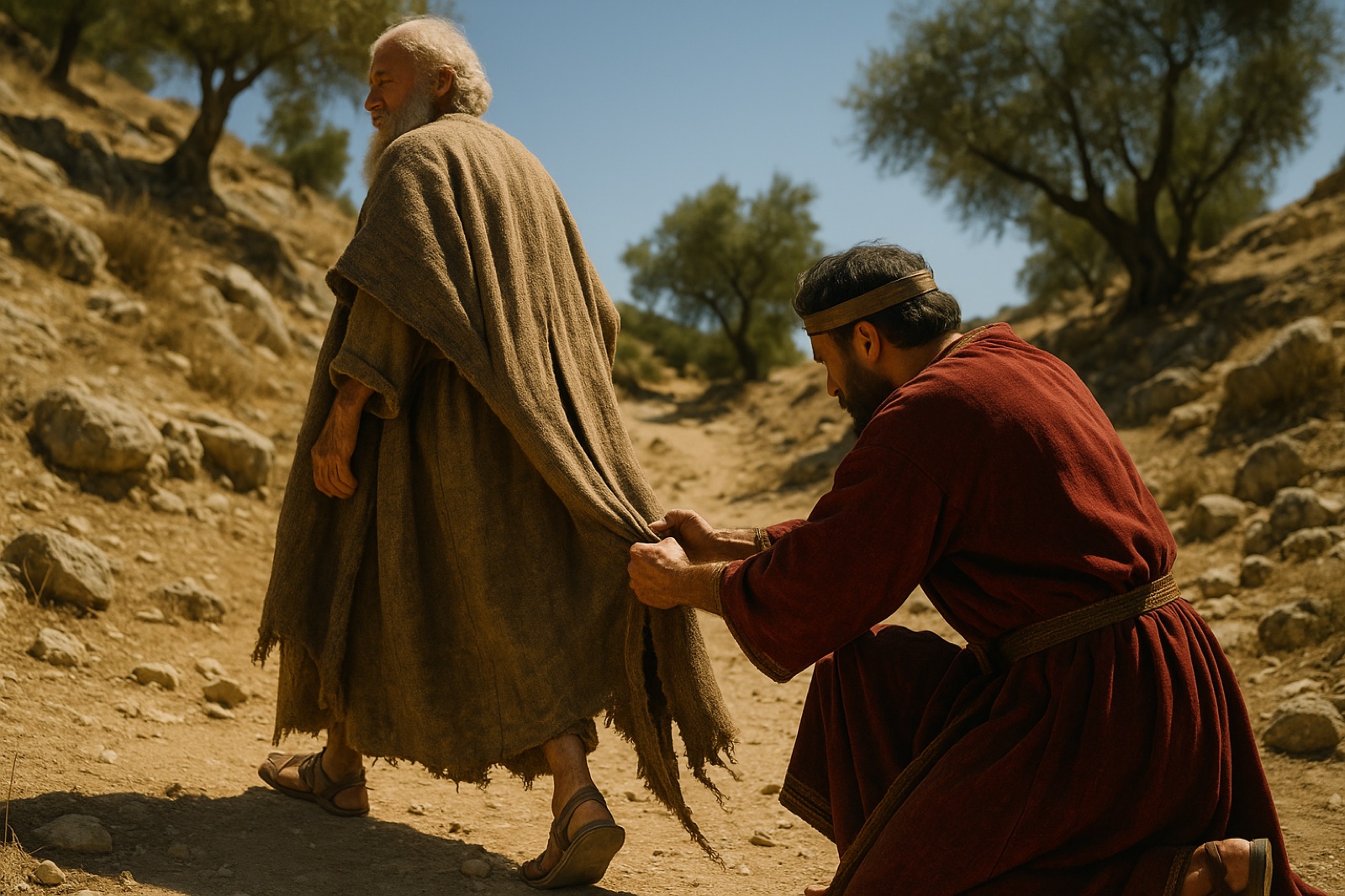
“And as Samuel turned about to go away, he laid hold upon the skirt of his mantle, and it rent.” — 1 Samuel 15:27
Saul grabbed the old prophet’s cloak to stop him leaving, and it tore in his hands. Samuel turns that torn cloth into a sentence: “The LORD hath rent the kingdom of Israel from thee this day” (15:28). And then — right then, with a ripped hem hanging between them — Samuel says verse 29. God is not a man, that God should repent.
Read that way, verse 29 is not a lecture on God’s nature dropped into the middle of a story. It is an answer to a grip. Saul was trying to hold on hard enough to make the verdict go away. And the answer is: God cannot be pulled by the hem.
Then listen to Saul’s second confession:
“Then he said, I have sinned: yet honour me now, I pray thee, before the elders of my people, and before Israel, and turn again with me, that I may worship the LORD thy God.” — 1 Samuel 15:30
I have sinned — yet honour me now. Saul’s real request is not “make me right with God.” It is “don’t let this look bad in front of the elders.” Notice too how he says it: “the LORD thy God.” Not mine. Yours.
And one more thing sits hidden in plain English. Verse 11 says Saul “is turned back from following me.” In verses 25 and 30, Saul keeps asking Samuel to “turn again with me.” Saul wanted everybody else to turn. The prophet. The verdict. God. The one person in the chapter who never turns is Saul.
Nineveh Said Less and Got More
Now put Saul next to a city that had every reason to expect nothing.
Jonah walked into Nineveh and announced one line: “Yet forty days, and Nineveh shall be overthrown” (Jonah 3:4). No “unless.” No offer. No way out. The people did not even know if turning would help. Their king said it plainly: “Who can tell if God will turn and repent, and turn away from his fierce anger, that we perish not?” (Jonah 3:9).
They turned anyway. No bargain. No guarantee. And:
“And God saw their works, that they turned from their evil way; and God repented of the evil, that he had said that he would do unto them; and he did it not.” — Jonah 3:10
Saul confessed with words and held on to the hem. Nineveh let go of the hem and turned. One asked for the outcome to change. The other changed direction and left the outcome with God.
(If you have read our piece on second chances in Jonah 3:1, this is the other half of that same chapter: Jonah got a second word, and so did Nineveh.)
The Part That Never Changes Is Why the Rest Can
Here is the strangest line in the whole book of Jonah. Jonah is furious that Nineveh was spared, and he tells God why he ran away in the first place:
“…for I knew that thou art a gracious God, and merciful, slow to anger, and of great kindness, and repentest thee of the evil.” — Jonah 4:2
Jonah knew. He knew before he ever got on the boat. Mercy was not a surprise twist. It was who God had said God was, all the way back in Exodus 34:6: “The LORD, The LORD God, merciful and gracious, longsuffering, and abundant in goodness and truth.” Jonah was quoting it.
And God says the rule out loud through Jeremiah, so nobody has to guess:
“At what instant I shall speak concerning a nation, and concerning a kingdom, to pluck up, and to pull down, and to destroy it; If that nation, against whom I have pronounced, turn from their evil, I will repent of the evil that I thought to do unto them.” — Jeremiah 18:7-8
So here is the whole picture, and it is not a contradiction at all:
- What never changes: who God is. Merciful. Just. Not fooled. Not moved by a grip on the hem or by how things look in front of the elders.
- What really does change: how God responds to a person who actually turns. Because God is always merciful, a real turn always meets mercy.
God does not change. That is exactly why your turning matters. If God were moody, you could never know whether turning would be welcomed. Because God is steady, you can.
What This Means When You Pray
Go back to the first verse of the chapter. When God told Samuel about Saul, “it grieved Samuel; and he cried unto the LORD all night.” (Many modern translations render that first phrase as “Samuel was angry.”) An old man, upset and heartbroken, praying until morning.
The verdict on Saul did not change. But look at how the next chapter opens:
“And the LORD said unto Samuel, How long wilt thou mourn for Saul, seeing I have rejected him from reigning over Israel? fill thine horn with oil, and go, I will send thee to Jesse the Bethlehemite: for I have provided me a king among his sons.” — 1 Samuel 16:1
I have provided. The chapter that ends with God grieving is followed by a chapter that starts with God providing. Samuel’s all-night prayer did not get him the answer he wanted. It got him the next step. And that next step was David.
So when you pray, you are not hanging on to a robe, trying to hold God in place until the answer changes. That was Saul’s kind of prayer, and it tore. You are talking to the God Jonah described — gracious, merciful, slow to anger — who sees what is actually happening in you, and responds.
Sometimes the answer is what Nineveh got: the thing you feared does not come. Sometimes it is what Samuel got: the thing you hoped for does not come, and God hands you oil and a road to Bethlehem instead. Either way, you were heard. Your turning was seen. It mattered.
If you want to keep turning this passage over, you can bring your own follow-up questions to our free Bible Answers AI assistant (it opens in ChatGPT).
Actions to Take Today
- Read the tear. Open 1 Samuel 15 and read just verses 24 to 30 — it takes about two minutes. Put your finger on the word “yet” in verse 30. Notice how much of Saul’s heart hides in that one word.
- Find your “yet.” Think of one thing you have been praying about. Write your prayer about it in one sentence. Then honestly finish this line underneath: “…yet what I really want is ___.” If the answer is about how it looks, or about keeping control, you have found your hem.
- Make one Nineveh move. Choose one small, real change of direction connected to that prayer — a message you need to send, a habit you need to drop, a person you need to stop avoiding. Do it today, without knowing what God will do with it. “Who can tell” is enough.
Journal Prompts
- Where in your life are you asking God to turn, when you have not turned yourself?
- Saul said “the LORD thy God.” When you pray, does God feel like your God, or like someone else’s God you are trying to get past?
- Samuel prayed all night and still got a “no.” What would it look like to accept a “no” and still ask God for the next step?
A Prayer
God, I have been holding on to the hem. I have been asking You to change things while I stay exactly where I am. I don’t want to be Saul, sorry mostly about how it looks. Help me turn for real, even without knowing what happens next — I trust that You are gracious and merciful, and that has never changed. And if the answer is still no, show me where the oil and the road are. Amen.
Let’s Talk About It
Saul confessed twice and nothing changed. Nineveh’s king only managed “Who can tell” — and the city turned, and everything did. Do you think we sometimes treat saying sorry as a substitute for actually turning? Tell us what you think in the comments below.
A steady God is good news only if that God is actually near. If you want help noticing that nearness in real life — at the sink, on the bus, in the middle of a hard week — The Beginner’s Guide to Feeling God’s Presence Every Day is free.
Share This
Saul said “I have sinned” twice in 1 Samuel 15 and nothing changed. Nineveh just turned, and everything did. I’ve been asking God to change things while holding on to the hem. Time to let go.
God can’t be pulled by the hem. But a heart that actually turns has always been met with mercy. That part never changes. https://bgodinspired.com/index.php/bible-resources/bible-answers/does-god-change-1-samuel-15/
Questions People Ask About Whether God Changes
Does God change?
The Bible says God’s character does not change: “For I am the LORD, I change not” (Malachi 3:6). But the Bible also says God responds to people. Jeremiah 18:7-8 states that when God announces judgment on a nation and that nation turns from its evil, God “will repent of the evil.” God’s nature stays the same; God’s response to a person who genuinely turns is part of that unchanging nature.
Why does 1 Samuel 15 say God repented and also that God does not repent?
First Samuel 15:11 and 15:35 say the LORD “repented” of making Saul king, while 15:29 says God “is not a man, that he should repent.” All three use the Hebrew verb nacham, meaning to be deeply moved or grieved. Verses 11 and 35 say God was genuinely grieved. Verse 29, spoken right after Saul grabbed Samuel’s cloak and tore it, says God cannot be pressured into reversing a just verdict the way a human can.
Why did God relent for Nineveh but not for King Saul?
King Saul confessed “I have sinned” twice in 1 Samuel 15, but followed his second confession with “yet honour me now… before the elders of my people,” showing his concern was his public image. The people of Nineveh, in Jonah 3, turned from their evil ways with no promise that it would help. Jonah 3:10 says God saw “that they turned from their evil way” and did not bring the disaster. The difference was a real change of direction.
Can prayer change God’s plans?
The Bible shows God responding to people, as in Exodus 32:14, where “the LORD repented of the evil which he thought to do unto his people” after Moses prayed. It also shows prayers that did not change the outcome, like Samuel praying all night over King Saul in 1 Samuel 15:11. Prayer is not a way to pressure God. It is a real conversation with a merciful God who hears and responds, sometimes by changing the situation and sometimes by giving the next step instead.