 0
0
 0
0
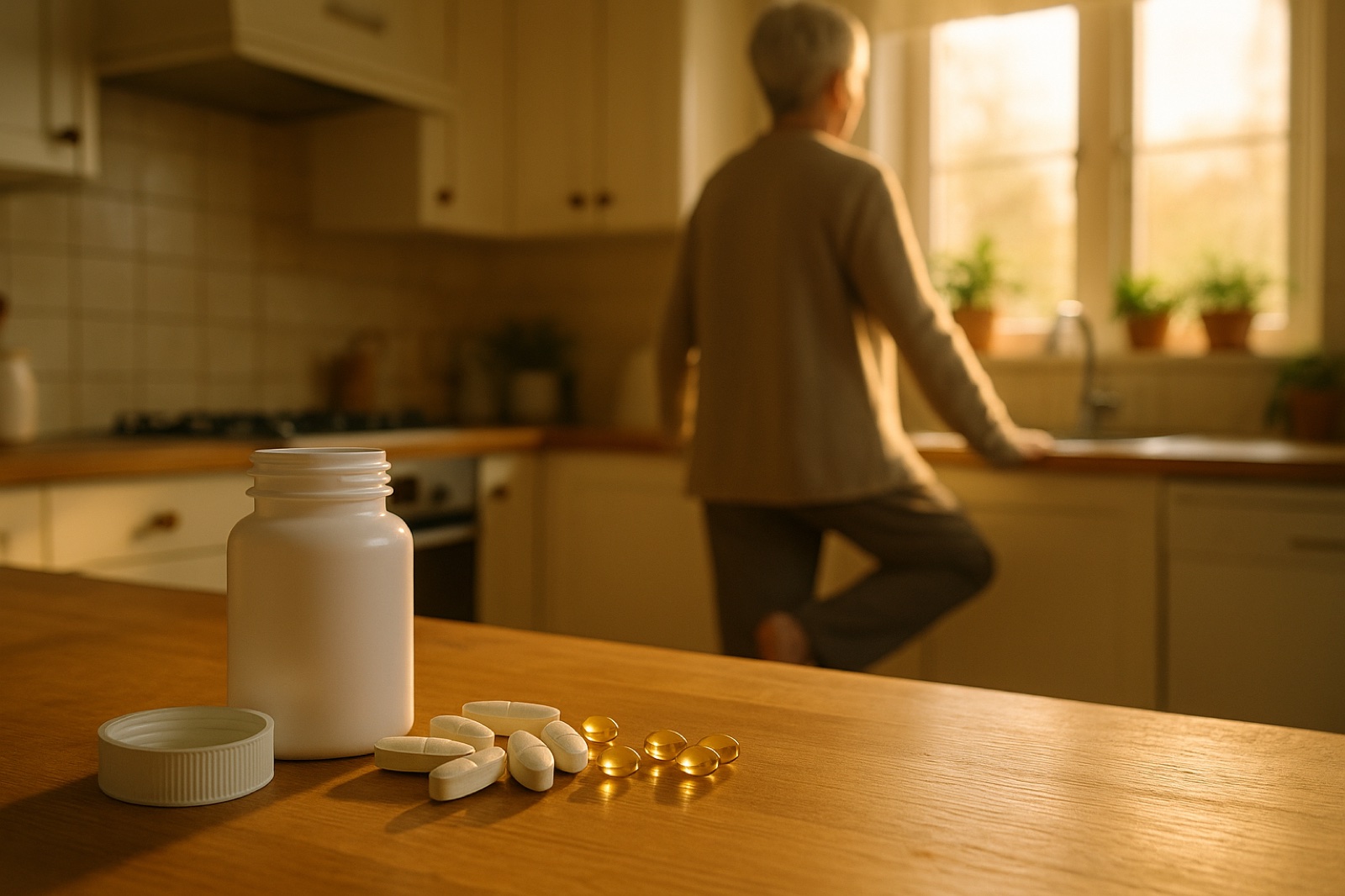
Maybe there is a bottle of calcium and vitamin D on your kitchen counter right now. Maybe it is on your mother’s counter. You take one every morning, or you remind someone you love to take one, because that is what you do to keep old bones from breaking.
Here is the hard news. A huge review of the research says those pills do very little to stop falls or fractures in most older people.
Here is the good news. The things that do help are mostly free. And the biggest danger in a fall may not be the bone at all.
What the Calcium and Vitamin D Review Actually Found
In May 2026, a research team in Canada published a review in The BMJ. They gathered 69 randomised trials, covering 153,902 adults, and asked one simple question: do calcium and vitamin D pills prevent falls and broken bones?
They looked at three groups of trials:
- Vitamin D alone: little to no effect on fractures or falls. The researchers rated this evidence as high certainty.
- Calcium alone: little to no effect on fractures.
- Calcium and vitamin D together: little to no effect on fractures, falls, or hip fractures in particular.
Their conclusion was plain: the findings “do not support routine supplementation with calcium, vitamin D or combined supplementation to prevent fractures or falls.”
The small print most headlines skipped
The combined pill did show a slight drop in fractures. On paper, the hip fracture number even looks like a real win. So why did the researchers still say “little to no benefit”?
Because before they looked at the results, they decided how big a change would actually matter to a real person. That is a smart habit. A drop can look big as a percentage and still be tiny in actual people, when the thing you are trying to prevent is already rare. The combined pills did not clear the bar the team set in advance.
There are two more caveats worth keeping. The researchers said their results may not apply to people with specific bone disorders, or to people taking osteoporosis medicine. And some of the smaller analyses rested on only a few trials.
So please do not stop anything your doctor prescribed because of an article. If you take these pills, bring this study to your next appointment and ask whether they still make sense for you. That conversation is the right next step.
What Does Prevent Falls? Balance and Strength
If the pill is not the answer, what is? The editorial that ran with the review pointed somewhere much more ordinary: balance and resistance exercise, plus programmes that combine exercise with checking the home for hazards, tailored to each person’s risk.
This is not a guess. A large 2019 Cochrane review of exercise for older people living at home found that exercise reduced the rate of falls by about 23 percent, with high-certainty evidence. The exercises that worked best trained balance, walking and muscle strength.
We have seen the same pattern on this site before. When 139 trials ranked non-drug treatments for sore knees, exercise landed near the top of the list for knee arthritis pain. The body keeps answering the same way: use it, gently, often.
Simple balance moves you can do at the kitchen counter
You do not need a gym, money, or special clothes. A sturdy counter or the back of a heavy chair is enough. Always keep one hand on it.
- Sit to stand. Stand up from a firm chair without using your hands, if you can. Sit back down slowly. Repeat a few times.
- Heel raises. Holding the counter, rise up onto your toes, then lower slowly.
- One-leg stand. Holding the counter, lift one foot a little off the floor. Hold for a slow count, then switch.
- Heel-to-toe walk. Walk along the counter, putting one heel right in front of the other toes, like walking a line.
Start small. A few minutes a day, done every day, beats a big effort once a month. If you have a health condition, a heart problem or dizziness, check with a health worker first.
Check the home for trip hazards
The other half of what the editorial recommended costs nothing either. Walk through the home slowly and look for loose rugs, cords across walkways, clutter on the stairs and dark hallways. Put a light by the bed. Keep the things you use every day where you can reach them without climbing.
The Hidden Danger: Falling Alone
This is the part almost nobody talks about.
Most talk about falls is about the moment of the fall. But for many older people, the real harm comes after. It comes from lying on the floor, unable to get up, with no one there.
A study in the BMJ followed 110 people over the age of 90 in Cambridge, England, for a year. The researchers, Jane Fleming and Carol Brayne, found that 82 percent of falls happened when the person was alone. Of those who fell, 80 percent could not get up after at least one of their falls. And 30 percent had lain on the floor for an hour or more.
Doctors call this a “long lie.” Hours on the floor can lead to dehydration, getting dangerously cold, pressure sores and muscle damage. In that study, a long lie was strongly linked to serious injury, going into hospital, and moving into long-term care.
Then came the most surprising finding. Many of these people had a call alarm, a button to press for help. In 80 percent of the falls where the person was alone, they did not use it. The authors concluded that people need to be taught how to get up from the floor, and that alarms need to be easier to use.
Read that again. The pill everyone takes barely helps. The alarm button many people wear often goes unpressed. What actually protects people is ordinary: stronger legs, a clear floor, a plan for getting up, and someone who will notice if you don’t.
How to get up after a fall (and what to do if you can’t)
Physiotherapists teach a simple method. It is worth practising slowly, with someone nearby, before you ever need it.
- Stay still first. Take a few breaths. Check whether you are hurt. If you are in real pain or cannot move a limb, do not try to get up. Call for help.
- Roll onto your side, then push up onto your hands and knees.
- Crawl to a sturdy chair or low piece of furniture.
- Put both hands on the seat. Bring one foot forward so it is flat on the floor.
- Push up slowly with your arms and your front leg, then turn and sit down on the chair. Rest before you do anything else.
If you cannot get up, call out or bang on the floor or wall. Pull anything nearby over you to stay warm, like a blanket, a coat or a towel. Keep moving your arms and legs gently to help your blood flow. Shuffle toward a phone if you can.
The daily check-in
This part needs no equipment at all. If you live alone, agree with one person, a neighbour, a friend or a family member, that you will message or call each other at the same time every day. If one of you does not check in, the other one calls. If no answer, they come round or send someone.
It sounds almost too simple. But that one habit can turn a fall from a long lie into a short one. If you are the person looking after someone older, our piece on caring for aging parents goes deeper into what that care can look like.
Why This Matters More Than Bones
There is a very old piece of wisdom, thousands of years old, that says two people are better than one, because when one falls the other can lift them up. It then feels sorry for the person who falls with nobody there to help.
For a long time that sounded like poetry. Now there is a study that puts numbers on it.
Maybe that is why we were never really built to go it alone. People of faith have noticed for a very long time that God tends to show up through the hands of other people, the neighbour who knocks, the friend who calls, the voice that says “I noticed you didn’t text this morning.”
If this has made you wonder how connected you really are right now, you can take our free, private How Lonely Am I? check. It takes a couple of minutes and gives you an honest place to start.
What to Take Away
- For most healthy older adults, calcium and vitamin D pills do little to prevent falls or broken bones.
- Do not stop anything a doctor prescribed. Ask them about this study instead.
- Balance and strength exercise helps, and it can be done free at a kitchen counter.
- Clear the floor. Light the path to the bathroom at night.
- Learn and practise how to get up from the floor.
- Set up one daily check-in with one person.
The bottle on the counter was never going to catch anyone. But a steadier pair of legs might. And so might a friend who calls at nine o’clock every morning, just to hear you say you’re fine.
Discussion Question
Which do you think matters more for staying safe as we get older: stronger legs, or someone who checks on you every day? Tell us what you think in the comments.
Share This
- A review of 69 trials and 153,902 adults found calcium and vitamin D pills do little to prevent falls or fractures. What helps instead is free. https://bgodinspired.com/index.php/health-and-wellness/calcium-vitamin-d-falls/
- In one study of people over 90, most falls happened when they were alone, and many could not get up. The call alarm often went unpressed. I’m setting up a daily check-in with my mum this week. https://bgodinspired.com/index.php/health-and-wellness/calcium-vitamin-d-falls/
- My grandmother takes her vitamin D every morning like clockwork. Turns out a few minutes of balance practice at the kitchen counter might do more. Worth a read if you love someone older. https://bgodinspired.com/index.php/health-and-wellness/calcium-vitamin-d-falls/
Q&A: Calcium, Vitamin D and Falls
Do calcium and vitamin D supplements prevent falls in older adults?
For most older adults, no. A systematic review published in The BMJ in May 2026, covering 69 randomised trials and 153,902 adults, found that vitamin D alone, calcium alone, and calcium and vitamin D combined had little to no meaningful effect on falls or fractures. The findings may not apply to people with specific bone disorders or people taking osteoporosis medication.
Should I stop taking my vitamin D because of this study?
Do not stop a supplement or medicine a doctor prescribed without talking to them first. The 2026 BMJ review found little benefit from routine calcium and vitamin D for fall and fracture prevention in most older people, but some people take these for other medical reasons, such as a diagnosed deficiency or a bone condition. The best step is to ask a doctor whether the supplement still makes sense for you.
What actually prevents falls in older people?
Exercise that trains balance, walking and muscle strength has the strongest evidence. A 2019 Cochrane review of older people living in the community found exercise reduced the rate of falls by about 23 percent, with high-certainty evidence. Removing trip hazards at home, such as loose rugs and cords, and programmes that combine exercise with a home hazard check are also recommended.
What is a long lie after a fall?
A long lie is when an older person falls and cannot get up for a long time, often defined as an hour or more. It can cause dehydration, dangerous cooling of the body, pressure sores and muscle damage. In a BMJ study of 110 people aged over 90 in Cambridge, England, 82 percent of falls happened when the person was alone and 30 percent of those who fell had lain on the floor for an hour or more.
How do you get up safely after a fall?
First stay still and check for injury, and do not try to get up if you are badly hurt. If you feel able, roll onto your side, get onto your hands and knees, crawl to a sturdy chair, put both hands on the seat, bring one foot forward flat on the floor, push up slowly and turn to sit down. If you cannot get up, call out, keep warm with anything nearby and keep moving your arms and legs gently while you wait for help.