 0
0
 0
0
Sometime in the spring of 2024, a rock about the size of a small apartment building slammed into the Moon.
Nobody saw it happen. Not one telescope on Earth. Not one telescope in space. The flash came and went, and the whole planet carried on with its week.
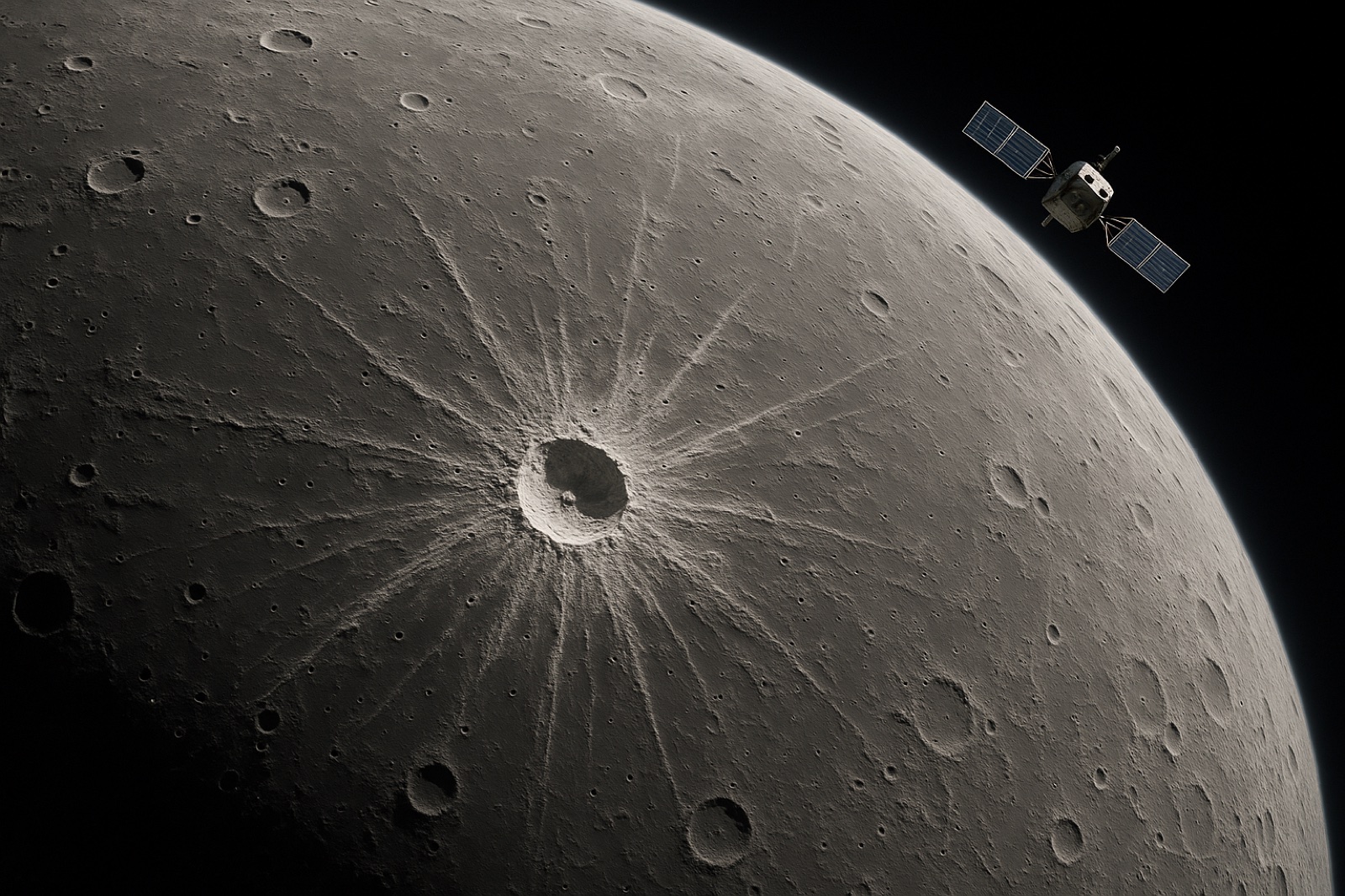
But the Moon did not carry on. It kept the mark. And this week, NASA announced that this new crater on the Moon is the biggest fresh crater its lunar orbiter has ever found.
The New Crater on the Moon, in Plain Numbers
The crater has a name now: McGetchin, after Thomas McGetchin, a lunar scientist who once led the Lunar and Planetary Institute in Houston.
Here is what it looks like, according to NASA’s announcement:
- About 222 metres across (728 feet). That is roughly the length of two football pitches.
- About 43 metres deep (141 feet). That is roughly as deep as a 14-storey building is tall.
- Made by a rock the size of a three- to six-storey building, likely a piece of an asteroid or comet.
- Formed between 11 April and 22 May 2024. Scientists narrowed the date by comparing photos taken before and after.
- About three times bigger than the previous record-holder the orbiter found, around a decade ago.
NASA’s scientists estimate that a strike this size hits the Moon only about once in a century, or even less often. The results were published on 15 September 2026 in two papers in the journal Science Advances.
So the headline is fresh. The crater is not. It is more than two years old. And that gap is the most interesting part of the whole story.
Nobody Saw It Hit. So How Did We Find It?
NASA’s Lunar Reconnaissance Orbiter has been circling the Moon since 2009, taking pictures of the ground below again and again.
Here is the surprise. The orbiter’s wide-angle camera actually photographed the new crater in May 2024, soon after it formed. The record was there almost right away.
It just sat in the pile. The spacecraft sends back so much data that those pictures went unnoticed for more than a year.
Then, in 2025, an image specialist named Robert Wagner was doing routine quality checks. He was running software that compares old and new photos of the same spot and flags anything that changed. One spot lit up.
“I just stopped, dropped everything, and started looking into what that spot was,” he told NASA. He later called it “by far the most obvious impact debris pattern I’ve ever seen in one of these images.”
Think about that for a second. The impact was not missed because nobody recorded it. It was missed because nobody had looked yet.
What the Moon Remembered That We Didn’t
Once the team knew where to look, the Moon had a lot to tell them.
The strike threw rock and dust across more than 100 kilometres of the surface (about 66 miles), NBC News reported. That spray left a bright splash that shows up even in wide, zoomed-out images of the Moon.
A heat-sensing instrument on the same orbiter found something stranger. Around the crater there is a “cold spot” about 6.5 kilometres wide (4 miles). At night it sits roughly 9°C cooler (16°F) than the ground around it. It is a sign the impact disturbed the ground far beyond the rim of the crater itself.
This is why the Moon is such a good record-keeper. There is no wind there. No rain. No rivers. No plants growing over the scar. A mark on Earth would soften in a few seasons. A mark on the Moon just waits.
That is also why scientists care so much. Fresh craters help them work out how often space rocks hit the Moon, which helps them date older surfaces across the solar system. And with plans for people to live and work on the Moon, they need to know how far flying debris can travel. You would not want to build a base inside the splash zone.
If you want a sense of how old the surfaces those scientists are dating really are, our free How Old Is the Universe? Explorer walks you through it one step at a time.
Even the Moon Forgets, Eventually
Here is the twist that most of the headlines skip.
The Moon keeps records for a very long time. But not forever. Tiny space rocks rain down all the time, slowly stirring the top layer of dust. Lunar scientist Mark Robinson told NBC News that the astronauts’ footprints from the Apollo landings will “definitely be long gone” within about 80,000 years.
So the Moon is patient. It is not perfect. Even its memory wears away in the end.
This is not the first time an answer was hiding in old space data. Astronomers recently found a stellar stream tracing dark matter that had been sitting in old Hubble pictures all along. It turns out a lot of discovery is not seeing something new. It is finally noticing what was already recorded.
The Hit Nobody Noticed
Most of us know what it feels like to take a hit that nobody saw.
A diagnosis you haven’t told anyone about. A marriage that ended quietly. A job loss you covered up with “Oh, I’m just between things.” A grief that everyone else seemed to move past a year ago. The flash came and went, and the world carried on with its week.
But you kept the mark. You know exactly where it is.
There is a line in an ancient Hebrew song, more than two thousand years old, that calls the moon “a faithful witness in heaven.” The people who wrote it had no orbiter. They just looked up at night and saw something steady that kept watching.
What they were really pointing at was God. A witness who does not need to sift through a year of data to find the spot. Who did not miss the moment because the telescopes were aimed somewhere else. Who does not forget after 80,000 years. The thing that happened to you that nobody noticed was noticed.
That doesn’t undo the crater. But there’s a real difference between a wound nobody saw and a wound somebody saw and stayed with.
Why This New Crater Is Worth a Moment of Your Day
McGetchin crater will sit there, quietly, for thousands of years. Future astronauts may stand on its rim. Scientists will keep learning from it long after this week’s headlines are gone.
And if you ever wonder whether life could survive in a place that harsh, NASA has looked at that too: can microbes survive on the Moon? The answer is more surprising than you’d guess.
Tonight, if the sky is clear where you are, take one look up. Somewhere on that bright face is a brand-new scar that nobody saw being made. It is still there. It was kept.
Discussion Question
The most surprising part of this story is not the crater itself, but that the photos sat unnoticed for more than a year. Do you think the next big discoveries will come from new missions, or from finally looking properly at data we already have? Tell us what you think in the comments.
Share This
Post 1: A rock the size of a building hit the Moon in 2024 and not one telescope saw it. The orbiter photographed the crater soon after, and nobody noticed for over a year. Kind of beautiful, honestly. bgodinspired.com
Post 2: The new crater on the Moon is 222 metres wide and “once in a century.” But the part that got me: the Moon just kept the mark and waited for someone to look. Some of us needed to hear that this week. bgodinspired.com
Post 3: No wind, no rain, nothing grows on the Moon, so a hit from 2024 still looks brand new. Read how NASA finally found the biggest fresh crater it has ever seen: bgodinspired.com
Questions People Ask About the New Crater on the Moon
Is there a new crater on the Moon?
Yes. In September 2026, NASA announced McGetchin crater, a new crater on the Moon about 222 metres (728 feet) wide and about 43 metres (141 feet) deep. It formed between 11 April and 22 May 2024 and is the largest newly formed crater NASA’s Lunar Reconnaissance Orbiter has ever identified, about three times bigger than the previous record.
Why did no telescope see the 2024 Moon impact?
The impact that made McGetchin crater escaped real-time detection by telescopes on Earth and in space. NASA’s Lunar Reconnaissance Orbiter photographed the fresh crater in May 2024, but the images were not recognised among the huge volume of mission data until 2025, when an image specialist running change-detection software noticed the new bright spot.
How often does an impact this big hit the Moon?
NASA scientists estimate that an impact large enough to make a crater the size of McGetchin, about 222 metres across, happens on the Moon roughly once in a century or even less often. That rarity is why the 2024 strike is described as a once-in-a-century event.
Why do craters last so long on the Moon?
Craters last a long time on the Moon because it has no air, wind, rain, rivers or plants to wear them down. The main thing that slowly erases lunar marks is a constant rain of tiny space rocks that stirs the dusty surface. Even so, marks like the Apollo astronaut footprints are expected to vanish within roughly 80,000 years.
Why does a new crater on the Moon matter for future Moon bases?
Fresh craters show scientists how often space rocks strike the Moon and how far the debris flies. The 2024 impact that formed McGetchin crater sprayed material across more than 100 kilometres (about 66 miles), which helps planners judge the risk that flying debris could pose to crews and equipment at a future lunar base.