 0
0
 0
0
Think about the last time someone changed something you loved. The app update that moved every button. The new recipe for the soup your family has made the same way for years. The song at church that replaced the one you knew by heart. Your first reaction probably wasn’t “how exciting.” It was closer to “the old one was fine.”
Jesus knew that feeling. And the new wine into old wineskins meaning is not what most of us were taught. Most people read the saying as a rebuke aimed at stiff, rigid religious people. But in Luke’s Gospel, Jesus adds one more sentence that Matthew and Mark leave out. It is a sentence about why nobody wants the new thing straight away. It is honest. It is almost kind. And once you see it, the whole saying changes.
What Is the New Wine Into Old Wineskins Meaning?
Here is the short answer. Jesus was asked why His followers were feasting instead of fasting. He answered with three small pictures: a patch on a garment, new wine in old skins, and a person who has already been drinking old wine. Together they say this: what Jesus brings is truly new, it won’t fit neatly inside the old habits, and people will naturally resist it at first. Not because they are wicked, but because the old is familiar and it tastes good.
If you have been searching the King James Version and can’t find the word “wineskins,” that’s because it isn’t there. The KJV says “bottles.” In Jesus’s world, a “bottle” for wine was a skin, usually from a goat, sewn shut into a bag.
The Question That Started It: Why Don’t Your Disciples Fast?
The saying appears in three Gospels: Matthew 9:14-17, Mark 2:18-22 and Luke 5:33-39. In all three, it is an answer to a complaint. In Luke it comes right after Jesus called a tax collector named Levi, and Levi threw a big dinner for Him with a crowd of other tax collectors. The religious leaders grumbled about who Jesus was eating with. Then came the question:
“Why do the disciples of John fast often, and make prayers, and likewise the disciples of the Pharisees; but thine eat and drink?” (Luke 5:33, KJV)
Fasting was a serious, good practice. John the Baptist’s own followers did it. So this wasn’t a silly question. It was a fair one from people who took God seriously.
Jesus answered with a wedding. You don’t fast at a wedding while the bridegroom is still in the room. “But the days will come, when the bridegroom shall be taken away from them, and then shall they fast in those days” (Luke 5:35). Notice that Jesus doesn’t cancel fasting. There will be a time for it. It just isn’t now. Something new is happening, and it calls for a feast.
Why Old Wineskins Burst
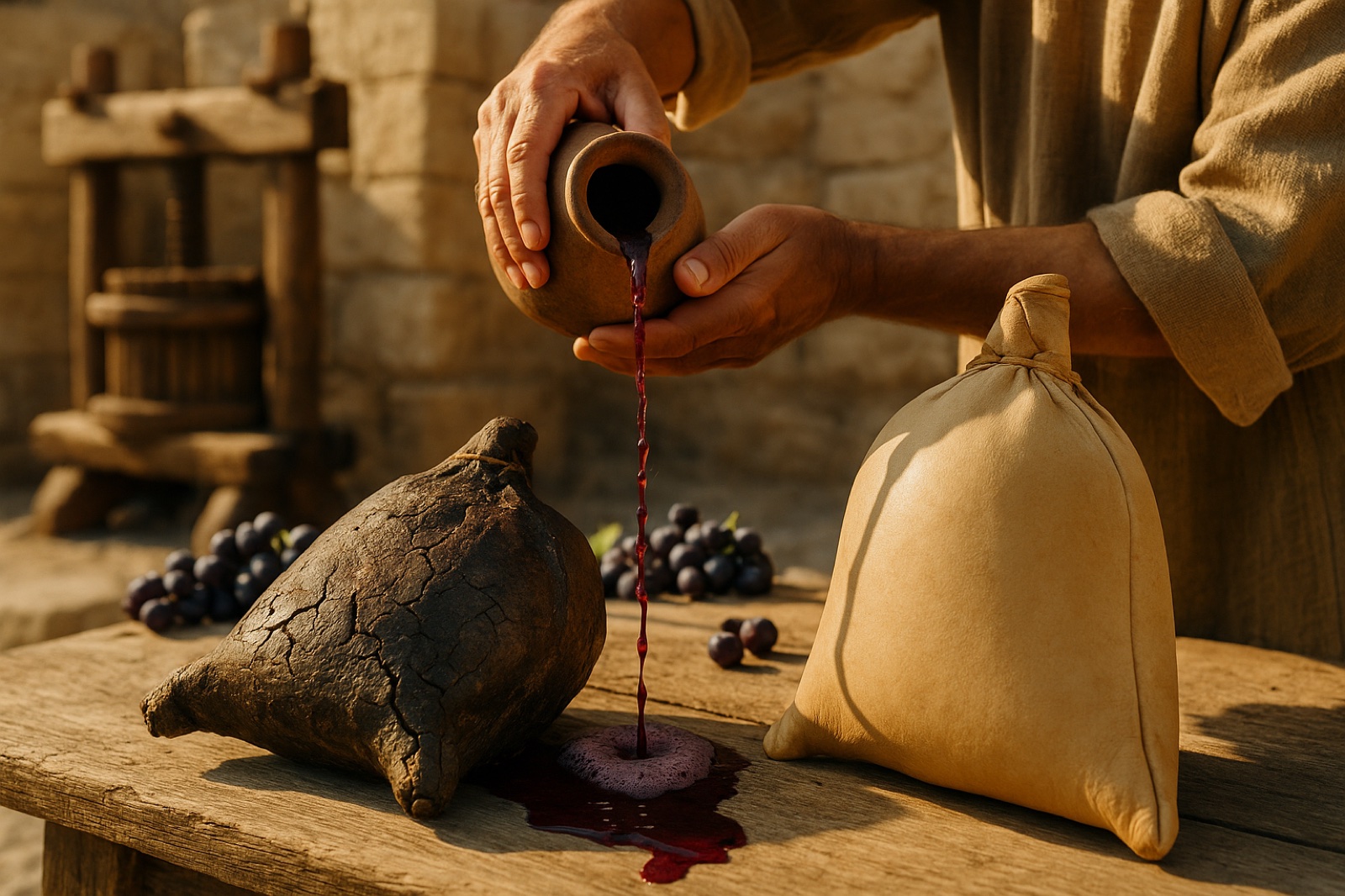
New wine in those days was still alive. It was still fermenting, still making gas, still growing. A brand-new skin is soft and stretchy, so it can give as the wine works. An old skin has already stretched as far as it will go. Over time it dries out and stiffens. Pour fresh wine into it, and there is nowhere for that pressure to go. The seams split.
“And no man putteth new wine into old bottles; else the new wine will burst the bottles, and be spilled, and the bottles shall perish. But new wine must be put into new bottles; and both are preserved.” (Luke 5:37-38, KJV)
Read that last phrase again: “and both are preserved.” Matthew has it too (Matthew 9:17). The goal is not to throw out the old skins. The goal is that nothing gets ruined, not the wine and not the skins. That is a very different spirit from “out with the old.”
Luke’s Patch Is Stranger Than You Remember
Before the wine, there is a patch. In Matthew and Mark, the picture is simple: sew a piece of new, unshrunk cloth onto an old coat, and when it shrinks, it tears the hole wider.
Luke tells it differently, and it’s easy to read right past. In Luke, someone cuts the patch out of a brand-new garment to fix an old one:
“No man putteth a piece of a new garment upon an old; if otherwise, then both the new maketh a rent, and the piece that was taken out of the new agreeth not with the old.” (Luke 5:36, KJV)
That’s a double loss. You ruin a new coat, and the patch doesn’t even match the old one. Jesus is saying you can’t just snip a little of what He brings and stitch it onto the life you already had. Tearing a piece off the new doesn’t save the old. It spoils both.
Jesus often taught this way, with ordinary pictures from the kitchen and the field. If you’ve ever wondered why, we looked at that in why Jesus spoke in parables.
The Line Only Luke Kept: “The Old Is Better”
Matthew and Mark stop at the new bottles. Luke keeps going, with one more sentence:
“No man also having drunk old wine straightway desireth new: for he saith, The old is better.” (Luke 5:39, KJV)
This is the part people skip, because it seems to argue against the point Jesus just made. If the new is so important, why admit that people prefer the old?
Because it’s true. Anyone who has had a well-aged wine knows it is smoother than something just pressed. Jesus isn’t mocking that person. He is describing them, accurately. Old wine really is good.
Here are three details that make this verse even more interesting.
1. Look at the word “straightway.” It means “immediately.” Jesus doesn’t say that no one who drinks old wine will ever want new. He says they won’t want it straight away. The first reaction is resistance. That’s normal. It isn’t the final answer.
2. The oldest copies may say “good,” not “better.” The KJV follows Greek manuscripts that read “better.” Many of the earliest manuscripts have the simpler word “good.” That’s why several modern translations read “The old is good.” And as Vine’s Expository Dictionary points out, “good” fits the picture: the man isn’t comparing the two, because he hasn’t tasted the new one. He is content, and so he doesn’t try.
3. Some ancient copies leave the verse out. A few early manuscripts, including a well-known one called Codex Bezae from around AD 400, don’t include Luke 5:39 at all. We can’t say for sure why. But it’s a hint that even early readers weren’t sure what to do with a Jesus who spoke so gently about the people resisting Him.
Jesus Understood Why People Resist Him
Put it all back together and look at who was in the room. On one side, Levi and his tax-collector friends, people with nothing to lose, feasting with Jesus. On the other, serious, devout people who had spent years fasting and praying the way their teachers taught them. For them, the old ways had been good. Truly good.
And Jesus doesn’t sneer at them. He names what’s happening. You’ve been drinking the old wine a long time. Of course you don’t want the new one straight away.
That changes how this saying lands in real life, and it lands in two directions.
It lands on the people around you. Your parent who won’t try the new way. The friend who is suspicious of your faith. The member of your church who fights every change. The saying is not a stick to beat them with. Jesus understood that comfort makes people slow to taste something new. If Jesus could be patient with that, so can we.
And it lands on you. This is the part that stings, gently. Most of us are the person holding the old cup. You may be following Jesus and still find yourself saying, “The old is good enough.” The old habit. The old way of handling anger. The old picture of God you grew up with. Luke 5:39 doesn’t shame you for that. It just tells the truth about it, so you can stop pretending you don’t feel it.
Because the problem with “the old is good” isn’t that the old is bad. It’s that it keeps you from ever tasting the new.
Is This About Traditional Churches Being Bad?
No. It’s tempting to turn this saying into a weapon: new churches good, old churches bad. But Luke 5:39 is the built-in guard against exactly that. Old wine is good. Old skins, kept for old wine, are fine. “Both are preserved.” And the very practice under question, fasting, Jesus says His followers will pick up again. What Jesus is warning against is trying to force what He brings into a shape that can’t hold it, and then losing both.
(If you’re wondering what the Bible says about wine itself, that’s a bigger question, and we took it on in what the Bible actually says about alcohol.)
Actions to Take
- Name one “old wine” in your life. Right now, write down one thing you keep doing mostly because it’s familiar. A habit, a routine, a way you talk to someone. You don’t have to change it yet. Just name it.
- Take one small sip of something new. Pick one thing you’ve been resisting and try the smallest possible version of it today. Read one chapter of a Gospel you usually skip. Pray standing up, or walking, instead of the way you always do. One sip, not the whole bottle.
- Give someone the patience Jesus gave. Think of one person who is slow to change and frustrates you. Send them a kind message today that has nothing to do with the thing you want them to change.
Journaling Prompts
- When something new comes into your life, what is the very first feeling you notice, before you’ve even decided whether it’s good?
- What “old wine” have you been content with for so long that you’ve never actually tasted the alternative?
- Where might you be trying to cut a patch off something new and stitch it onto an old way of living, instead of letting it be whole?
A Prayer for When the Old Feels Better
God, I’ll be honest, I like the old wine. I like what I know, and new things make me tense before I’ve even tried them. Thank you that Jesus didn’t mock people like me, but understood us. Give me the courage to take one small taste of what you are offering, and patience with the people around me who are just as slow as I am. Make me new enough to hold what you want to pour in. Amen.
“Not wanting something new straight away is not the same as never.”
Discussion Question
Do you think Jesus meant Luke 5:39 as a gentle observation about human nature, or as a warning to people who refuse to change? Tell us which way you read it in the comments.
If this saying is stirring something in you, a quiet sense that it’s time to taste the new, the gentlest way to start is a few days of walking alongside Jesus. Our free 3-day sample of 30 Days Walking with Jesus gives you a short video, audio and PDF for each day, so you can take one small sip at a time.
Want to keep digging into what Jesus said? You can ask follow-up questions with our free What Jesus Teaches AI assistant (it opens in ChatGPT).
Share This
- “No man also having drunk old wine straightway desireth new.” Straightway. Not never. Just not straight away. Luke 5:39 is kinder than I ever realized.
- I always read “new wine in old wineskins” as Jesus scolding stubborn people. Then I noticed Luke adds “The old is better,” and Jesus is actually explaining why we all resist change at first. Patient with them. Patient with me.
- Jesus didn’t say throw out the old skins. He said put new wine in new skins, “and both are preserved.”
Q&A: New Wine and Old Wineskins
What does new wine into old wineskins mean?
In Matthew 9:17, Mark 2:22 and Luke 5:37-38, Jesus says new wine must not be poured into old wineskins, because the still-fermenting wine will burst the old, stiff skins and both will be lost. The saying means that the new life Jesus brings cannot simply be squeezed into old religious habits. It needs a new container, so that both the wine and the skins are preserved.
Why does the King James Bible say “bottles” instead of “wineskins”?
The King James Version translates the Greek word for a wineskin as “bottles.” In the first century, wine was often stored in sewn animal skins, usually goatskin, not glass bottles. Modern translations use “wineskins” to make that clear, but the KJV passages in Matthew 9:17, Mark 2:22 and Luke 5:37-38 describe the same thing.
What does “the old is better” mean in Luke 5:39?
Luke 5:39 says, “No man also having drunk old wine straightway desireth new: for he saith, The old is better.” Only Luke’s Gospel includes this line. Jesus is describing a real human reaction: someone comfortable with the old wine doesn’t immediately want the new, because the old tastes good. Many early Greek manuscripts read “the old is good,” which suggests the person hasn’t even tasted the new wine to compare.
Why did old wineskins burst?
New wine in the ancient world was still fermenting and releasing gas, so its container needed to stretch. A new animal-skin wineskin was soft and flexible. An old wineskin had already stretched and become dry and stiff, so the pressure from fermenting wine could split its seams, spilling the wine and destroying the skin.
Is the new wine and old wineskins parable against traditional churches?
The saying is not a condemnation of tradition. In Luke 5:38 Jesus says new wine goes into new skins “and both are preserved,” and in Luke 5:39 Jesus acknowledges that old wine is good. Jesus also says in Luke 5:35 that His followers will fast later. The warning is against forcing something new into a form that cannot hold it, not against old practices themselves.