 0
0
 0
0
Mugo lies on his back in his hut, looking up at the soot on the roof, and he is nervous. Outside, the village of Thabai is getting ready for Uhuru, the day Kenya becomes free. The whole village has made up its mind. Mugo, the quiet man who suffered in the detention camps and never talked, will stand up on that day and speak.
There is one problem. Mugo is the man who betrayed Kihika, the village’s great freedom fighter, to the British. Nobody knows. Nobody ever would have known.
A Grain of Wheat, the 1967 novel by the Kenyan writer Ngũgĩ wa Thiong’o, is usually taught as a book about betrayal. That is true, but it is not the deepest part of it. The real meaning of A Grain of Wheat sits somewhere harder: what it does to a person to be praised for the very thing he is most ashamed of, and why Mugo finally says it out loud when nobody is making him.
This piece discusses the whole novel, including the ending.
A hero built out of silence
Mugo never wanted to be anyone’s hero. His parents died when he was small. He was raised by an aunt who drank and made him feel worthless. He grew into a man who wanted one thing: to farm his land and be left alone.
But during the Emergency, two things happened that the village never forgot. In the trench the villagers were forced to dig, a homeguard was beating a pregnant woman named Wambuku. Everyone else looked away. Mugo reached out and stopped the blow. He was arrested and sent to the camps. At Rira, the colonial officer John Thompson had him beaten, and Mugo said nothing. He led a hunger strike.
Out of those moments, Thabai builds a legend. And here is the thing worth noticing. Look at what the legend is made of. It is made of Mugo’s silence. His silence under torture. His silence about the camps. His silence now.
Even when Mugo tries to tell the truth, it turns into more legend. At one gathering he says, more or less, that he survived for his own reasons, not for the cause. People hear a humble man. When he tells the elders his mind is not well and he cannot lead the celebration, his refusal only makes him greater in their eyes.
This is the quiet horror of the first half of the book. The village has a machine for making heroes, and every honest thing Mugo says gets fed into it. Anyone who has ever been praised for someone they know they are not will recognise the trap. The praise does not lift the weight. It adds to it.
Why Mugo betrayed Kihika
Kihika is everything Mugo is not. He is bold, he talks, he reads the Bible like a revolutionary, and he takes to the forest to fight. After he kills District Officer Robson, he comes to Mugo’s hut. He wants Mugo to organise the fighters’ underground network in the village.
Mugo does not want any of it. Why should this young man drag him into a fight he never started? He is too frightened to say no to Kihika’s face. Then he sees a notice offering a reward for Kihika. He walks to the District Office and asks to see Thompson.
Ngũgĩ gives Mugo a strange excuse, and it is one of the sharpest details in the book. Mugo has long half-believed he was chosen for something great. He has dreamed of detainees crying out for him to save them. As he talks himself into the betrayal, he thinks of Moses: if Moses had died in the reeds, nobody would ever have known he was meant for greatness. Mugo tells himself he is important. He must not die.
So he hands Kihika over to protect his own destiny. Kihika is hanged. Mugo feels sick with regret almost at once.
And then the village gives him exactly the destiny he dreamed of. On Uhuru day, people sing songs about Mugo right alongside Kihika. He got his Moses story. It is the worst thing that ever happened to him.
A Grain of Wheat: everyone confesses to the wrong man
Here is a pattern that is easy to miss on a first read. Because the village thinks Mugo is holy, people bring him their shame.
Gikonyo, the carpenter, comes to him first. In detention, Gikonyo confessed to taking the oath so he could go home early. He came home to find that his wife, Mumbi, had a child by Karanja, the man who served as a homeguard and later a chief for the colonial government. Gikonyo pours this out to Mugo as if Mugo were a priest.
Then Mumbi comes. She is Kihika’s sister. She tells Mugo her side: the huts burned during the Emergency, the hunger, how Karanja helped her, and what happened between them. The novel says her story cracked something open inside him.
Think about what that means. The man the village chose to hear its secrets is the man hiding the worst secret of all. Every confession laid in front of him makes his own silence heavier. He is being trusted as the one clean person in Thabai, and he is the reason Kihika is dead.
When Mumbi comes to plead with him to speak at Uhuru, it finally breaks. He tells her he killed her brother. Mumbi is confused, because Kihika was hanged by the British. Then Mugo’s hands go to her throat, and she has to fight him off. Yet Mumbi does not answer with revenge. Her choice is its own small study in what it costs to be ready to forgive.
“You asked for Judas”
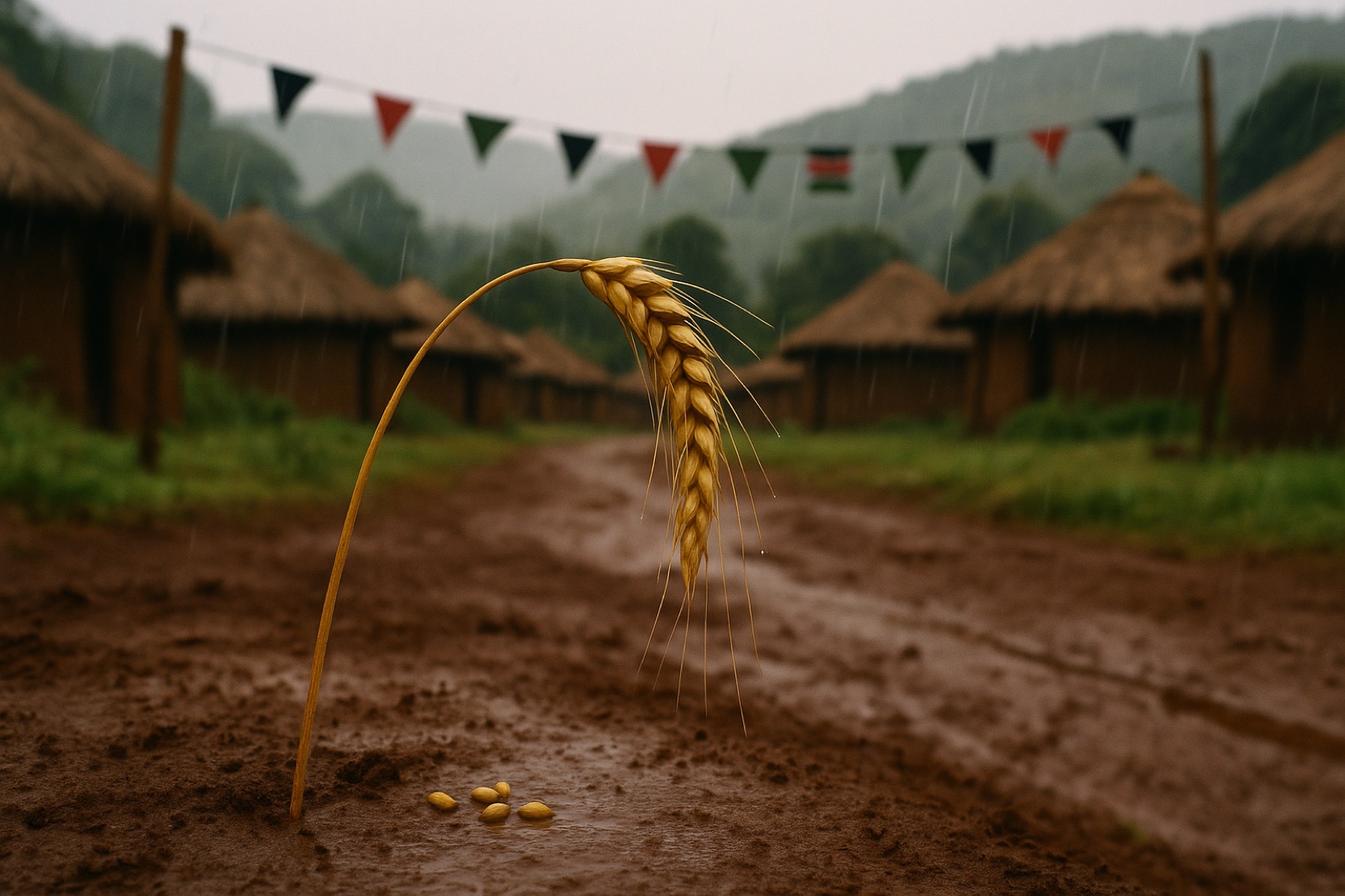
Uhuru day comes in the rain. There is dancing. There is a race, and Gikonyo falls and breaks his arm. Then General R., who fought in the forest with Kihika, stands up to speak. He and Lieutenant Koinandu have a plan. Kihika’s betrayer must be named and punished, and they are sure it is Karanja.
Mugo walks up out of the crowd. “You asked for Judas,” he says, and he tells them it was him.
For a moment he feels light. Then comes terror. The crowd goes silent and parts to let him walk away.
Notice what has happened. For the whole book, every true thing Mugo said was turned into a legend. This is the one sentence nobody can hear as modesty. It cannot be fed into the machine. It is the first thing he has said that the village cannot make him a hero for.
And nobody forced it. Karanja was about to take the blame. Mugo could have stayed home, stayed silent and stayed a legend for the rest of his life.
The novel does not pretend this saves him. Later, General R. and Koinandu come for Mugo and tell him he will face a trial. The book does not stage what follows, and it does not make his confession a way out.
The verse underlined in Kihika’s Bible
The title comes from scripture, and it is worth being careful about how. Kihika’s Bible has verses underlined in it. One is the cry to Pharaoh to let the people go. Another is the saying of Jesus in John’s Gospel that a grain of wheat has to fall into the ground and die before it bears much fruit. That verse opens the last part of the novel, and Paul’s line about a seed that must die stands at the very front of the book.
Kihika reads these verses as a call to arms. He tells his listeners that everyone who takes the oath to free Kenya is a Christ, and that “we become a sacrifice for one another.” The novel is also hard on the mission church, which it shows arriving gently and preparing the way for the settlers. This is not a book that flatters Christianity.
Here is what makes the title sharper than it first looks. Kihika is the obvious grain of wheat. His death is honoured in songs and speeches, and it helped win the flag. But the fruit we actually watch start to grow on the last pages, in one wounded marriage, comes from somewhere else. It comes from the traitor.
Gikonyo lies in a hospital bed with his broken arm. For days he keeps thinking about Mugo’s confession and wondering whether he could ever find that kind of courage. He starts asking what really separates him from Karanja, or from Mugo, or from anyone who betrayed people. And he makes up his mind to talk to Mumbi properly, about the child and about their future.
Said out loud, to someone
Look at the path the truth takes in this book. Mugo felt sorry the moment he left Thompson’s office. It did nothing for him for years. Being sorry, alone, only ate at him. The grip loosens only when the thing is said to another person: first to Mumbi, then to everyone. And it does not stop with Mugo. It passes to Gikonyo, who has his own buried shame, and then toward his wife.
There is a very old line, in a short letter near the back of the New Testament, that could almost be a description of Thabai: “Confess your faults one to another… that ye may be healed.” Notice what it does not say. It does not say confess so you will not be punished. It does not say feel sorry in private and the feeling will pass. It says one another. The healing is in the telling, and the telling happens between people.
Ngũgĩ’s novel is honest about the part people like to skip. Saying it does not erase the consequence. Mugo still walks toward a trial. What confession gives him is the one thing admiration never could. For years, a whole village loved a man who did not exist. When Mugo says “Judas,” the real man stands in front of them for the first time. He is finally known, not just praised.
The stool and the rain
The book ends small. Karanja goes back to Githima, defeated. Mugo is gone. And Gikonyo, in his hospital bed, decides what he will carve for Mumbi: a stool with the figure of a woman on it, big with child. Mumbi comes to see him, and they agree they need a real talk about what each of them wants.
It is not a happy ending. Uhuru itself felt strangely flat to the people who waited for it. But something has started growing in Thabai, and it did not grow from the speeches, and it did not grow from the legend.
If you have read Chimamanda Ngozi Adichie’s Half of a Yellow Sun, you will remember how that novel asks who gets to write a war down. A Grain of Wheat asks something even more personal. The title promised a seed that has to fall and die. The strange place Ngũgĩ lets us see one begin to sprout is not a martyr’s grave. It is a traitor’s sentence, spoken in the rain, on a day when nobody would ever have known.
What do you think?
Mugo confessed when Karanja was about to take the blame and nobody would ever have found out. Do you read his confession as real redemption, or as a man who simply could not stand being loved for a lie any longer? And does that difference matter to how you judge him? Tell us what you think in the comments.
Questions Readers Ask About A Grain of Wheat
What is A Grain of Wheat about?
A Grain of Wheat is a 1967 novel by Ngũgĩ wa Thiong’o set in the Kenyan village of Thabai in the days before Uhuru, Kenya’s independence in December 1963. Through flashbacks to the Emergency and the Mau Mau struggle, it follows villagers carrying hidden guilt. At its centre is Mugo, a quiet man the village honours as its bravest sufferer, who is secretly the one who betrayed the freedom fighter Kihika.
Why does Mugo confess in A Grain of Wheat?
In A Grain of Wheat, Mugo confesses because being praised as a hero for years has made his secret unbearable. Villagers like Gikonyo and Mumbi bring him their own shame, and Mumbi’s story breaks through his isolation. When General R. calls for Kihika’s betrayer at the Uhuru celebration, expecting Karanja, Mugo steps forward and admits it himself, even though nobody would ever have found out.
What does the title A Grain of Wheat mean?
The title A Grain of Wheat comes from the Bible: the saying in John 12:24 that a grain of wheat must fall into the ground and die to bear much fruit, which is underlined in Kihika’s Bible and opens the novel’s last part, and Paul’s related line in 1 Corinthians 15:36 at the front of the book. It points to sacrifice. Kihika’s death is the obvious example, but Mugo’s confession is the one that visibly changes lives by the end.
Who betrayed Kihika in A Grain of Wheat?
Mugo betrayed Kihika in A Grain of Wheat. After Kihika killed District Officer Robson, he came to Mugo’s hut and asked him to help organise the underground. Mugo, frightened and unwilling to be involved, went to the colonial officer John Thompson after seeing a reward notice. Most of the village wrongly suspects Karanja, the former homeguard chief.
What happens to Mugo at the end of A Grain of Wheat?
At the end of A Grain of Wheat, Mugo publicly confesses at the Uhuru celebration and the silent crowd lets him walk away. Later, General R. and Lieutenant Koinandu come for him and tell him he will face a trial. The novel does not show the trial or its outcome directly, and Mugo accepts what is coming calmly.
Share This
- The saddest thing in A Grain of Wheat: every time Mugo tells the truth, the village hears modesty. The only sentence they can’t turn into a legend is “You asked for Judas.”
- Rereading A Grain of Wheat and just noticed: Gikonyo and Mumbi both bring their secrets to Mugo, as if he were a priest. The man they confess to is the one hiding the worst secret in Thabai.
- Kihika’s Bible has the grain-of-wheat verse underlined. But the fruit you actually watch start to grow on the last pages of Ngũgĩ’s novel comes from the traitor’s confession, not the hero’s grave.