 0
0
 0
0
Most of us spend years trying to reach solid ground. A proper roof. A door that locks. A place that is finally ours.
And sometimes we get there and notice something strange. The house is steady, but we feel dry inside. Nothing is wrong, exactly. It just feels empty.
The Feast of Tabernacles speaks straight into that feeling. Once a year, God told Israel to walk out of their solid houses and live for seven days in shelters made of branches. On purpose. Every year. And on the last day of that feast, many centuries later, Jesus stood up in the Temple and shouted something aimed right at people who feel dry.
Let’s walk through what this feast is, where it came from, and why that shout still lands today.
What Is the Feast of Tabernacles?
The Feast of Tabernacles is one of the three great pilgrimage feasts of the Old Testament. In Hebrew it is called Sukkot, which means “booths” or “shelters.” You may also hear it called the Feast of Booths.
God set the date in Leviticus 23:34: “The fifteenth day of this seventh month shall be the feast of tabernacles for seven days unto the LORD.” It came at the end of the harvest. Deuteronomy 16:13 says to keep it “after that thou hast gathered in thy corn and thy wine.”
The seventh month of the Hebrew calendar falls in September or October. In 2026, the seven days run from sundown on Friday 25 September to nightfall on Friday 2 October, with a special “eighth day” straight after.
It closes a run of autumn holy days. The Feast of Trumpets opens the month. The Day of Atonement, with its famous scapegoat, comes ten days later. Then, five days after that, comes Tabernacles.
And the mood changes completely. Atonement is a solemn fast. Tabernacles is a celebration. Leviticus 23:40 says, “ye shall rejoice before the LORD your God seven days.” Joy is not a side effect of this feast. Joy is the instruction.
Why Did God Tell Israel to Live in Booths?
Here is the command itself, from Leviticus 23:42-43:
“Ye shall dwell in booths seven days; all that are Israelites born shall dwell in booths: That your generations may know that I made the children of Israel to dwell in booths, when I brought them out of the land of Egypt: I am the LORD your God.”
Notice who this was for. Not the people who walked through the wilderness. They already knew what it felt like to sleep under branches and cloth.
It was for “your generations.” The children and grandchildren who would be born in the land. People with stone houses, fields, wells, and walls.
In other words, this was a feast for settled people. Comfort makes us forget. Once the roof is solid, it is easy to believe we built our own safety. So once a year, God had the whole nation step outside and remember: you were carried. For forty years you had no permanent home, and you were kept alive anyway.
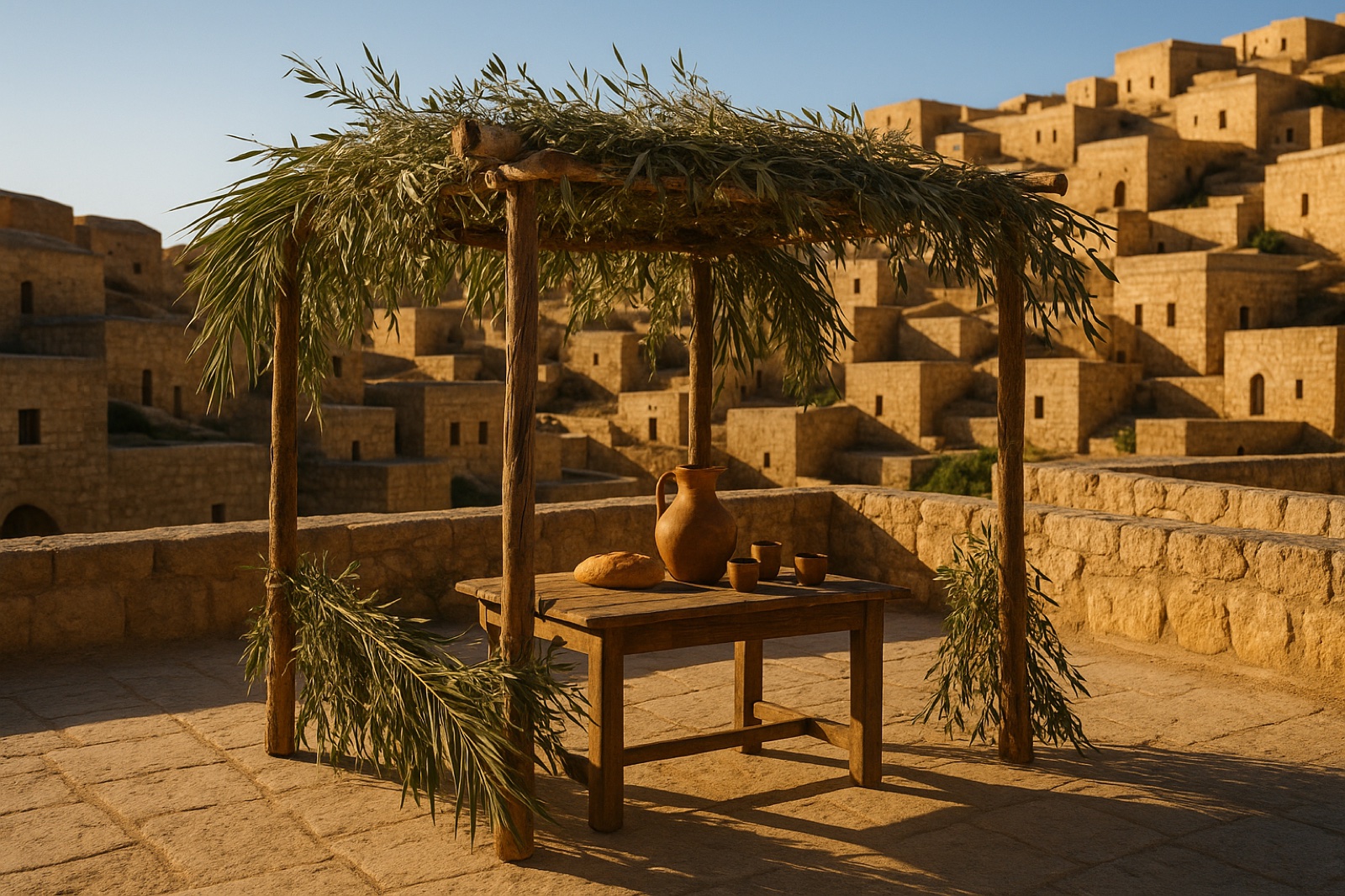
The booths were built from whatever grew nearby. Leviticus 23:40 lists “the boughs of goodly trees, branches of palm trees, and the boughs of thick trees, and willows of the brook.” Nothing fancy. Nothing built to last.
Later Jewish teaching took this very seriously. The Mishnah, a collection of Jewish tradition written down around AD 200, says that for all seven days a person should treat the booth as their permanent home and their house as the temporary one (Mishnah Sukkah 2:9). Sit with that flip for a second. For one week, the fragile thing is home, and the strong house is just somewhere you visit.
The Line in Nehemiah Almost Everyone Reads Past
After the exile in Babylon, a small group of Jews came back to a ruined Jerusalem. Nehemiah 8 tells how they read the law, found this command, and went out to fetch “olive branches, and pine branches, and myrtle branches, and palm branches” (Nehemiah 8:15). They built booths on their roofs, in their courtyards, and in the streets.
Then comes a line that is said once and never repeated:
“…for since the days of Jeshua the son of Nun unto that day had not the children of Israel done so. And there was very great gladness.” (Nehemiah 8:17)
Jeshua the son of Nun is Joshua. That is a gap of many centuries.
Now, Israel had kept this feast before. Solomon’s people gathered at “the feast in the month Ethanim, which is the seventh month” (1 Kings 8:2), and 2 Chronicles 8:13 names the feast of tabernacles in Solomon’s worship. So the verse most likely means not like this. Not the whole people, living in booths, with this kind of joy. The Bible doesn’t spell out exactly what was different, and it’s honest to leave that open.
But look at who finally did it. Not kings in palaces. People who had just come home from exile with very little. The ones who knew what it meant to lose a house were the ones who understood the booths. And the result was “very great gladness.”
Jesus at the Feast of Tabernacles
John 7 is set at this very feast. John 7:2 says it plainly: “Now the Jews’ feast of tabernacles was at hand.”
The chapter opens with tension. Jesus’ own brothers push Him to go to Jerusalem and show Himself off. John adds a painful note: “For neither did his brethren believe in him” (John 7:5). That story has a surprising ending, which we traced in Jesus’ brothers didn’t believe in Him. One later led the church.
Jesus goes anyway, but “not openly, but as it were in secret” (John 7:10). Halfway through the week, He starts teaching in the Temple. The crowd argues about who He is. Then, at the very end of the feast, comes this:
“In the last day, that great day of the feast, Jesus stood and cried, saying, If any man thirst, let him come unto me, and drink. He that believeth on me, as the scripture hath said, out of his belly shall flow rivers of living water.” (John 7:37-38)
“Cried” means He called out loudly. That matters. Teachers in that world usually sat down to teach. Jesus Himself “sat down” before speaking in the synagogue at Nazareth (Luke 4:20). Here, He stood up and raised His voice.
One more honest detail. John says “as the scripture hath said,” but no single Old Testament verse matches those words exactly. Passages often suggested include Zechariah 14:8, “living waters shall go out from Jerusalem,” and Isaiah 12:3, “with joy shall ye draw water out of the wells of salvation.” John doesn’t tell us which one Jesus had in mind.
The Water Ceremony, and What the Bible Doesn’t Say
Many Bible teachers link this shout to a water ceremony at the Temple. This is where it pays to be careful, because that ceremony is not described in the Bible.
It comes from the Mishnah. Sukkah 4:9 describes a priest filling a golden jug with water from the Pool of Siloam, bringing it into the Temple with trumpet blasts, and pouring it out at the altar. The joy around it was famous. The Mishnah says, “One who did not see the Celebration of the Place of the Drawing of the Water never saw celebration in his days” (Sukkah 5:1). It also says great lamps were lit at night, and “there was not a courtyard in Jerusalem that was not illuminated” by them (Sukkah 5:3).
This is later Jewish tradition, written down well over a century after the Temple was destroyed in AD 70. Many scholars think it reflects what really happened in Jesus’ day. But John never mentions it. So it is likely background, not biblical fact.
Now here’s the part almost nobody mentions. The same Mishnah says the water pouring was done for seven days (Sukkah 4:1). Not eight. And Leviticus 23:36 adds an eighth day to the feast: “on the eighth day shall be an holy convocation unto you.”
So which day was “the last day, that great day”? Scholars are genuinely split. Some say the seventh day, the high point of the water ceremony. Others say the eighth day. If so, Jesus stood up on the one morning when no water was poured at all. The jug put away. The altar dry. And into that quiet, He shouted, “If any man thirst, let him come unto me, and drink.”
Nobody can say for certain which day it was. But both readings carry the same message. If it was the seventh day, Jesus was saying: the water you are celebrating points to Me. If it was the eighth, He was saying: the ceremony has ended, and I am still here.
And a little later in John’s account, still teaching in the Temple, Jesus says, “I am the light of the world” (John 8:12). At a feast remembered for lamps that lit up a whole city, that line would not have gone unnoticed.
The Feast of Tabernacles Meaning for Your Life Today
Put the pieces side by side.
God gave a feast to settled people so they would not forget they were carried. The danger was never the booth. The danger was the stone house, and the quiet belief that the walls were what kept them alive.
That is a very modern danger. You can finally have the steady job, the rent covered, the family roughly okay, and still feel like dry ground. Or you can have none of those things, and be living in something as fragile as a branch shelter right now. The feast speaks to both. If your life is solid, it says: remember who carried you. If your life is fragile, it says: this is exactly where God met Israel.
And then Jesus stands up at that feast and names the one qualification for what He offers. Not success. Not holiness. Not having it together. Thirst. “If any man thirst.” If you feel dry, you already qualify.
There is one more thread. John 1:14 says, “the Word was made flesh, and dwelt among us.” The Greek word John uses for “dwelt” comes from the word for a tent. John is saying Jesus pitched His tent among us. The One who told Israel to live in fragile shelters came and lived in one too: a human body, with all its weakness.
And the feast was never meant to stay small. Deuteronomy 16:14 says to rejoice with “the stranger, and the fatherless, and the widow.” Zechariah 14:16 pictures people from “all the nations” going up “to keep the feast of tabernacles.” The booth was always meant to have room for more people.
Quote to remember: “The only thing Jesus asked for was thirst.”
Actions to Take Today
- Step outside for five minutes. A doorway, a balcony, a tree, a bus stop is fine. Look up and name three times you were carried when you had nothing solid to lean on. Say them out loud or type them into your phone.
- Answer John 7:37 in one honest sentence. Read “If any man thirst, let him come unto me, and drink.” Then tell Jesus, in plain words, the one place in your life that feels driest right now. No polish needed.
- Make room in your booth. Send one message to someone who is alone, grieving, or between homes, and invite them to share tea, a simple meal, or a walk this week. It costs nothing, and it is exactly the kind of joy Deuteronomy 16:14 asked for.
Journaling Prompts
- What in your life has quietly become your “stone house,” the thing you trust to keep you safe?
- If every solid thing in your life stayed exactly as it is, what would you still be thirsty for?
- Think of a time you felt carried. What did you actually have in your hands back then?
A Prayer for When You Feel Dry
Jesus, some days I have a roof over my head and I still feel empty. I’ve trusted my walls more than I’ve trusted You, and I’ve forgotten how many times I was carried. I’m thirsty, and I’m tired of pretending I’m not. You said anyone who thirsts can come to You and drink, so I’m coming, just as I am. Fill the dry places in me, and make room in my life for someone else who is thirsty too. Amen.
Discussion Question
Do you think Jesus shouted on the seventh day, with the water ceremony at its peak, or on the eighth day, after it had stopped? Which picture speaks to you more? Tell us in the comments below.
Share This
- “God told a settled nation to live in branch shelters for a week, every year, so they’d remember they were carried. I needed that reminder today.”
- “‘If any man thirst, let him come unto me, and drink.’ (John 7:37) The only requirement is thirst. Not having it together. Just thirst.”
- “The Feast of Tabernacles starts at sundown on 25 September this year. I’m asking myself what my ‘stone house’ is, and who carried me before I had one.”
Feast of Tabernacles: Questions and Answers
What is the Feast of Tabernacles?
The Feast of Tabernacles, called Sukkot in Hebrew, is a seven-day biblical feast commanded in Leviticus 23:34-43. It falls on the fifteenth day of the seventh Hebrew month, at the end of the harvest. God told Israel to rejoice and to live in temporary shelters made of branches for seven days, followed by a holy eighth day. It is one of three pilgrimage feasts in the Old Testament.
When is the Feast of Tabernacles in 2026?
In 2026, the Feast of Tabernacles (Sukkot) begins at sundown on Friday 25 September and the seven days end at nightfall on Friday 2 October. The “eighth day,” a separate holy day described in Leviticus 23:36, follows immediately afterwards. Because the Hebrew calendar is lunar-based, the dates on the everyday calendar move each year, usually landing in September or October.
Why did Israel live in booths during the Feast of Tabernacles?
Leviticus 23:42-43 says Israel lived in booths for seven days so that later generations would know God made the children of Israel dwell in booths when bringing them out of Egypt. The feast was mainly for people already settled in houses. Living in fragile branch shelters once a year reminded them that they had been carried through forty years in the wilderness, not kept safe by their own walls.
What did Jesus say at the Feast of Tabernacles?
According to John 7:37-38, on “the last day, that great day of the feast,” Jesus stood and cried out, “If any man thirst, let him come unto me, and drink. He that believeth on me, as the scripture hath said, out of his belly shall flow rivers of living water.” John 7:39 explains that Jesus was speaking about the Spirit that believers would receive. Scholars disagree about whether “the last day” means the seventh or the eighth day of the feast.
Is the water-pouring ceremony at the Feast of Tabernacles in the Bible?
No. The Feast of Tabernacles water-pouring ceremony, in which a priest carried water from the Pool of Siloam and poured it at the Temple altar, is described in the Mishnah (Sukkah 4:9), a body of Jewish tradition written down around AD 200. The Bible itself does not describe it. Many scholars believe it reflects Temple practice in Jesus’ time and often connect it to Jesus’ words in John 7:37-38, but that link is a likely background, not something the Gospel states.