 0
0
 0
0
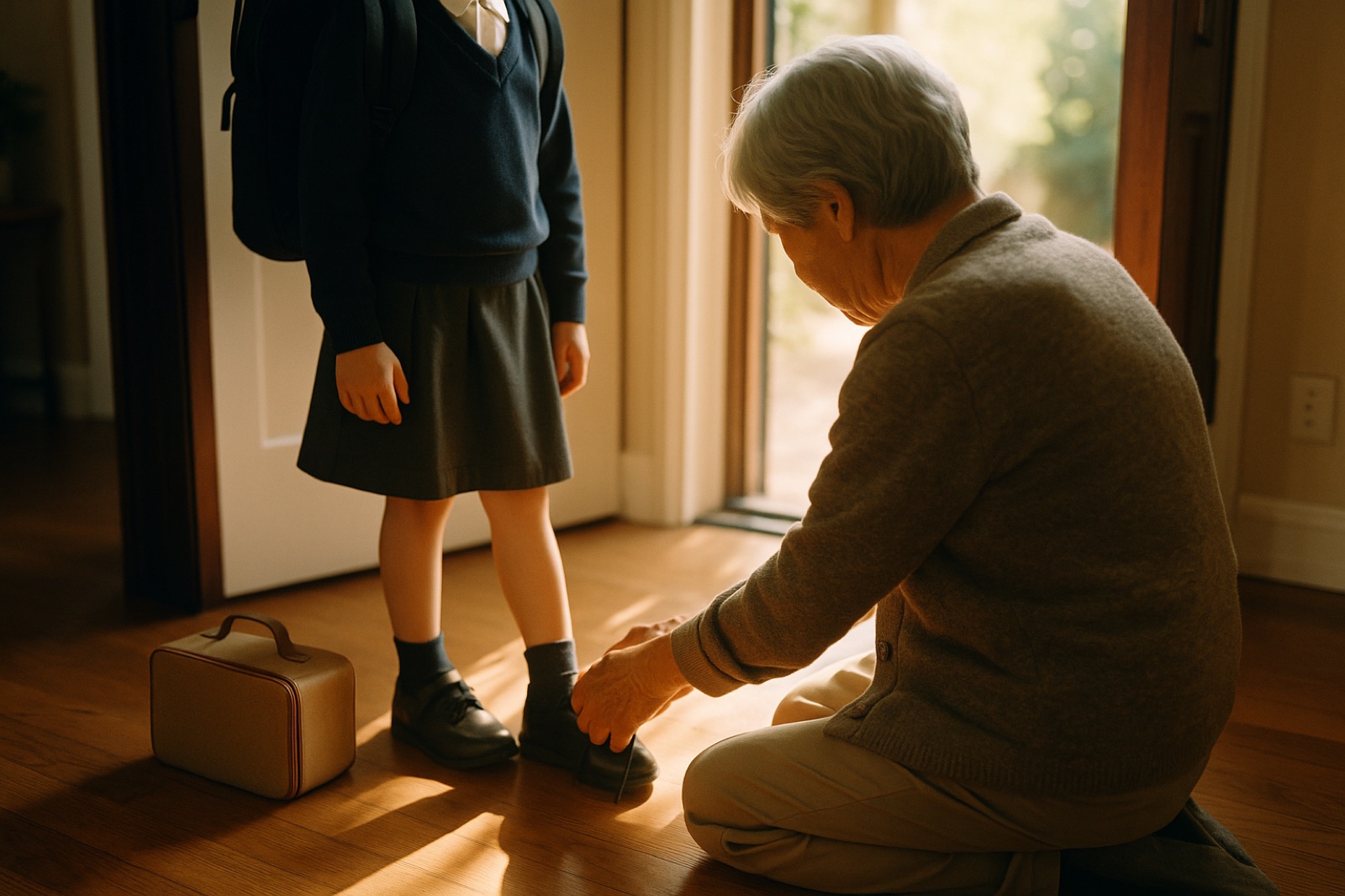
You thought you were finished with lunchboxes. With school forms, with fevers at 2am, with a small voice asking for one more story. Then life turned, and a grandchild came to live with you. Maybe for a season. Maybe for good.
If you are one of the grandparents raising grandchildren right now, you probably did not plan this. Nobody does. A parent died, or got sick, or went away to work, or simply could not do it. And you said yes, because that is what love does. But some nights, sitting in a quiet kitchen after the kids are finally asleep, a question creeps in. Is this my life now? Did my own story just end so theirs could keep going?
The Bible has an answer to that question. It even has a word for what you became.
Grandparents Raising Grandchildren Is More Common Than It Feels
It can feel like you are the only one at the school gate with gray hair. You are not.
In the United States alone, almost 1 million grandchildren were being raised by their grandparents with no parent living in the home in 2024, according to U.S. Census Bureau figures gathered by the Grandfamilies & Kinship Support Network. And it is far from only an American story. In many parts of Africa and Asia, researchers who study families have tracked what they call “skip-generation” homes: grandparents and grandchildren living together while the middle generation is missing. Sometimes the parents have died. Very often they have moved far away to find work so the family can eat.
So if you are in Nairobi, Manila, Lagos, Manchester, or a small town nobody has heard of, and you are raising your child’s child, you are part of a very large, very quiet crowd.
The Woman Who Changed Her Name to “Bitter”
The Book of Ruth is usually told as a love story. But it begins as a grief story, and the person at the center of the grief is an older woman named Naomi.
Naomi left home during a famine with her husband and two sons. In a foreign country, her husband died. Then both her sons died too. The Bible says it in one flat, heavy line: “the woman was left of her two sons and her husband” (Ruth 1:5).
When she finally came home, the women of her town barely recognized her. And Naomi told them to stop using her name. Naomi means something like “pleasant.” She wanted a new one:
“Call me not Naomi, call me Mara: for the Almighty hath dealt very bitterly with me. I went out full, and the LORD hath brought me home again empty.” (Ruth 1:20-21)
Mara means bitter. Naomi was saying, my story is over. What is left of me is the ending.
Many grandparents raising grandchildren know that feeling from the inside. Not because they don’t love the children. They do, fiercely. But because the reason the children are with them is often a loss. A loss of a son or daughter to death, to illness, to addiction, to distance. You can be grateful and grieving at the same kitchen table.
The Baby in Her Lap
The last scene of Ruth is not a wedding. It is an older woman holding a baby.
Ruth, Naomi’s widowed daughter-in-law, marries a man named Boaz and has a son. And then the camera turns away from the young parents and lands on the grandmother:
“And Naomi took the child, and laid it in her bosom, and became nurse unto it. And the women her neighbours gave it a name, saying, There is a son born to Naomi.” (Ruth 4:16-17)
Read that again. A son born to Naomi. The neighbours knew exactly whose baby it was. But they gave the grandmother the credit, because she was the one doing the carrying.
To be honest about the story: Ruth and Boaz were alive. Naomi was not raising Obed alone, the way many grandparents today are. She was sharing the work. But the Bible does not treat her part as a side role. It treats it as the ending the whole book was walking toward.
The Bible Has a Word for What You Became
Here is the part most people read right past. When Ruth 4:16 says Naomi “became nurse unto it,” the Hebrew word is omenet. It does not mean a nurse who feeds a baby. Naomi was far too old for that. It means a guardian. A foster-carer. The one a child is trusted to.
That same word shows up again in the Book of Esther, and this time there is no parent in the picture at all. Esther was an orphan, and her older cousin Mordecai took her in:
“And he brought up Hadassah, that is, Esther, his uncle’s daughter: for she had neither father nor mother… whom Mordecai, when her father and mother were dead, took for his own daughter.” (Esther 2:7)
“Brought up” is the same Hebrew word, omen. The same word even appears when Moses, worn out, complains that he is being asked to carry a whole people “as a nursing father beareth the sucking child” (Numbers 11:12). Being the one who carries a child who is not your own by birth is heavy enough that even Moses felt it.
And the word comes from the same Hebrew root family as amen. At its core that root is about being steady and reliable. Something you can lean your weight on. In the Bible’s own language, the grandparent who takes in a child is not a backup plan. They are the omen. The trustworthy one. The one the child leans on.
There is a whole family of these people in scripture. A woman named Jehosheba once hid her baby nephew in the temple for six years to keep him alive. Nobody wrote songs about her. But the whole story depended on her.
What Nobody Tells You: It Costs Something
It would be dishonest to pretend this is easy. Raising children in your 60s or 70s asks a lot of a body that has already worked hard for decades.
Researchers at the U.S. Census Bureau recently looked at this question on a huge scale. They linked census records for more than 64 million Americans aged 50 and over to death records across nearly two decades. What they found was not one simple answer. For some groups, grandparents who lived with and cared for grandchildren had higher death rates than their peers. For other groups, the rates were actually lower. The researchers were clear that the risk is not the same for everyone. It changed with who the grandparents were and how long they had been caring for the children. The study did not measure how much help each family had, but it is hard to imagine that does not matter too.
The strain is real, but nobody should assume it is fixed. And remember Moses, the “nursing father” who said the load was too heavy. He told God plainly, “I am not able to bear all this people alone, because it is too heavy for me” (Numbers 11:14). God did not scold him. God gave him seventy elders, “and they shall bear the burden of the people with thee, that thou bear it not thyself alone” (Numbers 11:17). Help was the answer, not more willpower. Which is hard to hear if you are the kind of person who would rather do it yourself than ask. (If that’s you, it’s worth reading about why asking for help feels so hard.)
There is a promise in Isaiah that was written for tired, older people. It is not a promise that life will be light. It is a promise about who does the carrying:
“And even to your old age I am he; and even to hoar hairs will I carry you: I have made, and I will bear; even I will carry, and will deliver you.” (Isaiah 46:4)
Hoar hairs means gray hair. God saw your gray hair coming before you did. And the promise is not “you will manage.” It is “I will carry.”
You Are Not the Ending. You Are the Middle.
Go back to the women of Bethlehem, standing around Naomi and the baby. They say something that is easy to miss. They don’t only say the child is a blessing to Naomi. They say:
“And he shall be unto thee a restorer of thy life, and a nourisher of thine old age.” (Ruth 4:15)
Naomi thought she was the one doing all the nourishing. The neighbours saw that this child would nourish her. The woman who called herself Bitter got her life handed back to her, one sleepless night and one small hand at a time.
And then the book does something remarkable. It ends with a family tree. Obed grew up and had a son named Jesse. Jesse had a son named David, who became Israel’s most famous king. Centuries later, Matthew opens his Gospel with that same line of names: “Booz begat Obed of Ruth; and Obed begat Jesse” (Matthew 1:5). The baby in Naomi’s lap is in the family line of Jesus.
That does not mean every grandchild will be famous. It means something better. Naomi thought she was living in the last chapter of her story. She was actually in the middle of a much bigger one, and God was nowhere near done with her. You may feel like your life got put on hold so a child’s life could keep going. From heaven’s side, you are not on hold at all. You are the steady one a whole future is leaning on.
The Bible has long treated grandparents as carriers of faith from one generation to the next. When you are raising that next generation yourself, you are not doing something less than parenting. You are doing the work of an omen: being faithful for someone who needs a faithful person.
What to Do This Week
- Say the true thing out loud. Tonight, after the children are asleep, say it once, even if only to God: “I love these children, and I am also grieving what brought them here.” Both are allowed. Naomi said her grief out loud in the middle of town, and the Bible kept every word.
- Name your two hours. Write down one person who could watch the children for just two hours: a neighbour, a church member, an older teenager you trust, another grandparent at school. Send them a message today asking if they could help one afternoon this month. Even Moses was given helpers so he would not carry the load alone. You are allowed some too.
- Find your people. Ask at your child’s school, your church, or a local community centre whether there is a group for grandparents or relatives raising children. Many of these groups cost nothing. Sitting in a room with people who understand, even once, can be a real relief.
Journaling Prompts
- When did you first realize this was not going to be a short arrangement? What did you feel in that moment that you have never told anyone?
- Naomi asked to be called “Bitter.” If you gave this season of your life a name, what would it be, and what name do you hope it earns by the end?
- Who has quietly been an omen for you, someone steady you could lean on? What did they give you that you are now giving to a child?
A Prayer for Grandparents Raising Grandchildren
God, I did not expect to be doing this at my age, and some days I am so tired I don’t know how I will get through tomorrow. I love these children with everything I have, and I am also sad about the reasons they are here with me. Please carry me the way You promised to carry people with gray hair. Give me patience at bedtime, strength in my body, and someone I can lean on when I can’t do it all. And help me believe that my story is not over, that You are still writing it, right here in this ordinary, busy house. Amen.
Let’s Talk
Naomi’s neighbours said the baby was “born to Naomi,” giving the grandmother the credit. Do you think the people who step in to raise children get enough honour in our churches and communities, or do they mostly go unseen? Share your thoughts in the comments below. We would love to hear from you.
Share This
- I thought my story was ending. Turns out I was just in the middle of it. The Bible has a word for grandparents who raise their grandchildren, and it comes from the same root as “amen.”
- Naomi called herself “Bitter.” The last page of her story is her holding a baby while the neighbours say “there is a son born to Naomi.” If you are raising your grandkids, you are not a backup plan. You’re the steady one.
- “Even to hoar hairs will I carry you.” Isaiah 46:4, for every grandparent packing school lunches again.
Questions About Grandparents Raising Grandchildren
What does the Bible say about grandparents raising grandchildren?
The Bible honours people who raise children who are not their own by birth. In Ruth 4:16, the grandmother Naomi takes her grandson Obed into her care, and her neighbours say “There is a son born to Naomi.” In Esther 2:7, Mordecai raises his orphaned cousin Esther as his own daughter. Isaiah 46:4 also promises older people that God will carry them “even to hoar hairs,” meaning into gray-haired old age.
Did Naomi raise Obed in the Bible?
Naomi helped raise her grandson Obed, but she did not raise him alone. His parents, Ruth and Boaz, were alive. Ruth 4:16 says Naomi “took the child, and laid it in her bosom, and became nurse unto it,” which describes her becoming his guardian or caregiver. Obed later became the grandfather of King David and is named in the family line of Jesus in Matthew 1:5.
What does “nurse” mean in Ruth 4:16?
In Ruth 4:16, the word translated “nurse” in the King James Version is the Hebrew word omenet. It does not mean breastfeeding. It means a guardian, foster-carer, or someone a child is entrusted to. The same Hebrew word describes Mordecai bringing up the orphan Esther in Esther 2:7, and it comes from the same root family as the word “amen,” which carries the idea of being steady and reliable.
Is raising grandchildren bad for grandparents’ health?
Research shows the effect is not the same for everyone. A U.S. Census Bureau working paper published in 2026 linked census records for more than 64 million Americans aged 50 and over to death records and found that grandparents who lived with and cared for grandchildren had higher death rates in some groups and lower death rates in others. The researchers said the risk is not uniform and depends on factors such as how long the caregiving lasts.
Is there a Bible verse for grandparents who are raising grandchildren?
Isaiah 46:4 is a strong Bible verse for grandparents raising grandchildren: “And even to your old age I am he; and even to hoar hairs will I carry you: I have made, and I will bear; even I will carry, and will deliver you.” Ruth 4:15 is another, where the women tell the grandmother Naomi that her grandson “shall be unto thee a restorer of thy life, and a nourisher of thine old age.”