 0
0
 0
0
If you are over 60, or you love someone who is, you already know the advice. Move more. Eat better. Keep your mind busy. Stay in touch with people. Nobody needs another list. What most of us are really asking is quieter, and scarier: will any of it actually work, and why is it so hard to keep doing?
A two-year trial across eleven countries in Latin America has just given one of the clearest answers yet about lifestyle changes for brain health. It isn’t a new food or a new pill. It’s closer to a shape. The people who did best got the same kinds of advice as everyone else. They just weren’t left to follow it alone.
What the LatAm-FINGERS trial actually tested
The study is called LatAm-FINGERS. It enrolled 1,065 adults aged 60 to 77 who were at raised risk of dementia, at 12 centers in Argentina, Bolivia, Brazil, Chile, Colombia, Costa Rica, the Dominican Republic, Ecuador, Mexico, Peru and Uruguay. It ran for two years, was published in The Lancet on 13 July 2026, and was presented at the Alzheimer’s Association International Conference in London.
That age group matters. Changes linked to Alzheimer’s can begin years before anyone notices them, which is exactly why what people do in their sixties and seventies is worth taking seriously.
Everyone in the trial was split into two groups by chance:
- The structured group (539 people) got ongoing coaching, supervised exercise, nutrition counseling built around a brain-friendly eating pattern called the MIND diet, computer-based brain training, regular checks on blood pressure and heart health, and 38 group meetings over the two years, set up for social connection and accountability.
- The flexible group (526 people) got periodic health education, general lifestyle advice, 4 group meetings, and no ongoing coaching or supervision.
Thirty-eight meetings across two years works out to roughly one every two to three weeks. Four works out to about one every six months. Similar advice. Very different rhythm.
Quick aside before the results. If you’re the kind of person who wants more than information — something that helps you feel less alone in the ordinary days — we made a free video guide and companion PDF for exactly that. It’s here if you want it.
The result: both groups got better, one got more better
Here’s the headline number you may have seen: the structured group showed about 55% greater improvement in overall thinking ability than the flexible group. The biggest difference was in episodic memory, the kind that holds on to what you did yesterday and where you put your keys. They also did better on planning and juggling tasks (what researchers call executive function) and on processing speed.
But that number hides something worth knowing. Both groups improved. On the trial’s combined thinking score, the structured group gained about 0.31 points a year on a standardized scale, and the flexible group gained about 0.20. Put those side by side and the first is roughly one and a half times the second. That’s where the 55% comes from.
So the flexible group wasn’t a failure. Whatever the reason — the advice, the handful of meetings, or simply being checked on now and then — their scores went up too. The structured group just went further. If you’ve been told that doing a little is pointless, this trial says otherwise. And if you’ve been doing a little on your own and wondering why it feels like pushing a boulder uphill, it says something about that too.
Most people stayed the course. 82% of participants completed the two-year follow-up, and the researchers reported no serious adverse events linked to the program. For older adults at risk, that isn’t a small detail. A program people actually stay in is worth more than a perfect one they quit in month three.
Salsa, tango and avocado: why it wasn’t just a translation
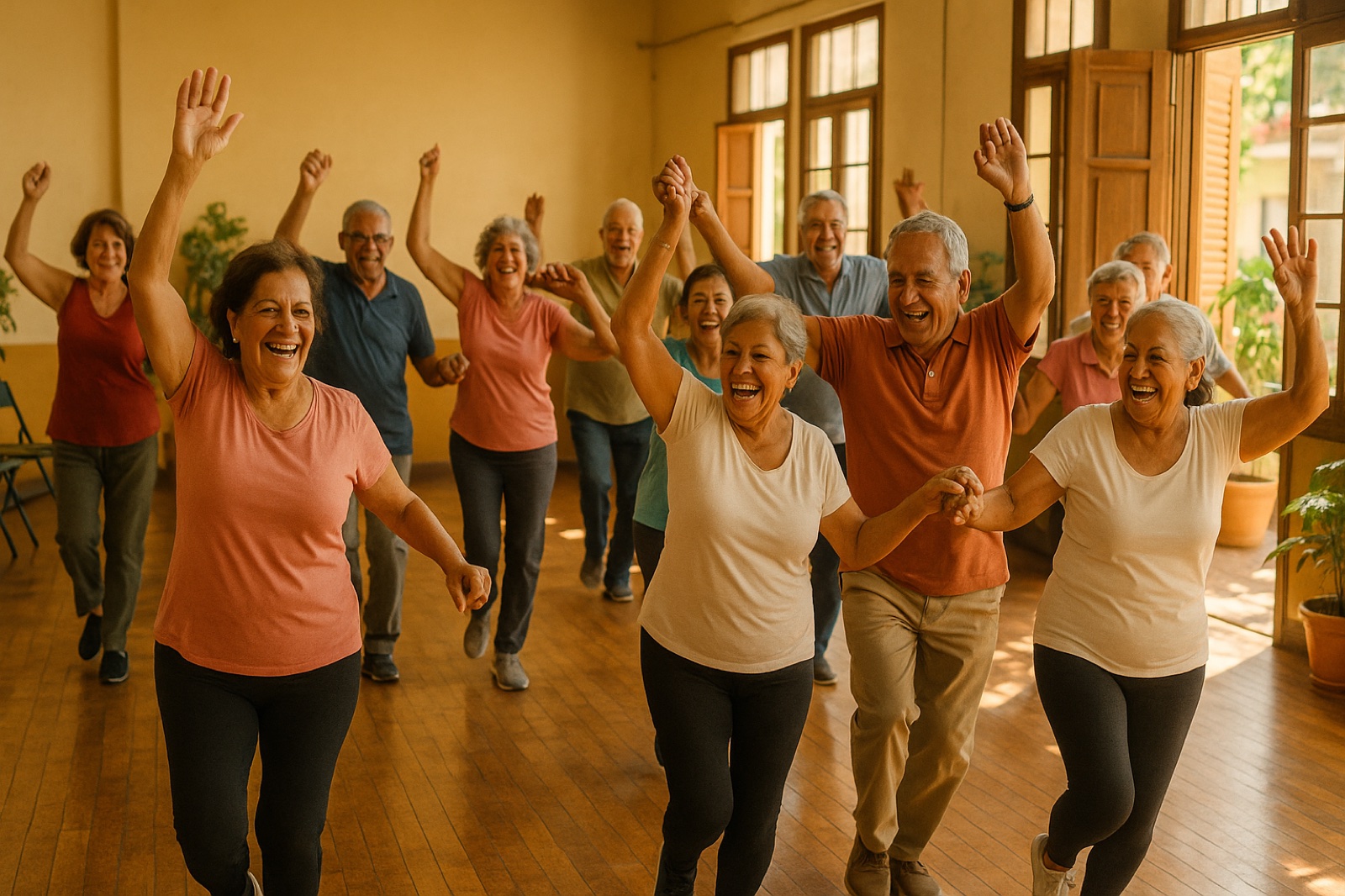
This part rarely makes the headlines. LatAm-FINGERS was built on an earlier American trial called U.S. POINTER, which followed 2,111 people and was published in 2025. But the Latin American team didn’t just hand people a translated leaflet. According to the conference materials, the exercise sessions drew on salsa and tango, the eating plan used regional foods like avocado, quinoa and açaí, and people who weren’t comfortable with technology got extra help with the computer training.
“We did not simply translate the U.S. POINTER model into Spanish and Portuguese,” said lead author Lucia Crivelli. “We adapted it to local cultures and habits while preserving its core elements — making the program practical, affordable and feasible as a public health strategy.”
That matters wherever you live. The lesson isn’t “do salsa.” It’s that a routine you can picture yourself enjoying, with food you already know how to cook, in a place you can actually get to, is the one you’ll keep. Laura Baker, who led U.S. POINTER, put it simply: “We now have a second strong finding in a completely different part of the world, which suggests that the U.S. POINTER formula can be adapted for anybody.”
The honest caveat: nobody can say it was the meetings
You’ll see this study summed up with the line “structure and social support matter.” It’s a good line. It’s also worth knowing who said it: Heather Snyder, a senior vice president at the Alzheimer’s Association, the organization that funded the trial — not one of the researchers who ran it.
And the trial itself can’t pull the threads apart. The structured group didn’t only get more meetings. They also got coaching, supervised exercise, diet counseling, brain training and health monitoring. Any one of those, or all of them together, could be doing the work. Nobody can tell you from this study that group meetings protect memory on their own.
What the study can tell you is this: similar healthy habits worked better when they came inside a steady rhythm, with someone checking in and other people on the same road, than when they came mostly as good advice to follow alone. That’s a smaller claim than “meetings prevent dementia.” It’s also a truer one, and a more useful one.
How to borrow the structure of a brain health program for free
You don’t need a research team to copy the shape of what worked. You need three things: a rhythm, a few people, and someone who notices if you don’t show up. None of them have to cost money.
- Put it on a fixed day. “Walk more” fades. “Tuesday and Friday at 7 with Ana” doesn’t. The structured group met on a schedule. Give yourself one.
- Find your four people, not your forty. A walking group, a dance class at a community hall, a choir, a card game you walk to and from. Small and regular beats big and occasional.
- Swap the coach for a friend. The trial used trained coaches. You can use a neighbor. Agree to message each other after you’ve moved, eaten a proper meal, or read something that stretched you.
- Keep your own food. The Latin American team used avocado and quinoa because that’s what people there eat. Build on the vegetables, beans, grains and fish you already buy rather than chasing someone else’s shopping list.
- Look for the in-between places. If life has shrunk to home and work, or home and not much else, there’s a reason that feels so thin. We wrote about what a third place is and why it’s so hard to replace.
If money worry is part of what keeps you at home, you’re not imagining its toll either. A study that followed people from birth found that long financial stress had already shown up in thinking tests by age 53. A free walking group on a fixed day with the same few faces isn’t a lesser version of this trial. It borrows the parts that cost nothing: the rhythm and the company.
Why doing it together might be the point
There’s a reason this finding feels familiar, even before the data. Most of us have lived it. The diet that lasted was the one a friend was doing too. The walk that happened was the one someone was waiting for. Alone, good intentions leak away. Together, they tend to hold.
That’s a very old idea, far older than any trial: two are better than one, because if one falls, the other can help them up. Many people believe that isn’t just a handy habit humans stumbled into. They believe we were made that way on purpose — that God built people for one another, and that needing company isn’t a weakness to outgrow but part of the design. A trial in eleven countries didn’t set out to test that. It’s still interesting that the program built to be kept together is the one that came out ahead.
So if you’re worried about your memory, or someone else’s, here’s the gentle version of what this study offers. You probably don’t need more information. You need a Tuesday. A few faces. Someone who’ll notice if you’re missing. Start there, keep it small, and make it something you’d look forward to even if it did nothing for your brain at all. The trial suggests the rhythm is worth more than it looks.
Common questions about lifestyle changes for brain health
What is the LatAm-FINGERS trial?
LatAm-FINGERS is a two-year randomized trial of 1,065 adults aged 60 to 77 at raised risk of dementia, run at 12 centers in 11 Latin American countries and published in The Lancet in July 2026. It compared a structured lifestyle program (coaching, supervised exercise, MIND-diet counseling, computer brain training, heart-health monitoring and 38 group meetings) with a flexible program of periodic health advice and 4 group meetings.
Do lifestyle changes actually improve brain health in older adults?
Two large trials suggest they can. In LatAm-FINGERS, older adults at raised dementia risk improved on thinking tests over two years in both a structured lifestyle program and a lighter advice-only program, with the structured program improving more. The earlier U.S. POINTER trial of 2,111 people, published in 2025, found a similar pattern. These trials measured changes in thinking-test scores, not dementia diagnoses.
What does “55% greater improvement” mean in the LatAm-FINGERS study?
In LatAm-FINGERS, the structured lifestyle group improved on a combined thinking score by about 0.31 standardized points a year, while the flexible advice group improved by about 0.20. The structured group’s rate of improvement was about one and a half times the flexible group’s, which is reported as 55% greater improvement. Both groups got better; the structured group got better faster.
Did the group meetings cause the memory improvement in LatAm-FINGERS?
The trial cannot say. The structured group received 38 group meetings, but also coaching, supervised exercise, diet counseling, computer brain training and health monitoring, so no single part can be singled out as the cause. The Alzheimer’s Association, which funded the trial, summarized the findings as showing that structure and social support matter.
How can I get the benefits of a structured brain health program for free?
The structured program in the LatAm-FINGERS trial combined healthy habits with a regular schedule, ongoing support and frequent group meetings. A free way to borrow that structure is to set fixed days for exercise, join or start a small walking or dance group, eat a vegetable-rich diet built from familiar local foods, and agree with a friend to check in on each other regularly.
Let’s talk about it
The structured group got coaching, exercise, diet help, brain training and 38 meetings. If you could keep only one of those, which do you think did the most work — and why? Tell us in the comments below.
And if you’d like something to keep you company on the ordinary days too — a way of noticing you’re less alone than you feel — the free video guide and PDF is right here.
Share this
Two-year study, 11 countries, 1,065 older adults: the same healthy habits worked better with a schedule and company than as advice on your own. Both groups improved. One improved more. https://bgodinspired.com/index.php/health-and-wellness/lifestyle-changes-for-brain-health/
I’ve always known the walk only happens when someone’s waiting for me. Turns out a big brain-health trial landed somewhere similar. Worth a read if you’re caring for an older parent, or getting there yourself: https://bgodinspired.com/index.php/health-and-wellness/lifestyle-changes-for-brain-health/
The part nobody mentions: the brain-health program used salsa, tango and avocado because that’s what people there actually do and eat. The routine you’ll keep beats the perfect one. https://bgodinspired.com/index.php/health-and-wellness/lifestyle-changes-for-brain-health/