 0
0
 0
0
You already know the scene, even if you have never put a name to it.
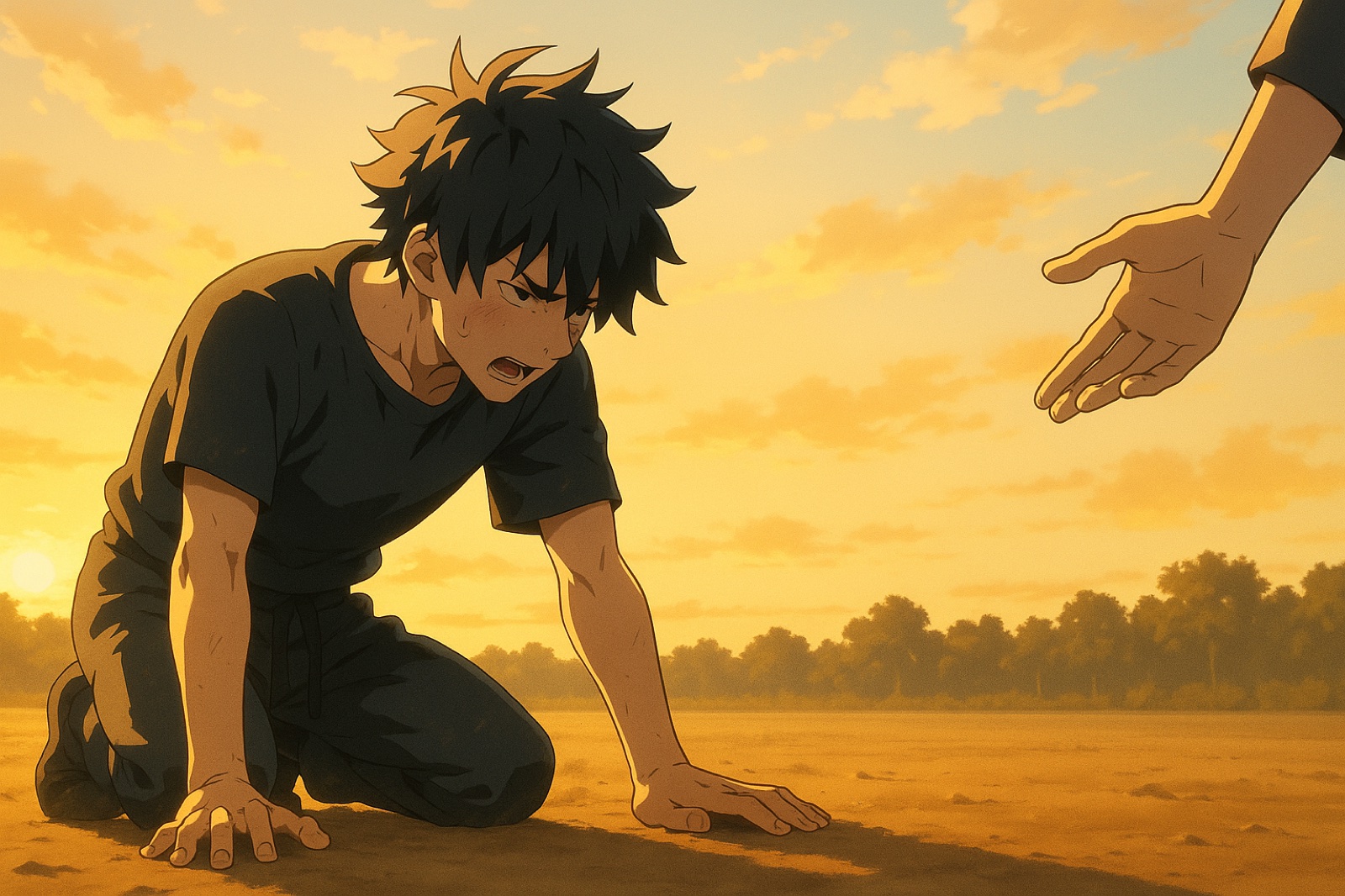
The hero is on the ground. Not because someone stronger turned up — that part he could have trained for. He is down because the thing he agreed to carry turned out to be heavier than any amount of training was ever going to make him. Call it shonen anime burnout. It is the most repeated emotional beat in one of the largest storytelling genres on the planet, and almost nobody talks about how strange it is that the genre keeps returning to it.
Strange, because shonen is supposed to be the optimistic one.
The scene every fan can picture
Anime is not niche anymore, if it ever was. Netflix now reports that more than half of its members have watched at least one anime title, and individual series in its most recent engagement report pulled around eight million views each. Whatever this genre is saying, it is being said to an enormous number of people at once — in Manila and Lagos and Nairobi and Jakarta as much as anywhere else.
And what it says, on the surface, is simple. Train. Endure. Protect everyone. Get back up.
That message is not a lie. It is genuinely good for a fourteen-year-old to hear that effort compounds. But watch enough of these stories and you notice the genre keeps writing itself into a corner it cannot train its way out of — and then it stops, sits in that corner, and gives the moment its best animation and its best music.
Shonen anime burnout is the genre’s most repeated scene
Here is the pattern, once you see it you cannot unsee it.
Act one: the hero is weak and decides to get stronger. Act two: he gets stronger, and the world scales up to match. Act three — and this is the part nobody puts on the poster — the world scales up past the point where getting stronger is the answer at all. The weight is not a training problem. It is a size problem. He is one person and the thing he promised to hold is bigger than one person.
The genre’s response to this is not to fix it. It is to slow down and film it.
The hero coughing blood. The mentor who cannot fight for as long as he used to. The strongest character in the story quietly aware that “strongest” and “enough” are not the same word. These scenes are the emotional peaks of the whole medium, and they are all the same scene: someone discovering that the engine they were sold does not run at this altitude.
It is a stranger thing to build a genre on than it first appears. Shonen is the genre of hard work — and its most beloved moments are the ones where hard work runs out.
The people drawing these stories are carrying it too
This is where it stops being fiction, and it is the part I did not expect to find.
Weekly serialised manga is one of the most physically punishing creative jobs that exists. It means drawing fine linework, at a desk, on a deadline that arrives again every seven days, for years. Yoshihiro Togashi — creator of Hunter x Hunter, one of the most acclaimed shonen series ever serialised — has spoken openly about chronic back pain severe enough that it has repeatedly stopped him from drawing at all. His series has gone on long, repeated hiatuses because of it. He has posted his own updates about it. He keeps returning to the work anyway.
Sit with that for a second. The genre that tells millions of young people to endure is produced by an industry where the enduring is completely literal, and where the body sending the message keeps giving out.
That is not a criticism of anyone. It is the same story twice — once in the panel, once in the hand drawing the panel. And it suggests the writers keep returning to that breaking-point scene for a reason that is not craft. They keep writing it because they keep living it.
What the genre actually says happens next
This is the part I got wrong going in.
I assumed shonen had no answer to the moment its engine fails — that it just made the hero dig deeper and called it resolve. That is not what the biggest series in the genre actually do.
Look at what My Hero Academia put at the centre of its entire world. The most important power in that story is called One For All, and it is not earned by training. It is handed over. It is passed from one person to the next, and it carries inside it the accumulated strength of everyone who held it before. All Might, the closest thing that world has to a perfect hero, is the eighth person to hold it. He is not the source. He is a link. And the story’s real turning point is not him getting stronger — it is him giving it away to a boy who was born with nothing, and then living, diminished, with what that cost.
Read that structure again. The genre’s most famous answer to “I am not strong enough to carry this” is not get stronger. It is you were never supposed to generate this yourself; someone before you carried it and gave it to you. (Our older piece on what My Hero Academia does with heroism circles the same ground from a different angle.)
Shonen already knows the answer is not effort. It knows the answer is inheritance.
It just cannot quite finish the thought. Because in every version the genre writes, the gift still has to be shouldered by the next person, who will also eventually break, who will also eventually pass it on. The weight never actually stops being carried by someone exhausted. It only changes hands.
The older version of this scene
There is a much older version of this story. Older than manga, older than the printing press.
Its shape is almost identical: a person doing work that genuinely matters, carrying something genuinely too heavy, arriving at the exact moment shonen loves to animate. But the line offered there is not train harder, and it is not pass it to someone younger. It is closer to put it down; it was already carried. In that telling, rest is not the reward at the end of the effort. It is a gift from God, offered at the start, to someone who has not earned it and cannot.
Which is a genuinely different ending than the one the genre keeps writing. Not a stronger hero. Not a successor. Just a weight that stops being yours.
If you are the one on the ground right now
You probably did not open an article about anime looking for this, so take it or leave it. But the reason that scene lands so hard is usually that you have been in it.
- Name the weight honestly. Write down the actual thing you are carrying — the person, the job, the money, the family expectation. Most burnout survives on being vague.
- Ask whether it is a training problem or a size problem. More effort fixes the first. Nothing fixes the second except a smaller load or more hands.
- Find one hand. One person who can take one piece of it this week. Not the whole thing. One piece.
- Stop mid-arc. The stories always let the hero collapse before the recovery. Real life gives you the option of resting before the collapse, and almost nobody takes it.
If you genuinely cannot tell anymore whether you are tired or burned out, our free Am I Burned Out at Work? assessment takes about two minutes and tells you plainly. It is worth knowing which one you are in.
A question worth arguing about
Which series handles that breaking-point moment best — and which one completely fumbles it by having the hero just power through? Anime fans have strong opinions about this and they are usually right. Leave yours in the comments; I want to know what you would put at the top.
Share this
- Shonen is the genre of “work harder” and its single best scene is always the one where working harder stops working. Somebody finally wrote about why: https://bgodinspired.com/index.php/entertainment/shonen-anime-burnout-why-every-hero-breaks/
- Just realised One For All is not a training arc. It is an inheritance. The strongest power in My Hero Academia is literally something you cannot earn, only receive. Ruined me a bit: https://bgodinspired.com/index.php/entertainment/shonen-anime-burnout-why-every-hero-breaks/
- The genre that tells millions of kids to endure is made by people whose backs are giving out doing it. That is not irony, that is the same story told twice: https://bgodinspired.com/index.php/entertainment/shonen-anime-burnout-why-every-hero-breaks/
Questions people ask about shonen anime burnout
What is shonen anime burnout?
Shonen anime burnout describes the recurring story beat in shonen series where a hero who has trained relentlessly finally hits a weight that training cannot solve, and physically or emotionally collapses under it. It is not an official industry term. It describes a pattern that appears across most major series in the genre, usually as one of the story’s emotional high points rather than as a failure.
Why do shonen heroes always break down eventually?
Because the genre’s core promise — get stronger through effort — creates an escalation with no ceiling. Each new threat must be larger than the last, so eventually the story reaches a threat that is larger than any single person, no matter how much that person has trained. The breakdown is the point where the genre’s own logic runs out, which is also why writers give those scenes so much weight.
What does One For All actually mean in My Hero Academia?
One For All is a power that is transferred deliberately from one holder to the next rather than being born with or trained into existence. Each holder adds to it, so it accumulates strength across generations. All Might is its eighth holder and Izuku Midoriya, known as Deku, is the ninth. The important structural detail is that it must be given and received — it cannot be earned by effort alone.
Is “just work harder” a harmful message in anime?
Not inherently. Effort genuinely does compound, and for a young audience that is a useful thing to hear. The risk is that the message, taken alone, implies that any failure is a failure of effort — which is untrue when the load is simply larger than one person can carry. Notably, the genre itself tends to correct this in its later arcs by introducing inherited power, shared burdens, and mentors who step back.
Is anime popular outside Japan?
Yes, and heavily. Netflix reported in its first-half 2026 engagement report that more than half of its members have watched at least one anime title, with individual series drawing around eight million views each in that period. Anime viewership is strongly global rather than concentrated in any single country.
The next time that scene comes on — the hero down, the music going quiet, the weight finally visible — notice that the story never actually blames him for it. Not once, in any series. Everyone in the room already understood it was too heavy. He was the last to find out.
You might be the last to find out too. (If you want the version of this about performing strength rather than carrying it, we wrote about what aura farming quietly costs.)