 0
0
 0
0
Some mornings your hands tell you something before you are properly awake. A knuckle that will not close. A jar lid that used to be nothing. And somewhere underneath it, quietly, the question almost everybody asks: what did I do to cause this?
Too much typing. Too many years of cold water and heavy lifting. The sport you played too hard, or the years you barely moved at all. It is an old instinct, and it is close to universal. New work out of Oxford on the origins of arthritis before birth suggests it may also be pointed at entirely the wrong thing. The joints that rheumatoid arthritis tends to attack appear to have been built differently in the womb — long before any of us had done anything at all.
What the Oxford Team Actually Looked At
The study came out of the Kennedy Institute of Rheumatology at the University of Oxford, and was published in the journal Nature Immunology on 12 August 2026 under the title “The embryonic origins of site-specific arthritis.”
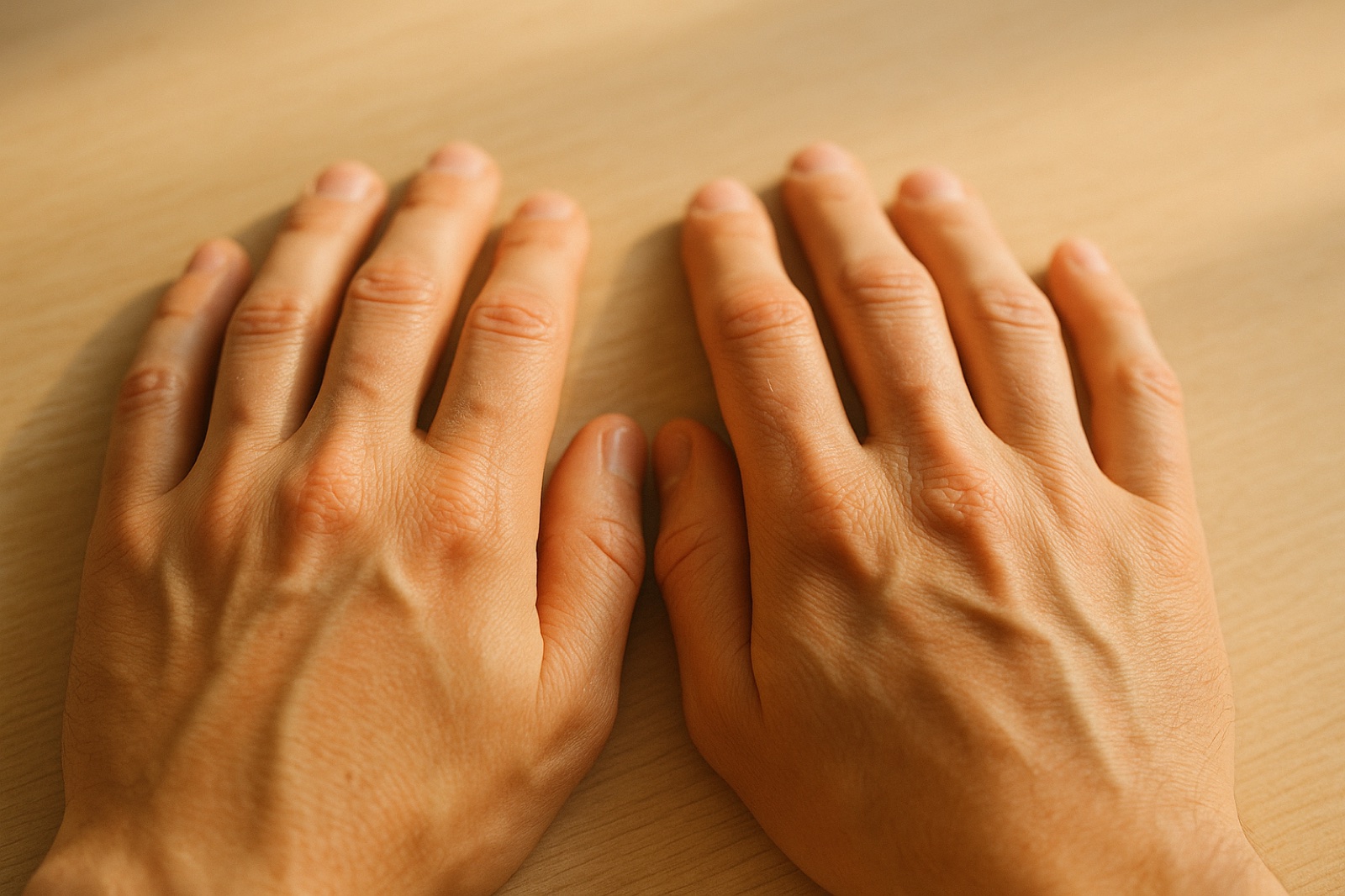
The researchers started from a fact that rheumatologists have lived with for a long time without being able to explain it. Rheumatoid arthritis is fussy about where it lands. It goes after the middle knuckles — the proximal interphalangeal joints, the ones that bend when you make a loose fist. It largely leaves alone the joints nearest your fingertips, the distal interphalangeal joints.
Same hand. Same finger. Same blood supply, same immune system, same genes, a couple of centimetres apart. One is a target. One mostly is not.
Nobody had a good answer for why. So the team went looking earlier than anyone usually looks — at finger joints still forming before birth. They combined single-cell RNA sequencing with imaging and X-ray tomography to map what the tissue was actually made of and how it was arranged.
The Difference Was Already There
The vulnerable middle knuckles were not built the same as the spared ones. They had a larger synovial volume — more of the soft lining tissue that fills the space inside a joint. And they were enriched for a particular kind of cell: PI16-positive fibroblasts, clustered around blood vessels and at the points where tendons and ligaments attach.
Fibroblasts are the quiet structural staff of the body. They build and maintain the scaffolding that everything else sits on. They are not usually the cells anyone suspects of anything.
These ones behaved differently. When the team exposed them to inflammatory signals, the PI16-positive fibroblasts in the vulnerable joints did not respond the way their neighbours did.
“PI16+ fibroblasts were enriched in vulnerable joints and responded differently to inflammatory signals,” said Dr Sarah Davidson, the postdoctoral researcher on the study.
Christopher Buckley, Kennedy Professor of Translational Rheumatology, put the wider point plainly: “The answer lies not only in the immune system but also in the tissues themselves.”
That sentence is doing more work than it looks like it is doing.
Why This Reframes the Whole Disease
For decades the story of rheumatoid arthritis has been an immune system story. The immune system misfires. It attacks the body’s own joints. Everything that follows — the drugs, the explanations, the mental picture the patient carries around — comes from that framing.
What this work suggests is that the immune system may not be the one choosing the target. The tissue may be. An immune system running hot has to land somewhere, and the architecture of each joint appears to have a say in where. Some joints are simply built in a way that makes them easier to set alight.
That is a different kind of vulnerability than the one most people imagine. It is not weakness earned. It is not damage accumulated. It is shape — laid down before birth, by a process nobody supervised and nobody chose.
What This Study Does Not Say
This part matters, and it is the part that gets flattened in headlines.
The study is about where arthritis takes hold, not whether a person will get it. Nobody is born with rheumatoid arthritis, and nothing here says otherwise. The finding is that if the disease does arrive, the map of which joints it visits was drawn a long time ago.
It also does not change anyone’s treatment today. This is early tissue biology, done in fetal joints. It opens a direction — the hope is that understanding the local environment of a joint eventually leads to treatments aimed at the tissue rather than only at the immune system. That is a hope, not a therapy, and the researchers have not claimed more than that.
What it does change, right now, is the story a person tells themselves at three in the morning.
The Question Underneath the Question
Here is the thing about that instinct to search backwards for the cause. It is not really about biology. It is about wanting the world to make sense.
If the pain has a reason, and the reason is something you did, then at least the universe is running on rules. Cruel rules, but rules. A ledger. Something you can argue with. Every culture has built some version of that ledger, and we still reach for it constantly — most of us have said “everything happens for a reason” out loud to someone, usually while standing next to a person in real pain and not knowing what else to offer.
The trouble is that the ledger is not there. A middle knuckle formed a certain way months before you were born. It kept no record of your choices because you had not made any yet.
People have been running into this wall for a very long time. There is a moment in one of the oldest stories we have where a crowd sees a man who has been ill since birth and immediately asks whose fault it was — his, or his parents’. It is the same question, asked thousands of years earlier, with the same certainty that somebody must have earned it. The answer given refused the premise entirely. Not his. Not theirs. The suffering was not a verdict, and looking for who to bill was the wrong task from the start.
People have been quietly relieved by that answer ever since, usually without being able to say why.
What to Do With This
None of this makes a bad hand hurt less. But a few things follow from it that cost nothing:
- Stop auditing your own history. If you have been mentally rewinding through decades of work, sport, cold weather and bad habits looking for the moment you did this to yourself — that search has no answer at the end of it, and the searching itself costs you sleep.
- Notice which joints. The pattern is real and it is information. If you can, mention to a clinician which joints are involved and which are not. Where the pain sits is part of the picture, not a detail.
- Say the honest version out loud. “This is not something I caused” is a sentence most people with chronic pain have never once said about themselves. It is worth trying.
- Let somebody carry a bit of it. Pain that nobody else knows about gets heavier. That is not weakness; it is arithmetic.
There is a strange kind of freedom in a finding like this. Not the freedom of a cure — nothing here cures anything. The freedom of being let off a hook you were never actually on. The joint was shaped that way before you arrived. Whatever you are carrying, the blame was never part of the diagnosis. If you want something to sit with rather than argue with on a hard morning, our free Bible Verse for How I Feel tool will find you one in about thirty seconds.
Your hands did not betray you. They were built, in the dark, a long time ago, by a process that was doing its best with the pattern it was given. So were you.
A Question Worth Arguing About
Do you think knowing a condition was not your fault actually makes it easier to live with — or does the search for a cause serve some purpose that “it was nobody’s fault” cannot replace? Tell us where you land in the comments. Both answers are defensible and we would genuinely like to hear yours.
Worth Sharing
- Rheumatoid arthritis attacks your middle knuckles and mostly spares the joints by your fingertips. Oxford researchers just found out why: those joints were built differently before birth. Nobody caused this. https://bgodinspired.com/index.php/health-and-wellness/arthritis-before-birth/
- If you have chronic pain and you have spent years quietly auditing your own history for the moment you caused it — this one is worth two minutes. The map was drawn before you were born. https://bgodinspired.com/index.php/health-and-wellness/arthritis-before-birth/
- Sending this to everyone I know who has been blaming themselves for their own body. The joints arthritis targets were already shaped that way in the womb. https://bgodinspired.com/index.php/health-and-wellness/arthritis-before-birth/
Questions People Are Asking
What did the Oxford study on arthritis before birth actually find?
Researchers at the Kennedy Institute of Rheumatology, University of Oxford, examined finger joints as they form before birth and found that the joints rheumatoid arthritis usually attacks — the proximal interphalangeal joints, or middle knuckles — develop with a larger synovial volume and more PI16-positive fibroblasts than the joints near the fingertips, which the disease usually spares. Those cells also react differently to inflammatory signals. The study, “The embryonic origins of site-specific arthritis,” was published in Nature Immunology on 12 August 2026.
Does this mean people are born with rheumatoid arthritis?
No. Nobody is born with rheumatoid arthritis, and this study does not claim otherwise. It addresses which joints the disease targets if it develops, not whether a person will develop it. The vulnerability described is structural — the way a particular joint is built — not the disease itself.
Why does rheumatoid arthritis affect some finger joints and not others?
Rheumatoid arthritis preferentially attacks the proximal interphalangeal joints (the middle knuckles) and largely spares the distal interphalangeal joints nearest the fingertips. The Oxford study suggests the reason lies in the joints themselves rather than only in the immune system: the vulnerable joints have more soft synovial lining tissue and a larger population of PI16-positive fibroblasts, which respond differently when exposed to inflammation.
What are PI16+ fibroblasts?
Fibroblasts are structural cells that build and maintain the connective scaffolding of the body’s tissues. PI16-positive fibroblasts are a subtype sometimes described as “universal” fibroblasts. In the Oxford study they were found clustered around blood vessels and where tendons and ligaments attach, and they were more abundant in the finger joints that rheumatoid arthritis tends to target.
Does this change how rheumatoid arthritis is treated right now?
Not yet. This is early-stage tissue biology carried out on developing joints, and no treatment changes on the basis of it. Its value is directional: if joint architecture helps determine where inflammation takes hold, future treatments might be aimed at the tissue environment of a joint rather than at the immune system alone. That remains a research direction rather than an available therapy.
Sources: Kennedy Institute of Rheumatology, University of Oxford — “Arthritis origins may begin before birth, study finds”; “The embryonic origins of site-specific arthritis,” Nature Immunology, 12 August 2026.
If the ledger idea is the part that stuck with you, we went further into it here: what the Bible actually says about karma — and it is not what most people expect.