 0
0
 0
0
For most of the space age, Mars had a fairly boring file. Cold. Dry. Finished. A planet where the interesting things happened a very long time ago and then stopped happening.
A lot of that came down to one detail. Mars has no plate tectonics.
Earth’s outer shell is cracked into huge moving plates. They grind past each other, dive underneath each other, and quietly recycle rock for billions of years. That churning is the engine most geologists credit for Earth’s complicated, layered crust. Mars has nothing like it. Mars is what scientists call a “stagnant lid” planet — one solid shell, no moving pieces, nothing being pulled back down and remade.
So the assumption followed naturally. No moving plates, no complicated crust. Lava rose, lava cooled, the end. Simple planet, simple story.
Then a team went back to a boundary 24 kilometres underground that nobody had ever managed to explain.
What sits 24 km beneath the surface of Mars
Seismologists had known for a while that something changes about 24 kilometres down inside the Martian crust. Seismic waves behave differently on either side of it. It is a real, measurable line — what geologists call an intracrustal discontinuity. Below it, at roughly 38 kilometres, the crust ends and the mantle begins.
The line itself was not the mystery. What the line meant was.
Researchers at the University of Oxford, led by Dr Tobermory Mackay-Champion with Jon Wade and J.-M. Kendall, worked the problem from the rock side. They compared hundreds of possible rock compositions against what the seismic waves actually did, using thermodynamic modelling alongside statistical techniques — the university’s Department of Earth Sciences and its Department of Statistics working the same question together. Their paper, “Seismic evidence for a melt-depleted lower crust and transcrustal magmatism on Mars,” was published in Nature Astronomy in June 2026.
Only one kind of rock fit the data below the boundary: ultramafic rock — heavy in iron and magnesium, low in silica. Above the boundary, mafic rock, with more silica in it, matched better.
That sounds like a technical footnote. It is not. Those two rock types stacked in that order are a fingerprint, and the thing they are a fingerprint of is not supposed to be there.
How you read a rock you can never touch
Nobody has drilled 24 kilometres into Mars. Nobody has drilled 24 kilometres into Earth either — the deepest hole humans have ever made falls well short of that. So the reading is done with sound.
NASA’s InSight lander carried a seismometer sensitive enough to feel the ground on another planet move. When a marsquake happened, or a meteoroid slammed into the surface somewhere over the horizon, the shock ran through the planet and arrived at that one instrument.
Two kinds of waves arrive. Pressure waves, which travel through anything. Shear waves, which cannot travel through liquid at all. The speed each one carries, and the gap between them, depends on what they passed through. Line those readings up against a catalogue of candidate rocks and you can start ruling things out — not by seeing the rock, but by working out what the rock cannot be.
That is the whole method. Listen to a planet ring, then eliminate every explanation that does not match the sound.
The lander that found it had been silent for years
Here is the part that gets left out of most write-ups of this discovery.
InSight is not working. It has not worked for a long time.
The lander touched down on Mars on 26 November 2018. Over the following four years its seismometer registered 1,319 marsquakes. Then Martian dust did what Martian dust does — it settled on the solar panels, thickened, and slowly starved the lander of power. NASA lost contact on 18 December 2022 and formally retired the mission three days later.
The evidence for these magma systems was published more than three years after the instrument that gathered it went quiet.
Which means the discovery was never really about a new measurement. Everything needed was already sitting in an archive, recorded, downloaded, filed. What was missing was somebody willing to spend the time asking whether the planet might be more complicated than its reputation. The data had been telling this story to anyone who checked. It just took a while before anyone checked properly.
Why a planet with no plate tectonics changes the question
Stack ultramafic rock under mafic rock and you are looking at what happens when molten rock sits somewhere long enough to sort itself out. The heavy crystals sink and pile up as a dense residue at the base of the crust. The lighter, more evolved melt rises above it. Do that repeatedly, over an enormous span of time, and you get a crust built in layers by a magma system that kept reprocessing its own material.
On Earth we call that transcrustal magmatism, and we have generally treated it as one of the things plate tectonics buys you.
Mars appears to have done it without them.
The researchers suggest the layer may extend sideways for hundreds, possibly thousands of kilometres beneath Mars’s northern hemisphere. Two things worth being precise about: this describes Mars’s deep past, not a volcanically active Mars today, and it is not a claim that anything lived there. What it does say is that the prerequisite was not a prerequisite.
Jon Wade put the consequence plainly: “One of the big questions in planetary science is whether Earth is unique. If Mars could develop this kind of complex crust without plate tectonics, then maybe the conditions needed for habitability can emerge on more planets than we realised.”
Mackay-Champion said the same thing from the other direction — that we assumed volcanism on Mars was simple compared with Earth’s, and this suggests the planet could sustain large, long-lived systems where molten rock evolved and reprocessed itself through the entire crust.
It is a strange kind of correction. Nothing about Mars changed. Only the filing did. And if you have ever wondered how confidently we date and describe things we cannot visit, this short explorer on how old the universe actually is walks through the same kind of reasoning at a much larger scale.
The thing about surfaces
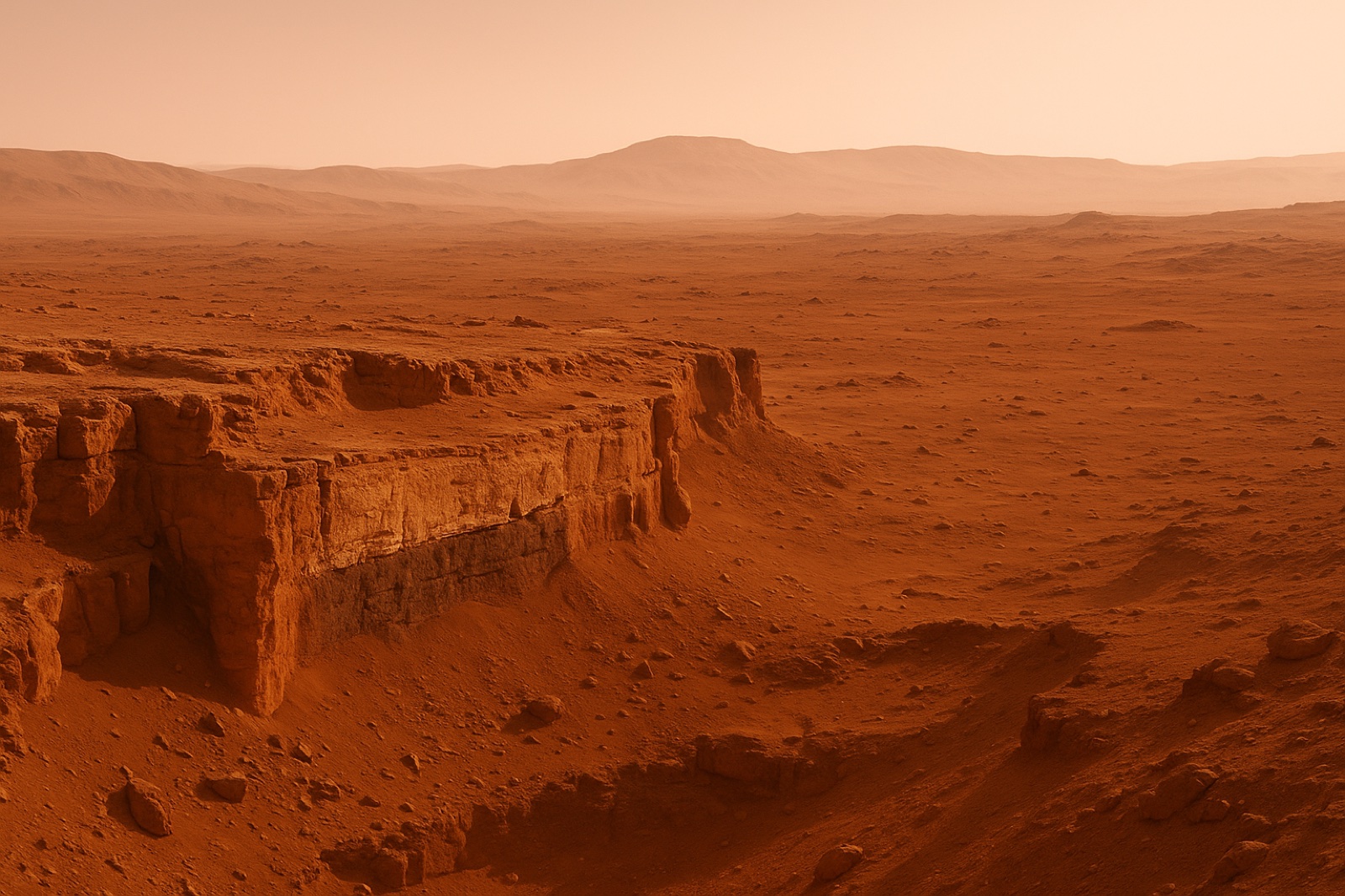
The visible surface of Mars — the rust-coloured plain everyone has seen in photographs — is not the story. It is the last page of one. Underneath it is a long, layered, deliberate process that no instrument ever watched happen and no eye was ever present for. The record of it survived anyway, written into the rock, waiting to be read by something that had not been invented yet.
There is a much older idea that says something similar about a person: that God makes each one in secret, carefully, out of sight, in a place nobody gets to watch — and that what you can see of someone now is the finished surface of a very long process, not the whole of it. Whether or not you hold that idea, it is a peculiar thing to find geology agreeing with the shape of it.
People get filed the way Mars got filed. Quiet one. Simple one. Not much going on there. Useful for this, not for that. The file is usually written from a distance, by someone who looked at the surface, made a reasonable guess, and moved on to something else.
Nothing had to change except the reading
What is worth sitting with is how little actually happened here. No new mission. No new instrument. No new planet. A silent lander, a four-year-old archive, hundreds of candidate rocks, and a team who decided the boring explanation was worth testing rather than assuming.
The complexity was there the entire time. It was under 24 kilometres of rock, on a planet nobody has stood on, generated by a process that finished before anything on Earth was watching — and it still left a record, and the record still held.
Most things that look finished are not. Most things that look simple have not been read closely enough yet. That is true of a planet, and it has been true of every hard-to-explain boundary anyone has ever bothered to go back to.
If this sort of thing pulls at you, we have written about the Mars heat anomaly that showed the cold planet is still hot inside, and about super-puff planets the size of Jupiter that turned out to be almost empty. Same lesson, different rock.
What do you think?
Scientists spent decades assuming Mars was simple because it lacked the one feature they thought complexity required. What is something the world has generally written off as simple or finished that you think is a lot more complicated than its reputation? Tell us in the comments — we read them.
Share this
- Mars has no plate tectonics, so we assumed it had a simple crust. Turns out there is a magma system 24 km down that built a layered one anyway. The prerequisite was never a prerequisite. bgodinspired.com/mars-hidden-magma-system
- The lander that made this discovery has been dead since 2022. The data was already sitting in the archive. Nobody had read it closely enough. bgodinspired.com/mars-hidden-magma-system
- Reminder that “simple” is usually just a description of how closely something has been looked at. A 24-kilometre-deep boundary on Mars quietly rewrote a whole planet’s file. bgodinspired.com/mars-hidden-magma-system
Questions people ask
What did scientists find beneath the surface of Mars?
A team at the University of Oxford found seismic evidence of vast magmatic systems inside the Martian crust. Analysing data from NASA’s InSight lander, they showed that a long-unexplained boundary about 24 kilometres below the surface separates ultramafic rock below from mafic rock above — a signature left by magma that pooled, separated, and reprocessed itself through the crust. The study, “Seismic evidence for a melt-depleted lower crust and transcrustal magmatism on Mars,” was published in Nature Astronomy in June 2026.
How deep is the boundary in the Martian crust?
The intracrustal boundary sits roughly 24 kilometres beneath the surface of Mars. Below that, at about 38 kilometres, the Martian crust ends and the mantle begins. Both figures come from analysis of seismic waves recorded by NASA’s InSight lander between 2018 and 2022.
What is the difference between mafic and ultramafic rock?
Mafic rock contains a higher proportion of silica, while ultramafic rock is richer in iron and magnesium and lower in silica. Ultramafic rock is denser. When ultramafic rock is found stacked underneath mafic rock, it suggests molten rock sat in place long enough for heavy crystals to settle out at the bottom while lighter, more evolved melt rose above — the pattern found beneath the Martian crust.
Does this mean Mars has active volcanoes today?
No. The finding describes magmatic systems that operated in Mars’s deep past, not present-day volcanic activity, and it makes no claim about life on Mars. The evidence is a compositional layering preserved in the crust, which records a process that has since ended.
Why does it matter that Mars has no plate tectonics?
Plate tectonics was long thought to be the engine required to build a complex, chemically layered crust, because it continually recycles rock. Mars is a “stagnant lid” planet with a single solid shell and no moving plates. Finding a layered, reprocessed crust there means that kind of geological complexity can develop without plate tectonics — which widens the range of planets where the conditions associated with habitability might arise.
Is NASA’s InSight lander still operating?
No. InSight landed on Mars on 26 November 2018 and recorded 1,319 marsquakes before dust accumulating on its solar panels cut its power. NASA lost contact on 18 December 2022 and retired the mission shortly afterwards. This 2026 discovery was made from data the lander had already sent back, more than three years after it fell silent.