 0
0
 0
0
For 35 years, a small group of astronomers pointed the best telescopes available at the same patch of Saturn and found nothing there.
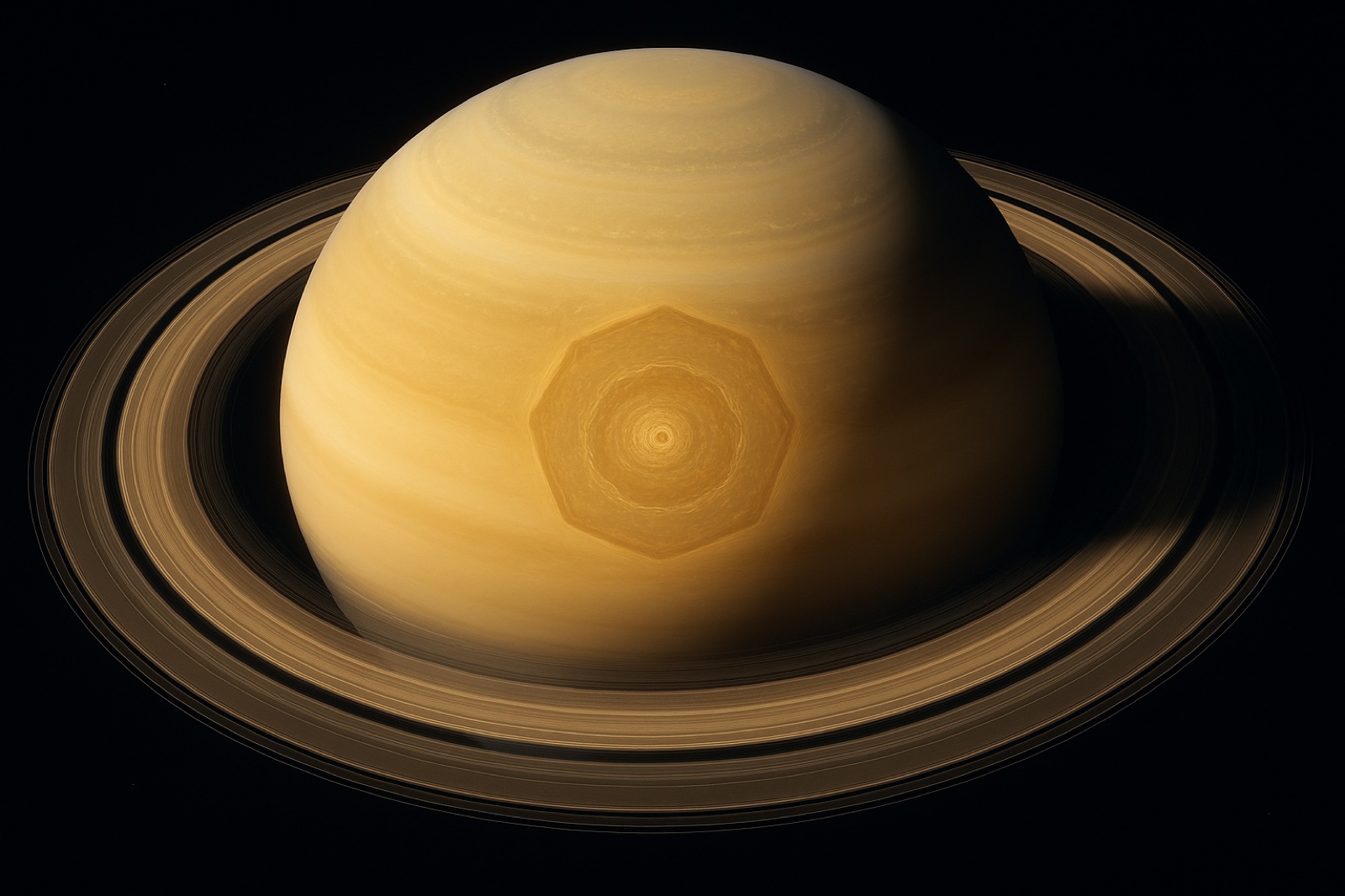
They were not being careless. They knew exactly what they were hunting for, and they had a good reason to think it existed. In September 2026 they finally published it: the Saturn decagon, a ten-sided wave wrapped around the planet’s south pole, on a scale where a single one of its ten edges is longer than Earth is wide.
The strange part is not that it took so long to find.
The strange part is that, for most of those 35 years, it genuinely was not there.
Why Astronomers Kept Looking at an Empty Pole
Saturn has a famous shape at its north pole. The Voyager spacecraft spotted it more than 40 years ago: a hexagon, six clean sides, a jet stream bent into a shape that looks manufactured. It has never gone away.
Saturn’s winds run in bands that mirror each other north and south. So the obvious question was always: if the north has a hexagon, where is the southern one?
Agustín Sánchez-Lavega of the University of the Basque Country in Spain, who led the new study, put the search in plain terms: “Given Saturn’s symmetry in its north-south jet stream system, we have been searching for a counterpart to Saturn’s northern hexagon on the south pole in Hubble images since 1990.”
Since 1990. That is the detail worth holding onto. This was not a blind spot nobody bothered to check. It was checked, deliberately, for three and a half decades, and the answer kept coming back empty.
What Is the Saturn Decagon?
The Saturn decagon is a ten-sided wave sitting inside one of Saturn’s polar jet streams. It is not a solid object and it is not a storm. Saturn is a gas giant with no surface to stand on, so what you are looking at is fast-moving atmosphere that has settled into a repeating pattern with corners.
The reported measurements put each of its ten sides at more than 16,700 kilometres — roughly 10,400 miles. Earth is about 12,700 kilometres across. One side of this shape would not fit our whole planet inside it.
It also runs deep. The research team found that the pattern extends through multiple layers of Saturn’s atmosphere, which means it is not a thin smear of cloud at the top. It is a structure with height, reaching down into the planet.
The findings were published in the journal Science Advances on 2 September 2026, with co-authors including Amy Simon of NASA and Michael Wong of the University of California, Berkeley, using observations from the Hubble Space Telescope.
If you have ever wondered what is actually inside a planet like this, the answer is stranger than most people assume — some gas giants are the size of Jupiter and almost completely empty on the inside.
The Shape Formed in the Years Nobody Could Watch
Here is the geometry that makes this story work.
Saturn is tilted, at about 26.73 degrees, in much the same way Earth is tilted. And like Earth, that tilt gives it seasons. The difference is the length. One Saturn year takes about 29.4 Earth years, so a single Saturn season runs for roughly seven years.
When the south pole tips away from us, it does not just get dim. It goes out of view entirely. From 2012 to 2023, that face of the planet was simply not available to look at from Earth.
NASA’s Cassini spacecraft was there in person for part of that stretch, orbiting Saturn from 2004 to 2017 and photographing it constantly. Sánchez-Lavega noted that Cassini’s images “showed no inkling of a long-lived formation, either.”
So the timeline narrows to something quite specific. Cassini saw nothing. Earth could not see anything. And then Saturn’s slow season turned that pole back toward the light, and there was a ten-sided shape waiting in the frame.
The current thinking is that it formed somewhere in that gap, roughly between 2017 and 2023 — during the exact stretch when almost nobody had a clear view.
Two Backyard Astronomers Saw It First
This is the part of the story that most coverage rushes past, and it is the best part.
The first hint did not come from a space telescope or a billion-dollar mission. In 2024, two amateur astronomers — Trevor Barry and Jean-Paul Oger — noticed a faint, undulating band along Saturn’s southern pole in ground-based images, working alongside Sánchez-Lavega through the Planetary Virtual Observatory Laboratory.
Ordinary people, with their own telescopes, looking at a part of the sky that had been boring for thirty years.
Their observation was strong enough to justify pointing something bigger at it. By 2025, the pattern had sharpened into an unmistakable decagon.
And then something quietly remarkable happened. Once the team knew what shape to look for, they went back through Hubble’s archive — and found it. Faint traces of a ten-cornered pattern, sitting in images taken in 2023, that nobody had read that way at the time.
The evidence had already been collected. It just had not been recognised. That happens more than you would think: a stellar stream that revealed dark matter in a galaxy 115 million light-years away had also been sitting in old Hubble data all along.
It is worth saying why Hubble had those pictures at all. There is a programme called OPAL that has quietly photographed the outer planets once a year, every year, for over a decade. Most of those photos show nothing new. That is rather the point of them. A boring annual portrait, taken faithfully, is the only reason anyone could tell that something had changed.
Nobody Can Explain Why It Formed Now
The honest answer to the obvious question is that the researchers do not know yet, and they say so.
Amy Simon framed the mystery directly: “The most intriguing part to me is that this seems to have just formed recently. The question is, why did it suddenly form now when we haven’t seen one before?”
Sánchez-Lavega has offered possibilities rather than an answer — the shape may be connected to the difference in latitude, to the background wind structure, or perhaps to a high-pressure vortex sitting underneath it. Further work with Hubble, with the James Webb Space Telescope, and with computer models will be needed to understand how it formed and how long it might last.
But there is one more finding, and it changes the emotional shape of the whole story.
The northern hexagon is a fixture. As Simon put it: “The northern hexagon has been there every time we’ve looked for more than 40 years. This feature is different — it appears to be strengthening, giving us the rare opportunity to watch a giant atmospheric pattern develop.”
It is not finished.
The decagon did not appear as a completed monument that had been sitting there all along, waiting to be photographed. It arrived mid-construction. It is getting sharper year on year, and for the first time astronomers get to watch one of these shapes actually being made instead of inheriting it already built.
The Part That Stays With You
Strip out the physics and you are left with a sequence most people will recognise from their own lives.
Someone looked, faithfully, for 35 years, and found nothing — and the nothing was real. It was not a failure of attention. The thing honestly was not there yet.
Then came a stretch of years where looking was not even possible. No progress reports. No partial view. Just a face turned away and a long wait with nothing to show for it.
And when the light finally came back around, the work had already started.
There is an idea much older than telescopes, running underneath a great deal of what people believe about God, that the seasons where nothing appears to be happening are not empty ones. It is an easy thing to say and a hard thing to live, mostly because the only proof ever on offer is the kind Saturn just gave: you have to wait for the face to turn back around, and you do not get to pick when that happens.
Keep the Habit of Looking
What actually made this discovery possible was not a breakthrough instrument. It was persistence with an ordinary one.
A yearly photograph nobody expected anything from. Two people with backyard telescopes pointed at a dull patch of sky. An archive that had quietly held the answer since 2023, waiting for someone to know what to look for.
None of that is glamorous. All of it was necessary.
Saturn’s south pole will keep turning toward us for a few more years before the season shifts again and the view closes. Astronomers will spend that window watching a shape ten thousand miles a side finish building itself, and they still will not be able to tell you why it chose now.
Which seems like a fair trade. You do not have to understand a thing to get to witness it. If you like sitting with that scale of question, you might enjoy our free How Old Is the Universe? explorer — it walks through how that number is actually measured, and how much of it is still an open argument.
A Question Worth Sitting With
Astronomers looked for this shape for 35 years, found nothing, and kept looking anyway. Do you think that kind of persistence is admirable — or is there a point where continuing to search for something you have never seen evidence of stops being reasonable? Tell us where you would have drawn the line.
Share This
- Astronomers spent 35 years searching Saturn’s south pole for a shape and kept finding nothing — because it hadn’t formed yet. Then the planet’s season turned, and there it was, still under construction. https://bgodinspired.com/index.php/bible-resources/bible-and-science/saturns-decagon-10-sided-shape-south-pole/
- Two amateur astronomers with backyard telescopes spotted a ten-sided wave on Saturn before any space agency did. One side of it is wider than Earth. https://bgodinspired.com/index.php/bible-resources/bible-and-science/saturns-decagon-10-sided-shape-south-pole/
- The clue had been sitting in Hubble’s archive since 2023. Nobody recognised it until they knew what shape to look for. That is basically every good discovery, and most good weeks. https://bgodinspired.com/index.php/bible-resources/bible-and-science/saturns-decagon-10-sided-shape-south-pole/
Questions People Are Asking
What is the decagon on Saturn?
The decagon on Saturn is a ten-sided wave pattern encircling the planet’s south pole, confirmed in research published in Science Advances on 2 September 2026 and led by Agustín Sánchez-Lavega of the University of the Basque Country. It sits inside one of Saturn’s jet streams and extends through multiple layers of the atmosphere, so it is a deep atmospheric structure rather than a surface feature or a single storm.
How big is Saturn’s decagon?
Reported measurements put each of the decagon’s ten sides at more than 16,700 kilometres, or roughly 10,400 miles. For comparison, Earth’s diameter is about 12,700 kilometres, so one side of the shape is longer than Earth is wide.
Why didn’t the Cassini spacecraft see Saturn’s decagon?
NASA’s Cassini spacecraft orbited Saturn from 2004 to 2017 and its images showed no sign of a long-lived shape at the south pole. Researchers believe the decagon formed later, sometime between roughly 2017 and 2023 — a period when Saturn’s axial tilt of about 26.73 degrees also kept the south pole turned away from Earth-based telescopes, from 2012 until 2023.
Is Saturn’s decagon the same as the hexagon at its north pole?
No. Saturn’s northern hexagon was discovered by the Voyager spacecraft more than 40 years ago and has been visible every time astronomers have looked since. The southern decagon has ten sides instead of six and appears to be new and still strengthening, which gives researchers a rare chance to watch such a pattern develop rather than finding one already established.
Why did the decagon form on Saturn now?
Nobody knows yet, and the research team says so openly. Lead author Agustín Sánchez-Lavega has suggested the shape may relate to the difference in latitude, to the background wind structure, or possibly to a high-pressure vortex beneath it. Further observations with Hubble and the James Webb Space Telescope, plus computer modelling, will be needed to explain how it formed and how long it will last.