 0
0
 0
0
Someone talked down to you this week. Not a fight. Not a threat. Just a tone — the small, practised tone a person uses when they have already decided you are beneath them. Maybe it was at work. Maybe it was family. You did not lose anything you could name, and that is exactly why it stuck.
And then somebody quotes the verse at you. Turn the other cheek. Let it go. Be the bigger person.
That is not quite what it says. The real turn the other cheek meaning sits in one word most of us slide straight past — and once you see it, the verse stops sounding like an instruction to stand still and take it twice.
The Turn the Other Cheek Meaning Most People Miss
Here is the verse, in full, from the King James Version:
“But I say unto you, That ye resist not evil: but whosoever shall smite thee on thy right cheek, turn to him the other also.” — Matthew 5:39
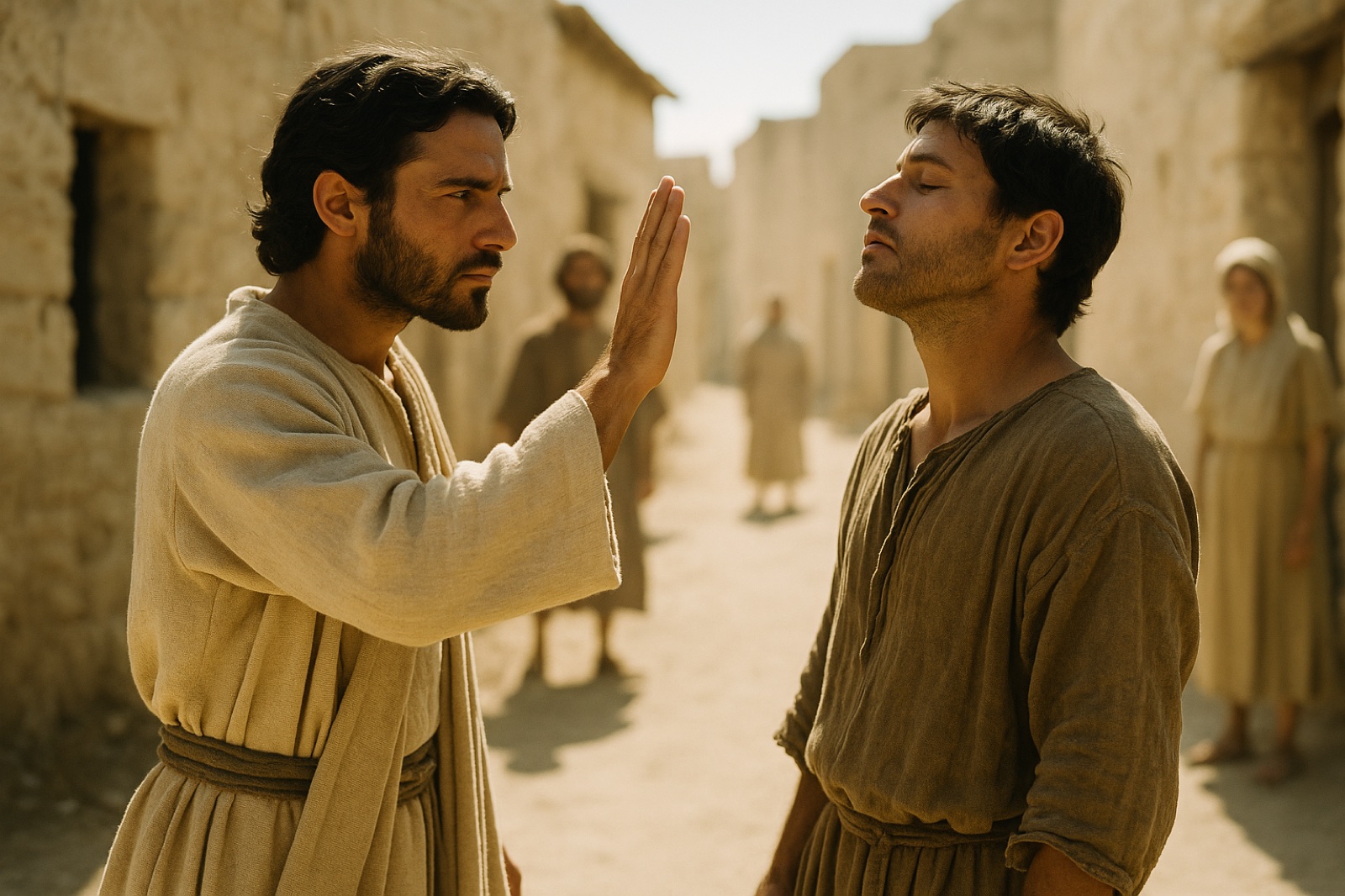
Read that again slowly. Not “a cheek.” Not “your face.” The right cheek.
Now try it where you are sitting. Reach out with your right hand and try to strike someone standing in front of you on their right cheek. You cannot do it with an open palm. The geometry will not allow it. Your hand arrives on the wrong side.
There is only one way to land that blow with a right hand — the back of the hand. And in the ancient world, a backhand was not how you fought someone. It was how you corrected someone you considered below you.
This is the detail the whole sentence turns on, and English translations keep it faithfully. We just read past it.
What Comes Right Before It
Jesus is not opening a new subject in verse 39. He is answering a line He quoted one verse earlier:
“Ye have heard that it hath been said, An eye for an eye, and a tooth for a tooth:” — Matthew 5:38
That older rule was never permission for revenge. It was a ceiling — a limit that stopped a family from answering a lost tooth with a lost life. If you have ever heard that line paired with the famous saying about the whole world going blind, the real trail behind that quote is worth following, because almost nobody says it the way it was actually said.
So the crowd listening already had a rule about proportion. Jesus takes the conversation somewhere else entirely. He stops talking about what the other person deserves and starts talking about what you are going to do with your own dignity.
What a Backhand Cost in Ancient Law
This is where the passage gets genuinely surprising, and it is the part I did not expect to find.
The Mishnah — the written collection of Jewish oral law, redacted around 200 AD — has a section on damages for humiliation, in the tractate Bava Kamma. It prices insults. Not injuries. Insults.
A slap to the cheek is assessed at two hundred dinars. A backhanded slap to the cheek is assessed at four hundred.
Twice as much. Not because it hurt twice as much — a backhand hurts less. Because it was meant to humiliate, and humiliation was the thing being paid for. The same four hundred is set for spitting on someone, for pulling out their hair, and for uncovering a woman’s head in the marketplace. That is the company a backhand keeps. It sits with the acts whose entire purpose is to make a person small in public.
One honest note on dating: the Mishnah was written down well over a century after Jesus spoke. It is not a rulebook He was quoting. It is the written form of a legal world that was already being argued over in His lifetime — evidence of the culture, not a citation.
The Line Nobody Quotes
People who know this passage usually stop at the four hundred dinars. But the Mishnah does not stop there. It states the principle underneath the whole schedule of payments: humiliation is assessed according to the honor of the person who was humiliated.
Which raises the obvious problem. What about someone with no standing? No property, no name, nobody to speak for them?
The text answers it directly. Rabbi Akiva ruled that even the poorest are to be treated as freemen who simply lost their property — because they are children of Abraham, Isaac and Jacob, and are all of prominent lineage.
The floor does not move. There is no discount for poverty.
And then the passage tells a story that is still startling. A man had uncovered a woman’s head in the marketplace and been fined the full four hundred. He waited until she was standing at her own doorway, broke a small jug of oil in front of her, and watched her uncover her own head to wipe the spilled oil into her hair. Then he brought witnesses and argued the fine should be cancelled — look, it clearly does not humiliate her.
Rabbi Akiva told him it made no difference. What she did to herself was hers. What he did to her was still worth four hundred.
Sit with that for a second. Her dignity was not measured by how wounded she looked. It was not hers to reduce and it was certainly not his to reprice.
Turning your cheek is not saying it was fine. It is refusing the ranking.
The Detail Luke Leaves Out
Honesty matters more than a clean argument, so here is the complication.
Luke tells the same teaching, and Luke does not specify a side:
“And unto him that smiteth thee on the one cheek offer also the other;” — Luke 6:29
One cheek. No right, no left. The detail everything above rests on belongs to Matthew alone.
That should keep us modest. The backhand reading is most associated with the scholar Walter Wink, who called it Jesus’ “third way” — neither fighting back nor lying down. It is a well-argued reading and a widely held one. It is not a settled fact. Other scholars, R.T. France among them, read “resist not evil” more narrowly as a limit on retaliating through the courts, and plenty of faithful readers across the centuries have simply taken the verse to mean what it appears to mean: do not hit back.
Here is the thing, though. Every one of those readings lands in the same place. None of them makes this a command to accept that you are worth less.
Not Surrender. Not Revenge. A Third Option.
A backhand is a sentence spoken with a hand. It says: you are below me, and we both know it.
There are two normal replies to a sentence like that. You can hit back, which accepts the game and just argues about who wins it. Or you can absorb it and walk away small, which accepts the ranking outright.
Jesus offers a third move, and it is not passive at all. Turning your face presents the left cheek — the one a right hand can only reach with an open palm. The blow you would use on an equal. You have not raised a hand. You have not run. You have quietly made the old blow impossible to repeat, and left the other person holding a decision they did not want to make.
That is not weakness. That is standing still, on purpose, in front of someone who expected you to move.
And it explains something about Jesus that is easy to miss. The prophet Isaiah described the servant of God this way: “I gave my back to the smiters, and my cheeks to them that plucked off the hair: I hid not my face from shame and spitting” (Isaiah 50:6). Cheeks, hair, spitting — the exact cluster the ancient law priced highest. Jesus did not teach this and then get exempted from it. He walked into the whole list.
The Turn is here: you are not obligated to let another person set your value, because God already settled it. Turning the other cheek is not agreeing that you deserved the first one. It is declining to accept the ranking the blow assumed — without becoming the thing that hit you.
This is also the quiet answer to every ledger we keep on people who wronged us. If your worth is not up for a vote, you do not need the scoreboard. That is much closer to the heart of what the Bible actually says about karma than most of us were taught.
One Thing This Verse Never Means
This has to be said plainly, because the verse has been misused to keep people in danger.
Matthew 5:39 describes an insult — a blow to a person’s honor, in public, that costs money and not blood. It is not about ongoing violence, and nothing in it asks anyone to stay somewhere they are being harmed. Getting to safety is not disobedience. Telling someone is not disobedience. Protecting a child, a friend, or yourself is not disobedience.
Scripture is never a reason to stand still while someone hurts you. If a verse is being used to keep you in reach of harm, it is being used against its own meaning.
What This Looks Like on Monday
You are unlikely to be backhanded this week. You are very likely to be spoken to as though you rank lower — by a manager, a relative, a stranger behind a counter, someone in a comment thread.
The modern version of turning your cheek is almost always this: staying in the conversation, keeping your voice level, and not accepting the frame. Not going quiet. Not going cruel. Just refusing to agree with the ranking, calmly, in the room.
It helps enormously to know your own default before the moment arrives — most of us reliably either swing back or shut down, and we do it without choosing. If you are not sure which one you are, our free What Is My Conflict Style? quiz will tell you in about two minutes, and knowing it is half the battle.
Actions to Take
- Write down the exact sentence that was said to you. Read it back and ask one question: was that aimed at something I did, or at what I am worth? Most of the sting comes from mixing the two up. Separating them takes two minutes.
- Find who you passed it on to. When someone backhands us, most of us hand it down to someone safer within the hour — a partner, a child, a colleague who did nothing. Think of who caught yours. Send them one short message today, and do not explain yourself at length.
- Decide your one sentence now, before you need it. Something plain and unbothered: “I’d rather we finish this properly.” Say it out loud once, alone, so your mouth already knows it. The whole point is having it ready when your pulse is up.
Journaling Prompts
- Whose opinion of you still quietly sets the ceiling on how you see yourself? Write the name. Then write what that person would have to say for you to finally feel settled — and notice whether they are ever actually going to say it.
- The last time you were made to feel small, where did it go in the hours afterward? Follow it honestly. It went somewhere.
- Where did you learn what you are worth? Not what you would say you believe about it. Where you actually learned it.
A Prayer for the Moment After
God, I keep replaying it, and I know it was small, and I am still not past it. Help me stop handing that person the job of telling me what I am worth. Steady me the next time it happens, so I do not go quiet and I do not go cruel. Let me stand there already knowing what You settled about me a long time ago. Amen.
Discussion Question
Do you think refusing to retaliate makes a person harder to push around, or easier? Tell us what you have actually seen — leave a comment below.
Share This
- Matthew says the RIGHT cheek. A right hand can only reach that one backhanded — the blow you gave someone you thought was beneath you. So turning the other cheek was never “take it twice.” It was refusing to be ranked.
- Ancient law charged double for a backhand than for a normal slap. Not because it hurt more. Because it was built to humiliate. That is the whole verse right there.
- Turning your cheek is not saying it was fine. It is refusing the ranking.
Questions People Ask
What does turn the other cheek mean?
In Matthew 5:39, Jesus tells listeners that whoever strikes them on the right cheek should be offered the other cheek as well. Because a right-handed person can only reach another person’s right cheek with the back of the hand, many scholars read that blow as a backhanded insult aimed at a social inferior rather than a fistfight. On that reading, offering the other cheek is not an invitation to more violence — it is a refusal to accept the lower rank the insult assigned. Other scholars read the verse more simply as a command not to retaliate.
Which cheek does the Bible say?
Matthew 5:39 specifies the right cheek: “whosoever shall smite thee on thy right cheek, turn to him the other also” (KJV). The parallel saying in Luke 6:29 names no side at all, referring only to “him that smiteth thee on the one cheek.” The right-cheek detail appears in the Gospel of Matthew alone.
Does turn the other cheek mean allowing abuse?
No. The blow described in Matthew 5:39 is an insult to a person’s honor rather than ongoing physical harm, and nothing in the passage requires anyone to remain in a dangerous situation. Leaving a place where harm is being done, telling someone, seeking help, and protecting others are all consistent with the teaching. Scripture should never be used to keep a person within reach of harm.
What did ancient Jewish law say about a backhanded slap?
The Mishnah, the written collection of Jewish oral law redacted around 200 AD, sets damages for humiliation in tractate Bava Kamma 8:6. A slap to the cheek is assessed at two hundred dinars and a backhanded slap at four hundred — the same figure set for spitting on someone or pulling out their hair. The passage states that such payments are evaluated according to the honor of the person who was humiliated. Because the Mishnah was written down well after the time of Jesus, it reflects the legal culture of that world rather than a code Jesus quoted.
Who was Walter Wink and what did he say about this verse?
Walter Wink was a biblical scholar who argued that the right-cheek detail in Matthew 5:39 points to a backhanded blow — the customary way a superior corrected an inferior in the ancient world — and that turning the other cheek denied the striker the power to humiliate. Wink described this as Jesus’ “third way,” standing between fighting back and submitting. The reading is influential but argued rather than settled; scholars including R.T. France instead read “resist not evil” as a limit on retaliating through legal means.