 0
0
 0
0
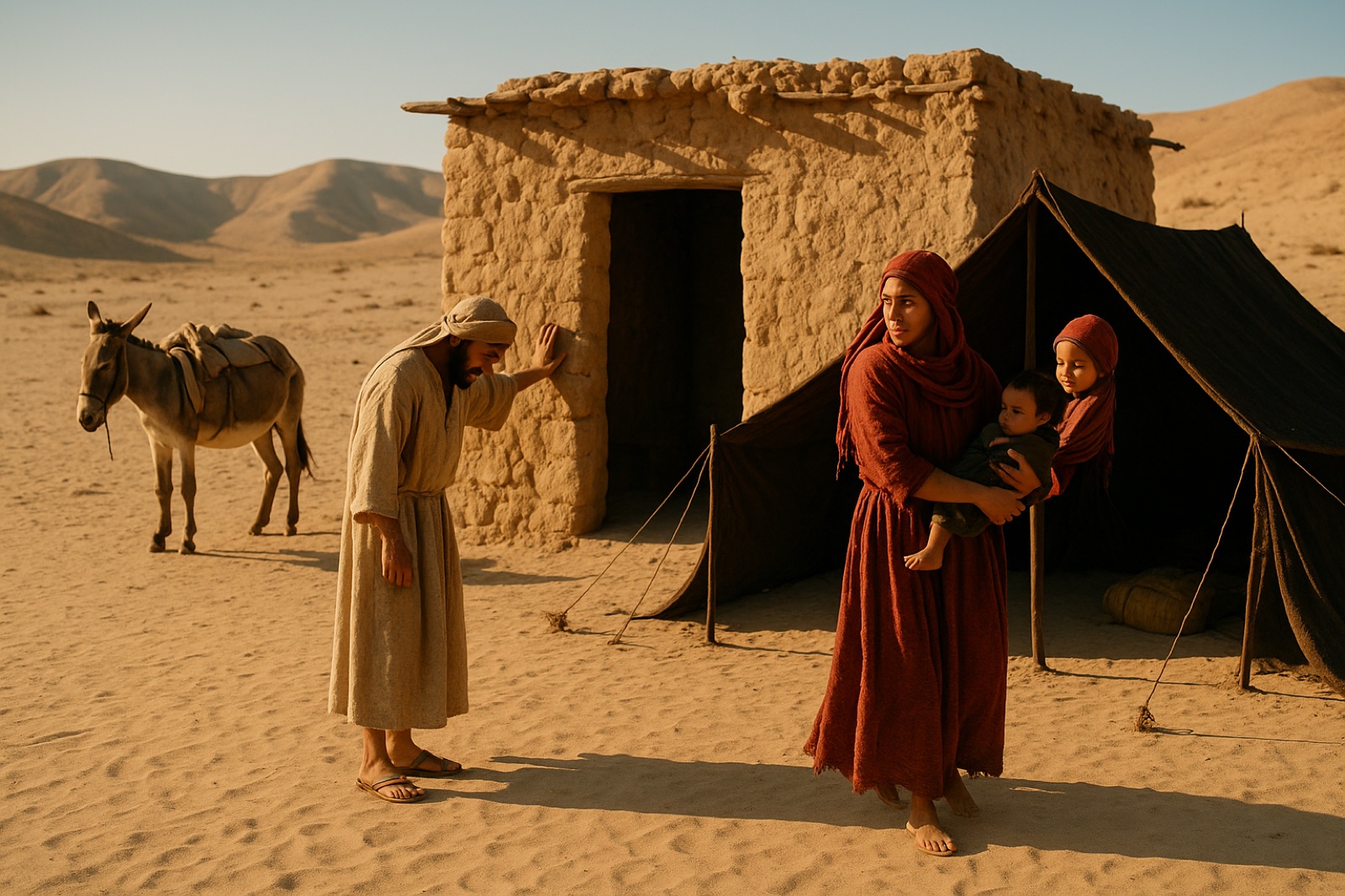
You are reading along in Exodus, and the story is finally moving. Moses has met God at the burning bush. He has argued, been given signs, been handed a mission. He is on the road back to Egypt with his wife and his son.
Then three verses arrive that stop you cold. You read them again. You read them a third time. And you sit there thinking: wait — what?
Why did God try to kill Moses? That is the question Exodus 4:24-26 puts in your hands, and then leaves you holding alone. No explanation. No follow-up. The story simply carries on as if nothing unusual just happened.
If that passage has ever unsettled you, nothing is wrong with your faith. It has unsettled everyone who has read it carefully — including the people who translated it thousands of years ago. Here is what it actually says, what it honestly does not say, and why it may be sitting in exactly that spot on purpose.
Why did God try to kill Moses? What Exodus 4:24-26 actually says
Here are the three verses, word for word:
“And it came to pass by the way in the inn, that the LORD met him, and sought to kill him. Then Zipporah took a sharp stone, and cut off the foreskin of her son, and cast it at his feet, and said, Surely a bloody husband art thou to me. So he let him go: then she said, A bloody husband thou art, because of the circumcision.”
— Exodus 4:24-26, KJV
That is the whole thing. Around sixty words. No reason given. No aftermath described.
Now notice what is missing, because the gaps are exactly why this passage is so hard:
- The text never says why. Not one word of motive.
- The text never clearly says who. In the Hebrew, “him” is simply “him.” Most readers take it as Moses, and that is the natural reading — but the passage itself does not spell it out.
- The text never says whose feet the blood was cast at.
- And nobody agrees on what “a bloody husband” actually means.
That last one is worth a pause. If you have heard this passage discussed anywhere, you have probably heard the phrase “bridegroom of blood.” That wording is not in the King James Bible at all. The KJV says “a bloody husband.” Different English Bibles land in noticeably different places on that one short phrase — which tells you something honest. The underlying Hebrew is genuinely difficult, and translators have been doing their best with a line that has puzzled readers for a very long time.
So let me say plainly what a lot of writing on this passage will not: nobody knows for certain what is happening here. Careful, faithful readers have disagreed about it for centuries and still do. Anyone who hands you a tidy, confident answer is giving you their best guess dressed as a fact.
That honesty is not a weakness in the Bible. As you will see in a moment, it may be the most trustworthy thing about this passage.
The ancient translators flinched too
Here is the detail that surprised me most, and it rarely comes up.
When Jewish scholars translated the Hebrew Bible into Greek — the version we call the Septuagint, produced a couple of centuries before Jesus — they did not render Exodus 4:24 straight. Where the Hebrew says the LORD met him, the Greek says an angel of the Lord met him. The old Aramaic translations, the Targums, made the same move.
Sit with what that means. The discomfort you feel reading this passage is not modern squeamishness. It is not weak faith or a soft generation. Readers who lived closer to this text than we ever will, working in the original language, felt it too — and reached for a way to soften it.
And here is the part I keep coming back to: the Hebrew was never changed. The hard version stayed in the book. Someone could have quietly smoothed it out at the source, and no one would have known. Nobody did. It is one of many places where scripture keeps a passage that makes its own story harder to explain — which is a real reason to trust it more, not less. If that pattern interests you, it runs through the disturbing Bible passages pastors never preach, and this one belongs near the top of the list.
And if a passage like this leaves you with more questions than you started with, that is a healthy place to be. You can think them through with our free Bible Answers assistant, which opens in ChatGPT and is built for exactly this kind of question.
Zipporah is the one who moves
Whatever is happening in verse 24, one thing in this passage is not ambiguous at all.
Moses does nothing. He does not speak. He does not pray. He does not act. As far as the text tells us, the man who had just been commissioned to walk into Egypt and confront the most powerful ruler on earth is completely passive in the most dangerous moment of his own life.
His wife is the one who moves. Zipporah — a Midianite woman, raised outside Israel and outside the covenant — reads the situation instantly and does the thing that needs doing. She takes a sharp stone. She circumcises their son. She speaks. And the danger lifts.
She is one of the very few women in scripture who acts decisively and single-handedly keeps the story alive, and she gets three verses for it before stepping back into the background. If you have never looked at her closely, who Zipporah was is worth an unhurried read.
Why circumcision, of all things? Because it was the sign of the covenant God had made with Abraham — the mark on the body that said this household belongs to that promise. And there is a detail in the Hebrew that makes it land harder: in Hebrew you do not make a covenant, you cut one. That is not a poetic flourish, it is what the Hebrew word for covenant literally does. A covenant was never a document. It was always something cut, and something that cost blood.
One careful note before we go further. The text never says Moses had neglected this. That is an inference — the oldest and most reasonable one, and later translators wrote it into their versions because the Hebrew itself would not say it — but it is still an inference, not a statement. What we can say with confidence is narrower, and more interesting: whatever the danger was, the answer to it was the covenant sign, applied in blood, immediately.
The three verses right before it change everything
This is where the passage stops looking random.
Almost everyone meets Exodus 4:24-26 as a strange fragment, quoted on its own, with nothing around it. Read what comes immediately before, and the whole picture shifts:
“And thou shalt say unto Pharaoh, Thus saith the LORD, Israel is my son, even my firstborn: And I say unto thee, Let my son go, that he may serve me: and if thou refuse to let him go, behold, I will slay thy son, even thy firstborn.”
— Exodus 4:22-23, KJV
Read them back to back and the echo is hard to miss. Verse 23: a message about a firstborn son, and a warning of death. Verse 24: the man carrying that message is met on the road, and his own son is suddenly at the centre of a matter of life and death.
One paragraph apart. The same words keep landing — son, firstborn, slay, and then blood. You do not need anyone’s commentary to see that. You can see it with your own eyes in your own Bible in about ninety seconds.
The turn: blood applied, and death passes by
Now hold that beside what happens eight chapters later.
In Exodus 12, on the night of the first Passover, death moves through Egypt and every household is exposed. What protects a family that night is not their record, their courage, or how useful they are to God. It is blood — applied, physically, to their own doorway. And death passes over them.
Now look back at that roadside. A household in danger. Blood, applied. The danger passes.
Moses’ own family lives out the Passover pattern before Egypt has ever heard the word.
God did not cancel the mission. God stayed on the road with Moses.
That changes how the whole passage feels. Read these three verses as “God nearly destroyed a man for missing a rule,” and you are left with a God who has to be handled carefully — and that is not the God the rest of Exodus shows you. Read them as the first place in scripture where a household is spared because blood was applied, and something else happens entirely. The most frightening moment in Moses’ story turns out to be the first rough sketch of the mercy the whole book is walking toward.
Which is worth saying out loud, because it is the opposite of what this passage looks like at first glance. Even here, the answer is not perform better. The answer is something applied on your behalf. That is grace, in its oldest and roughest form, at a roadside stop in the middle of a journey.
What this carries into an ordinary week
Two things travel from that roadside into your actual life.
First: the public assignment does not cover the private thing. Moses had a commission from God, signs in his hand, and a whole nation waiting on him. None of it settled what was unfinished in his own household. That is not a threat hanging over you. It is closer to an invitation — God is not only interested in your work, your calling, or the part of your life other people can see. God is interested in your home, where nobody is watching and nobody is impressed.
Second: the person beside you may be the one who moves. If you have ever been carried by someone else’s quick, unglamorous action — the friend who turned up, the spouse who made the decision while you froze, the neighbour who noticed — that is not a footnote in your story. In Exodus, it is the entire scene.
And if you are the Zipporah in someone’s life right now, the one who sees what needs doing and does it while everyone else stands still: scripture saw you. You are not overreacting. You may be the reason the story keeps going.
Actions to take
- Read Exodus 4:21-26 out loud, all six verses, in one go. Two minutes. The three-verse version is what makes this passage incomprehensible; the six-verse version is what makes it make sense. Do it before you read anything else about it.
- Name the one private thing you have been carrying while doing something public. Write it on paper in a single line. Not a plan. Not a solution. Just the name of it, where you can see it.
- Do the smallest honest version of it today. One message. One apology. One sentence said out loud to the person it concerns. Ten minutes at most. Zipporah did not hold a meeting about it — she moved.
Journaling prompts
- Where in your life are you doing the visible work well, and quietly hoping the invisible thing sorts itself out?
- Who has been a Zipporah for you — someone who acted while you were frozen? What have you never said to them about it?
- When you hit a part of the Bible you cannot explain, what do you usually do with it? What does that reveal about what you expect God to be like?
A prayer for the hard passages
God, I do not understand this one, and I am tired of pretending that I do. I would rather bring You my honest confusion than a neat answer I do not actually believe. Thank You that You did not edit the difficult parts out of the book — and that You have never edited the difficult parts out of me either. Meet me where I actually am tonight, in the unfinished thing I keep walking past. Amen.
Discussion question
Do you think the Bible is more trustworthy because it kept passages like this one, or do difficult texts make faith harder to hold? There is no safe answer here and no wrong one — tell us honestly what you think in the comments.
Share this
- Three verses in Exodus almost nobody preaches. God meets Moses on the road and seeks to kill him — and his wife is the one who moves. I have read Exodus a dozen times and never really looked at this.
- The ancient Greek and Aramaic translators found Exodus 4:24 so hard that they changed “the LORD” to “an angel of the Lord.” But nobody ever changed the Hebrew. The hard version stayed in the book. That is not a weakness — it is a reason to trust it.
- Exodus 4:23: God warns Pharaoh about a firstborn son. Exodus 4:24: Moses’ own son becomes a matter of life and death. Blood is applied, and the danger passes. Passover, eight chapters early, in Moses’ own tent.
Questions people ask about Exodus 4:24-26
Why did God try to kill Moses in Exodus 4:24-26?
Exodus 4:24-26 does not give a reason. The passage says only that the LORD met him at a lodging place on the way and sought to kill him, that Zipporah circumcised their son, and that the danger then lifted. The most common explanation is that Moses had not circumcised his son and so had neglected the sign of the covenant, but scripture never states this. Readers have disagreed about the passage for centuries, and it remains genuinely unresolved.
What does “a bloody husband” mean in Exodus 4:25?
“A bloody husband art thou to me” is how the King James Version renders Zipporah’s words after she circumcises her son. Other English Bibles translate the same Hebrew phrase as “bridegroom of blood.” The expression appears nowhere else in the Bible, its original sense is uncertain, and no translation of it is universally accepted.
Who did God seek to kill — Moses or his son?
The Hebrew of Exodus 4:24 uses only the pronoun “him,” without naming the person. Most readers understand it to mean Moses, since Moses is the subject of the surrounding narrative, and that is the standard reading. A minority have argued it refers to Moses’ son. The text itself does not specify.
Why did Zipporah circumcise her son at the lodging place?
Circumcision was the physical sign of the covenant God made with Abraham, marking a household as belonging to that promise. In Exodus 4:25 Zipporah performs it immediately with a sharp stone, and the threat against her husband ends. Her action is the turning point of the passage, and Moses himself neither speaks nor acts in the scene.
Is Exodus 4:24-26 connected to Passover?
The two passages share a striking pattern. Exodus 4:22-23, immediately before, concerns a firstborn son and a warning of death, and in Exodus 12 the Israelites are spared on the night of Passover when blood is applied to their doorways. At the lodging place a household in danger is likewise spared after blood is applied. The Bible does not state the link outright, but the repeated language of son, firstborn, death and blood is visible in the text itself.