 0
0
 0
0
To build the hottest thing anyone has ever made, you would assume you need something big.
That was the assumption for years. If you want to recreate the matter that filled the universe in its first moments, you take the heaviest atoms you can find — lead, usually — and you smash them together at almost the speed of light. Big nuclei. Big collision. Big energy. Anything smaller was thought to be too slight to do the job.
A team at CERN has now made that same primordial matter using two of the smallest nuclei ever tried. They are calling it a tiny Big Bang, and the surprise is not only that it worked. It is what the wreckage turned out to be carrying.
What a Tiny Big Bang Actually Is
Roughly a millionth of a second after the Big Bang, the universe was too hot for atoms to exist. Protons and neutrons could not hold together. What filled everything instead was a kind of soup made of the pieces that normally sit locked inside them — quarks, and the gluons that bind them.
Physicists call that soup quark-gluon plasma. It is the hottest and one of the strangest states of matter known, and it has not existed naturally anywhere in the universe for about 13.8 billion years.
So if you want to study it, you have to make some.
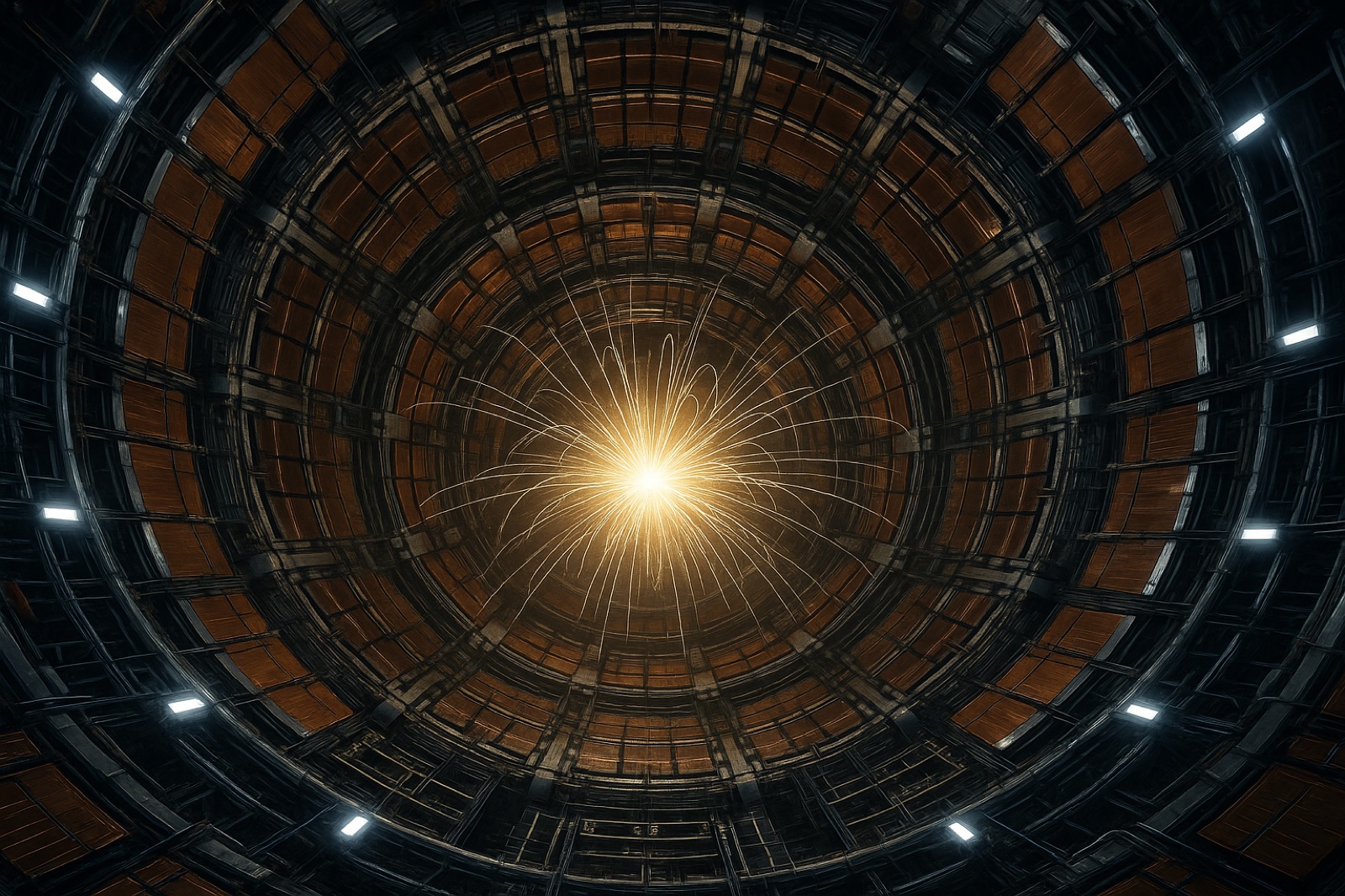
That is what the Large Hadron Collider does. Inside a ring buried under the border of France and Switzerland, atomic nuclei are accelerated to nearly the speed of light and slammed into each other. For an instant — far too short to imagine — the collision point gets hot enough to melt protons back into their parts. Then it cools, and it is gone.
Two Very Small Nuclei
The ALICE collaboration, one of the large international teams working at the collider, ran collisions using oxygen-16 and neon-20 nuclei. The data was recorded in July 2025, and the results were reported in August 2026.
Both of those are tiny. An oxygen nucleus holds sixteen particles. A neon nucleus holds twenty. A lead nucleus — the usual tool for this job — holds more than two hundred.
The plasma formed anyway.
“We have pushed the boundary for how small the atomic nuclei can be while still recreating this primordial matter — what you could call a Little Big Bang,” said You Zhou, an associate professor at the Niels Bohr Institute at the University of Copenhagen, who led the work.
It is worth being careful about how settled this is. Whether genuinely small collisions produce real quark-gluon plasma, or something that only imitates it, has been an open argument in physics for over a decade. This result pushes hard in one direction. It does not end the conversation.
The Part Nobody Was Really Expecting
Here is the finding that makes this more than a record.
Nobody has ever seen an atomic nucleus. You cannot photograph one. It is far too small for any microscope that exists or is likely to exist. Its shape has always had to be inferred, indirectly, from theory and from clues.
When these nuclei were destroyed, the particles that sprayed out did not scatter randomly. They flowed in patterns. And the patterns were different depending on which nucleus had been used.
Neon-20 is understood to be elongated — stretched out, a bit like a bowling pin. Oxygen-16 is more compact and clustered. Those two shapes produced two distinguishable signatures in the debris.
Which means the shape of the thing survived the destruction of the thing.
The nucleus was obliterated. It stopped existing as a nucleus at all. And the pattern it left behind still carried an honest record of what it had been — a record precise enough that researchers can work backwards from the mess to the geometry.
This is a real technique now, not a curiosity. It gives nuclear physicists a way to read the structure of something permanently invisible, using the one moment when it is coming apart. It is the same logic that lets astronomers weigh galaxies by the stars too faint to see — you measure the effect, and the effect tells you the cause.
The Question Turned Around
For most of this field’s history the question ran upward. How much mass do we need? How much energy? How big does a collision have to be before the universe’s first matter will appear?
That question has now flipped.
The team’s next step is to go smaller still — helium-4 is on the list, a nucleus of just four particles. They are no longer asking how large a collision must be. They are asking how small it can get and still work. Nobody knows the floor. That is precisely why they are looking for it.
There is an old idea, far older than particle physics, that runs along the same line: that what a thing truly is tends not to show up under direct inspection at all, but in what it leaves behind — and that nothing is ever too small to have a shape worth reading.
The people doing this work would not put it that way. They would say they are measuring flow patterns in heavy-ion collisions, and they would be right. But it is a curious thing to sit with — that the only way we have found to learn the shape of the smallest objects in existence is to watch what remains after they are gone.
Why This Matters Beyond the Collider
Practically, this widens what the collider can study. Small collisions are cheaper to run and easier to interpret, so a lot more of them can be done. It also gives physicists a fresh handle on nuclear structure, which feeds into everything from stellar physics to how the elements were made.
But the quieter result is the one about scale.
A great deal of scientific effort has gone into the assumption that the important things are the big things — the heaviest nucleus, the largest telescope, the biggest collision. This particular finding pushed in the opposite direction and found the universe’s oldest matter waiting in something almost nothing.
If the age and size of the universe is the part that keeps catching your attention, our free How Old Is the Universe? Explorer walks through how that number is actually measured, in a couple of minutes. And if scale is the thread you want to pull, a telescope built to photograph billions of galaxies at once is the same question pointed the other way.
One Question Worth Sitting With
Scientists spent years assuming the early universe could only be recreated by something enormous, and were wrong about it. Do you think that assumption was a reasonable one to make — or is there a habit in how we look at the world that makes us reach for the biggest version of a thing first? Tell us what you think.
Share This
- “Physicists made the universe’s oldest matter by colliding two tiny nuclei. The debris still carried the shape of what made it. You cannot photograph a nucleus — so they read the wreckage instead.”
- “For years the assumption was that recreating the early universe took something enormous. It didn’t. Now the question has flipped to how small it can possibly get.”
- “The shape of the thing survived the destruction of the thing. That is the part of this experiment I can’t stop thinking about.”
Questions People Ask About the Tiny Big Bang Experiment
What is a “tiny Big Bang”?
A tiny Big Bang is the nickname for a laboratory collision that briefly recreates quark-gluon plasma, the ultra-hot matter that filled the universe roughly a millionth of a second after the actual Big Bang. Researchers at CERN used the phrase “Little Big Bang” to describe producing that matter from unusually small atomic nuclei.
What is quark-gluon plasma?
Quark-gluon plasma is a state of matter so hot that protons and neutrons cannot hold together, leaving their component quarks and gluons moving freely. It filled the universe in its earliest moments and does not occur naturally anywhere today, so it has to be produced in particle colliders to be studied.
Which nuclei were collided in the CERN experiment?
The ALICE collaboration collided oxygen-16 and neon-20 nuclei at CERN’s Large Hadron Collider, using data recorded in July 2025. Oxygen-16 contains sixteen particles and neon-20 contains twenty, compared with more than two hundred in the lead nuclei normally used for this kind of experiment.
How can scientists know the shape of an atomic nucleus if it cannot be seen?
An atomic nucleus is far too small to photograph, so its shape is inferred indirectly. In collider experiments, the particles thrown out by a collision flow in patterns that differ according to the geometry of the original nucleus, allowing researchers to work backwards from the debris to the shape — elongated nuclei and compact nuclei leave distinguishable signatures.
What happens next in this research?
Researchers plan to test even lighter nuclei, with helium-4 named as a likely next step, in order to find the smallest collision system that can still produce quark-gluon plasma. That lower limit is currently unknown, and whether very small collisions produce true quark-gluon plasma remains an open question in physics rather than a settled one.