 0
0
 0
0
Nobody has ever seen dark matter. Not through a telescope, not in a laboratory, not once.
And yet in August 2026, a team of astronomers announced they had measured how much of it sits inside a galaxy about 115 million light-years from here. They did it by looking at a thin thread of stars — a stellar stream — and reading the dark matter off the shape of the curve.
The thread had been sitting in old telescope images the whole time. Nobody had noticed it.
What a Stellar Stream Actually Is
Start with a globular cluster: a tight ball of stars, hundreds of thousands of them, orbiting a galaxy the way a moon orbits a planet.
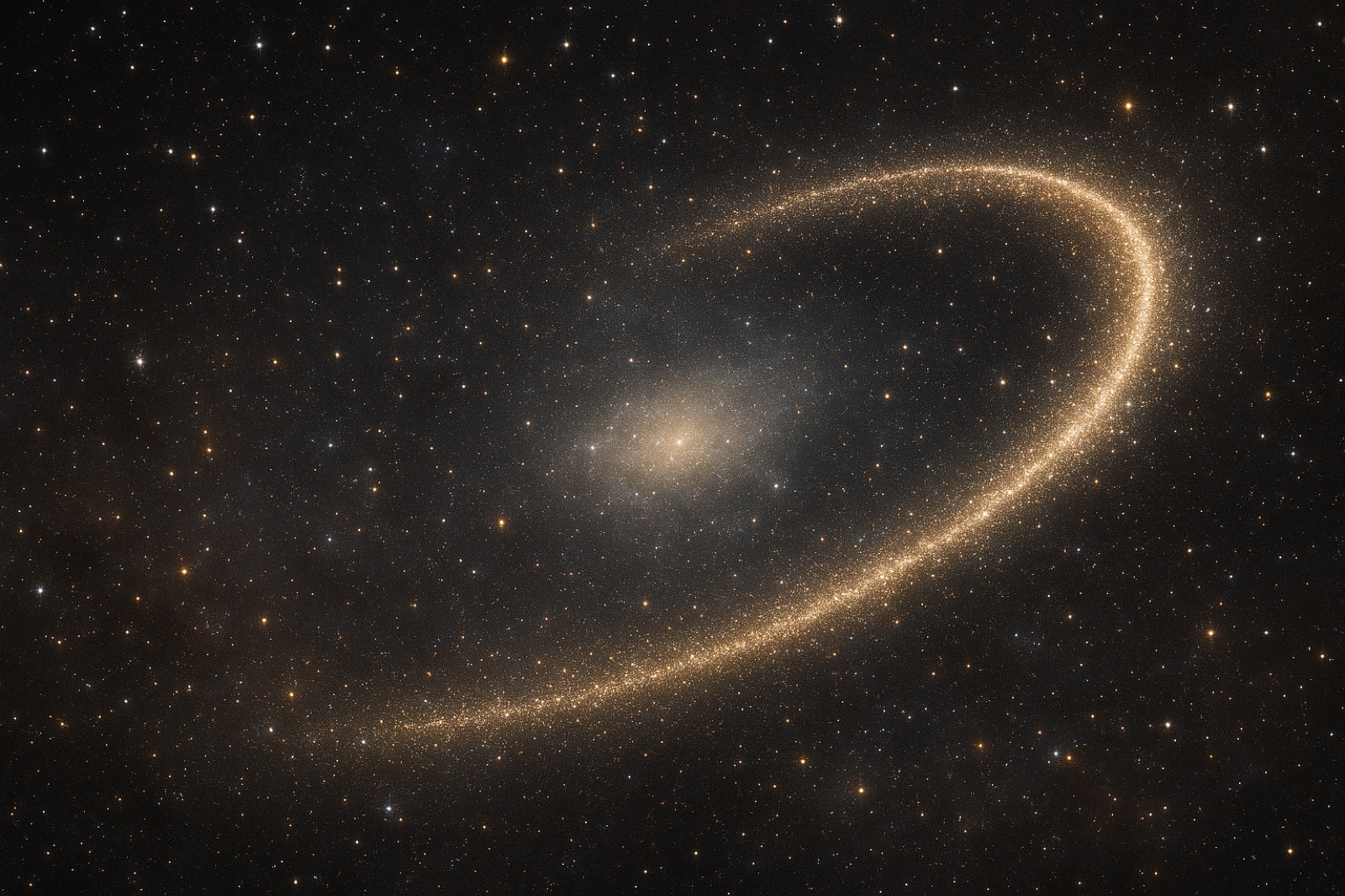
As it goes around, the galaxy’s gravity keeps tugging at the edges of the ball. Stars get peeled off. But they do not scatter. They keep travelling along almost exactly the same orbit the cluster was on, so they spread out into a long, thin ribbon — a trail of stars strung out along the path their parent cluster took.
That ribbon is a record. It is the shape of the gravity that pulled it.
Astronomers have studied streams like this inside our own Milky Way for years. What happened in August was different: for the first time, one was identified around a galaxy that is not ours.
How a Stellar Stream Maps Dark Matter
The galaxy is called UGC 9050-Dw1. It sits roughly 115 million light-years away, and it belongs to a strange category: an ultra-diffuse galaxy. Galaxy-sized, but with its stars spread so thinly that it is barely there at all.
The findings were published in Nature on 12 August 2026, from a team co-led by Julie Kiel Holm at the University of Copenhagen and Sarah Pearson at the Technical University of Denmark.
Here is the logic they used. Every star in that ribbon is riding an orbit. Orbits are shaped by gravity. Gravity comes from mass. So if you can model the orbit precisely enough, you can work backwards to the total mass of the galaxy holding it.
“The stars in a stellar stream all travel along nearly the same orbit, shaped by the galaxy’s gravity,” said Tjitske Starkenburg of Northwestern University, a co-author on the study. “By modeling that gravity, we can estimate the galaxy’s total mass.”
The team ran thousands of computer simulations, asking which arrangements of mass could produce the exact curve they were looking at.
Then comes the subtraction. As Holm put it: “We already know roughly how much of that mass comes from visible matter like stars, so the rest must be dark matter.”
Add up the light. Compare it to the gravity. The gap is the answer. In this case the gap was large — the galaxy holds a substantial amount of dark matter, which is what astronomers expected for an ultra-diffuse galaxy, though nobody had been able to check it this way before. Exactly what dark matter is remains unsettled. What it does is measurable.
The Detail Almost Everyone Skipped
Here is the part of this story that deserves more attention than it got.
No new telescope was built for this. No new observation was scheduled. The stream was found in archival Hubble Space Telescope data — images that had already been taken, already stored, already sitting in an archive.
Team member David Hendel spotted the stream in those images.
Think about what that means. The evidence was fully collected before anyone knew what it was evidence of. The photons had already arrived. The file had already been saved. Nothing about the universe changed in August 2026. What changed was that somebody looked at existing data and knew what they were looking at.
And there is a second detail folded inside the first, which is almost too neat to be true.
The stream was visible because the galaxy is so faint. A stellar stream is extremely dim. Against a normal, bright galaxy it would be washed out completely. UGC 9050-Dw1 is so sparse, so close to empty, that the faint ribbon finally had enough contrast to show up.
The emptiness of the place is what made the invisible thing readable.
What This Does Not Prove Yet
It is worth being precise here, because the exciting version of this story runs slightly ahead of the evidence.
The researchers’ bigger hope is not the mass measurement. It is this: when a small clump of dark matter passes near a thin stream of stars, its gravity should leave a mark — a gap, a kink, a ripple in the ribbon. Find those marks, and you are no longer measuring how much dark matter a galaxy has. You are mapping where it sits, clump by clump.
That would be a genuinely new way to test what dark matter is made of.
But it has not been done yet. Those features have to be confirmed as the work of dark matter clumps rather than something else, and this study looked at a single galaxy. One stream, one measurement, consistent with what other methods had already suggested — which is precisely why it was trusted, and also precisely why it is a beginning rather than a conclusion.
The Part That Has Nothing To Do With Telescopes
There is an old argument that believing in anything you cannot see is the opposite of thinking clearly. Evidence on one side. Faith on the other. Pick a team.
But look at what these astronomers actually did.
They never saw the thing. They never expected to. They found something they could see — a thread of stars — measured the way it had been bent, and then said, carefully, with numbers attached: something is here.
That is not a shortcut around evidence. That is evidence. It is just evidence of a particular kind — reading the invisible through what it visibly moves.
People have described God in almost the same terms for thousands of years. Not as something anyone claims to have photographed. As the explanation for a shape in the data — a pull on a life that keeps bending it somewhere it would not have gone on its own. Whether that pull is real is a fair question, and an old one, and not one an article settles.
But the method is not a strange one. It is the same method that just worked, 115 million light-years away.
What Happens Next
This was one stream around one unusually faint galaxy, found by a good eye in data that already existed. The next round will not depend on luck.
The European Space Agency’s Euclid mission and NASA’s Nancy Grace Roman Space Telescope are built to survey enormous stretches of sky at once — vastly more than Hubble can cover. If ribbons like this one are hanging around other galaxies, those two are the instruments most likely to find them.
Which means the number of galaxies we can weigh this way may be about to go from one to many.
It is worth sitting with the scale for a second. The light that carried this discovery left that galaxy around 115 million years ago and has been travelling ever since — a span that makes the age of the universe feel less like a number and more like a distance you could fall into.
And the ribbon itself was in the archive for years, fully visible, waiting for someone to recognise it.
Unnoticed was never the same thing as absent.
A Question Worth Arguing About
If the only way to detect something is by what it moves, is that weaker evidence than seeing it — or simply a different kind of evidence that we are less used to trusting?
Tell us where you land. We read every reply.
Share This
Astronomers just measured dark matter in a galaxy 115 million light-years away — using a ribbon of stars nobody had noticed in old Hubble images. The evidence was already collected. Someone just knew how to look. https://bgodinspired.com/index.php/bible-resources/bible-and-science/stellar-stream-dark-matter-distant-galaxy/
The stream was only visible because the galaxy is so faint. Against a brighter galaxy it would have been washed out completely. The emptiness of the place is what made the invisible thing readable. https://bgodinspired.com/index.php/bible-resources/bible-and-science/stellar-stream-dark-matter-distant-galaxy/
Nobody has ever seen dark matter. They measured it anyway — by the shape of what it bent. I have been thinking about that all day. https://bgodinspired.com/index.php/bible-resources/bible-and-science/stellar-stream-dark-matter-distant-galaxy/
Questions People Ask
What is a stellar stream?
A stellar stream is a long, thin ribbon of stars that forms when a galaxy’s gravity slowly pulls stars away from an orbiting globular cluster. The escaping stars do not scatter — they keep travelling along nearly the same orbit as the cluster, stretching into a narrow trail. Because the shape of that trail is set by the gravity acting on it, a stellar stream works as a record of the mass in the galaxy it orbits.
How do astronomers detect dark matter if it is invisible?
They measure its gravity rather than the substance itself. Dark matter gives off no light, so it cannot be photographed, but it still pulls on things that can be seen. Astronomers measure the motion or shape of visible objects — stars, streams, whole galaxies — calculate how much mass would be needed to produce that motion, then subtract the mass they can account for in visible matter. The remainder is attributed to dark matter.
Which galaxy did astronomers find the stellar stream around?
The stream was found around UGC 9050-Dw1, an ultra-diffuse galaxy about 115 million light-years from Earth. Ultra-diffuse galaxies are galaxy-sized but have their stars spread extremely thinly, making them very dim. That dimness is what allowed the faint stream to be seen at all. The findings were published in the journal Nature on 12 August 2026.
Why does finding a stellar stream outside the Milky Way matter?
Until this discovery, globular cluster stellar streams had only been studied inside our own Milky Way, which limited astronomers to measuring dark matter in a single galaxy — the one we live in. Identifying one around another galaxy shows the technique can travel. It opens the possibility of weighing dark matter in many different types of galaxies rather than extrapolating from ours alone.
Can stellar streams show where dark matter is clumped?
That is the hope, but it has not been confirmed. Astronomers expect that when a small concentration of dark matter passes near a thin stellar stream, its gravity should leave a gap, kink or ripple in the ribbon of stars. If those features can be verified as the work of dark matter clumps rather than some other cause, streams would become a way to map where dark matter sits, not just how much of it there is. As of the August 2026 study, that step remains ahead.
Reported from the research team’s announcement via Northwestern University.