
 0
0
 0
0
Spiritual Devotional about Spirituality and Science
Harmony of Hearts and Minds: Bridging Spirituality and Science
Hello, beloved community! 🌟
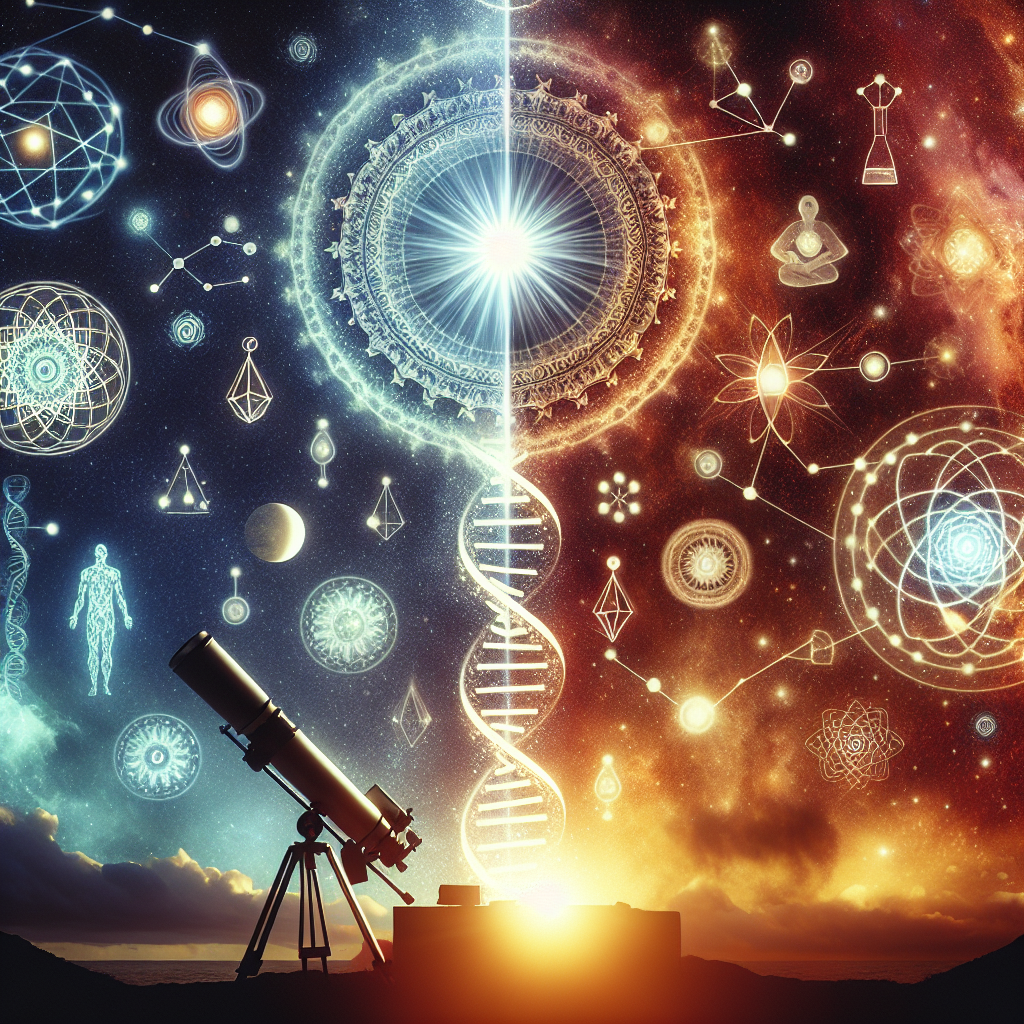
Today, let’s dive into an enriching exploration of how spirituality and science, often seen as distinct realms, beautifully intertwine to illuminate the mysteries of our existence. This journey not only enhances our understanding of the universe but also deepens our connection with the divine.
At first glance, spirituality and science may seem worlds apart—one is rooted in faith and the unseen, while the other relies on empirical evidence and observation. Yet, when we dig deeper, we discover that both seek truth, wisdom, and understanding.
The Beauty of Creation
In the very first chapter of Genesis, we find that God spoke the universe into existence. "And God said, ‘Let there be light,’ and there was light" (Genesis 1:3, NIV). This divine moment echoes in every scientific endeavor to understand the cosmos. Scientists study the vastness of space, uncovering the magnificence of stars and galaxies, revealing to us a glimpse of God’s creative power. Truly, science is a tool that helps illuminate the grandeur of God’s creation!
The Wonder of Life
Consider the intricacies of the human body. Psalm 139:14 reminds us, "I praise you because I am fearfully and wonderfully made" (NIV). Science explores the complexity of DNA, the heartbeat, and the neural networks that make us who we are. Each discovery is a testament to the divine artistry woven into our very being. Isn’t it awe-inspiring to know that every cell in our body sings praises of God’s handiwork?
Faith and Reason United
The Bible invites us to seek wisdom and understanding. Proverbs 3:5-6 encourages us to trust in the Lord and lean not on our own understanding, while also acknowledging Him in all our ways. Here lies a powerful harmony: faith doesn’t demand the absence of reason, nor does science erase the necessity of faith. Together, they lead us to a fuller, more profound comprehension of life’s mysteries.
Inspired Action
As we walk this earth, let’s embrace both the spiritual and the scientific realms with open hearts and minds. Allow your faith to ignite curiosity and let scientific exploration deepen your faith. By celebrating this beautiful synergy, we become vessels of God’s love and wisdom in a world yearning for hope and understanding.
Take a moment to appreciate the wonders of creation around you—a sunset, the laughter of a child, the miracle of life itself. Each is a reminder that science and spirituality are not separate paths, but threads in the same divine tapestry.
Let us lift our hearts in gratitude and seek to harmonize these marvelous gifts in our daily lives. Embrace the mystery, engage with creation, and let your journey be one of joy, discovery, and inspiration.
May your spirit be uplifted and your mind enlightened, beloved friends. 💖
Blessings to you all!
If you want to want to know more about this topic, check out BGodInspired.com or check out specific products/content we’ve created to answer the question at BGodInspired Solutions
Q&A about Spirituality and Science
Q&A: Spirituality and Science
Q1: How do spirituality and science differ in their approach to understanding the universe?
A1: Spirituality often involves personal, subjective experiences and beliefs concerning the soul, purpose, and the nature of existence. It may include practices that aim to connect individuals with a higher power or the universe on a deeper level. Science, on the other hand, relies on empirical data, experiments, and observation to understand natural phenomena. It seeks objective truths that can be tested and verified independently of personal belief.
Q2: Can spirituality and science complement each other?
A2: Yes, many believe spirituality and science can complement each other. While science can explain the mechanisms of how things work, spirituality can offer meaning and context to human experience. Some argue that integrating both can lead to a more holistic understanding of existence, addressing both the external and internal aspects of life.
Q3: Are there any scientific studies on the effects of spiritual practices?
A3: Yes, numerous studies have investigated the effects of spiritual practices, such as meditation and prayer, on mental and physical health. Research has shown that these practices can reduce stress, improve emotional well-being, and even lead to measurable changes in brain structure and function. However, results can vary, and more research is needed to fully understand these effects.
Q4: How do scientific theories like the Big Bang align with spiritual creation stories?
A4: Scientific theories like the Big Bang provide a framework for understanding the universe’s origins based on evidence and mathematical models. Spiritual creation stories, found in various religious texts, often convey deeper meanings about human existence and the cosmos. While they may differ in method and language, both seek to answer fundamental questions about our origins, though from different perspectives.
Q5: Can someone be both scientifically minded and spiritual?
A5: Absolutely. Many individuals find a balance between science and spirituality, valuing scientific inquiry’s rigor and spirituality’s personal and experiential aspects. Figures like Albert Einstein and Carl Sagan have expressed thoughts that combine scientific curiosity with a sense of wonder and reverence for the universe.
Q6: What role does skepticism play in both spirituality and science?
A6: Skepticism is a key component of scientific methodology, encouraging critical evaluation and questioning of evidence and hypotheses. In spirituality, skepticism can lead individuals to question dogma and explore personal truths. Healthy skepticism in both realms promotes deeper understanding and prevents the uncritical acceptance of ideas.
Q7: How do different cultures integrate spirituality and science?
A7: Different cultures integrate spirituality and science in varied ways. Some cultures have traditional systems of knowledge that encompass both natural and spiritual explanations for phenomena. Others separate the two more distinctly. The integration often depends on historical, philosophical, and sociocultural factors, leading to diverse expressions and understandings.


