
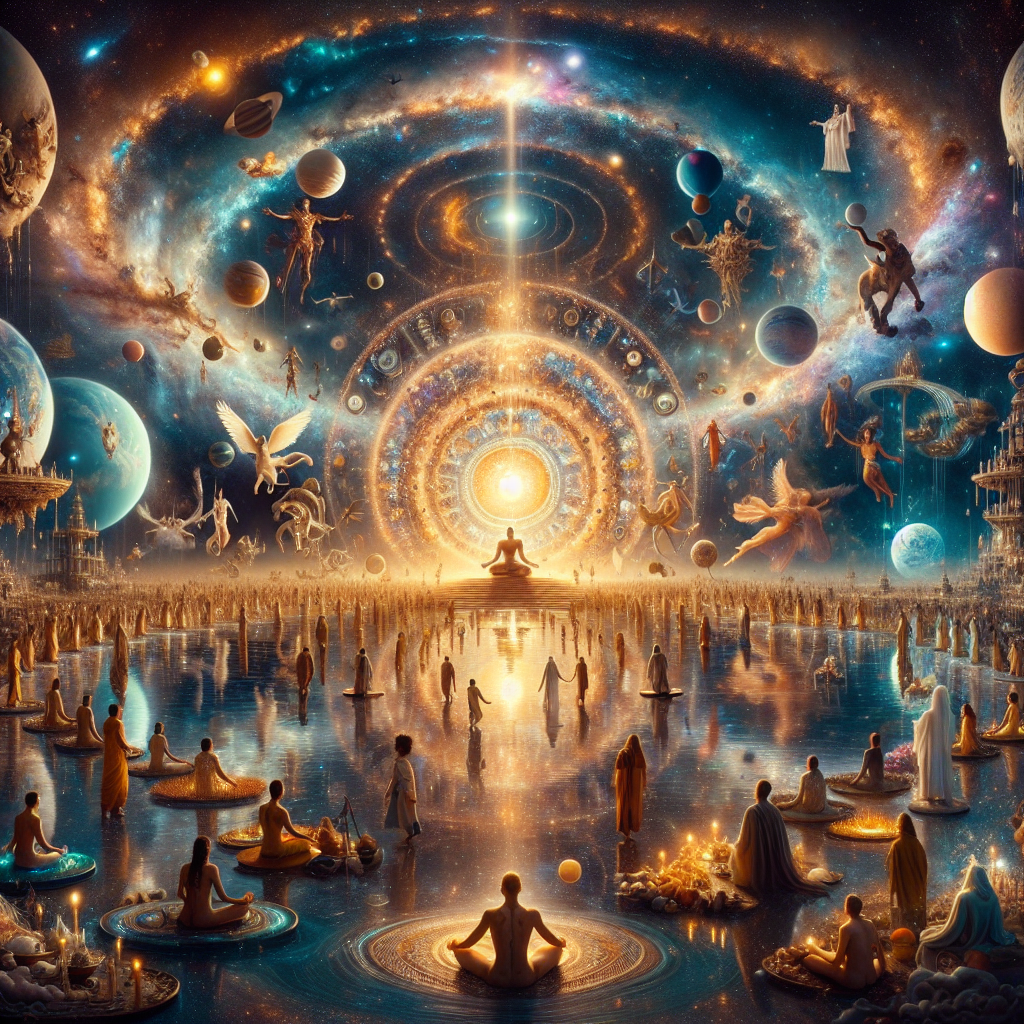
Spiritual Devotional about Non-Duality and Oneness
Title: Embracing Oneness: The Divine Dance of Non-Duality
Hello, beloved community! 🌟
Today, we embark on a spiritual journey exploring the profound yet liberating concepts of Non-Duality and Oneness. These themes have whispered through the sacred texts and teachings across ages, and when embraced, they instill a deeper sense of peace, love, and connection with the universe and our Creator.
Understanding Non-Duality and Oneness
Non-Duality, in essence, is the perception that all of existence is interconnected. It is the idea that beyond our apparent differences, every soul, every creature, and every atom is interwoven into a single, divine tapestry. Oneness is its heart – the recognition that we are not separate from the Divine, from each other, or from the world around us. We are all parts of a magnificent, shimmering whole.
The Biblical Connection
The Bible, bursting with spiritual wisdom, speaks to this profound truth in various ways. One of the most radiant gems can be found in Ephesians 4:4-6, which reminds us: "There is one body and one Spirit, just as you were called to one hope when you were called; one Lord, one faith, one baptism; one God and Father of all, who is over all and through all and in all."
Isn’t that awe-inspiring? This passage beautifully encapsulates the essence of Oneness – a divine unity that transcends our human-made distinctions and divisions.
Another powerful illustration of this idea is in Jesus’ poignant teachings about love. In John 13:34-35, He implores, "A new command I give you: Love one another. As I have loved you, so you must love one another. By this, everyone will know that you are my disciples, if you love one another." Here, love becomes a bridge to Non-Duality, a way of transcending separateness and embracing unity.
Living in the Light of Oneness
So, how do we bring the radiant principle of Oneness into our daily lives? Here are a few heartwarming steps:
-
Practice Compassion: Begin with yourself and extend it outward. Recognize the shared humanity in others, understanding that their joys and sorrows are reflections of our own.
-
Cultivate Presence: In moments of stillness, attune your awareness to the dance of life happening around you. Feel the Divine in the whisper of the wind, the laughter of a child, and the twinkle of the stars.
-
Embrace Diversity as Unity’s Expression: See the rich tapestry of cultures, beliefs, and perspectives as different threads that glorify the grand design of God’s creation. Your uniqueness and another’s are not barriers but beautiful notes in the symphony of existence.
-
Find God Within and Around You: Through prayer or meditation, connect with that divine spark within and acknowledge its presence in every being. Celebrate God’s omnipresence, knowing that His love flows through every heart.
A Final Encouragement
Dear friends, Oneness doesn’t mean losing yourself; instead, it invites you to embrace your true self in the vast, inclusive circle of life. Let’s journey together, weaving joy, kindness, and unity into the fabric of our shared existence.
Walk in love and let Oneness be your guide. Embrace the divine dance of Non-Duality, for you are wonderfully, beautifully connected to everything and everyone.
In unity and peace,
[Your Name] 🌍💖
Explore and dig up answers yourself with our BGodInspired Bible Tools! Be careful – each interaction is like a new treasure hunt… you can get lost for hours 🙂
Q&A about Non-Duality and Oneness
Q: What is Non-Duality?
A: Non-duality, or "Advaita" in Sanskrit, is a philosophical and spiritual concept that suggests that there is no separation between the self and the universe. It emphasizes that the perceived duality between the individual self and the external world is an illusion and that, in reality, there is only one unified existence. This understanding is often associated with various spiritual traditions, including Hinduism, Buddhism, and Taoism, and aims to bring about a realization of oneness and ultimate truth.
Q: How does non-duality relate to the concept of oneness?
A: Non-duality and oneness both point to the fundamental unity of all things. Non-duality specifically refers to the absence of separation or dual distinction between the self and the universe. Oneness takes this further by affirming that everything is interconnected and part of a single, overarching reality. Both concepts encourage the dissolution of boundaries and distinctions that fragment existence, fostering a holistic understanding of life.
Q: How can one experience non-duality or oneness?
A: The experience of non-duality or oneness is often described as a profound shift in perception where the boundaries between self and other dissolve. Practices such as meditation, mindfulness, self-inquiry, and contemplation are commonly used to cultivate this awareness. These practices help quiet the mind and loosen the rigid attachment to ego and identity, allowing one to perceive the interconnectedness of all things and experience a sense of unity and peace.
Q: What are the benefits of realizing non-duality and oneness?
A: Realizing non-duality and oneness can lead to numerous psychological and spiritual benefits. It often results in a deep sense of peace, as the individual no longer feels separate and isolated from the rest of existence. This realization can dissolve fear, reduce suffering, and enhance a sense of compassion and empathy towards others. Additionally, it often promotes a more harmonious and balanced way of living, as one becomes more aligned with the natural flow of life.
Q: How do different spiritual traditions interpret non-duality and oneness?
A: Various spiritual traditions have their interpretations of non-duality and oneness. In Hinduism, Advaita Vedanta focuses on the idea that the individual soul (Atman) and the universal soul (Brahman) are one. Buddhism speaks of "emptiness" and the interconnectedness of all phenomena, suggesting that nothing exists independently. Taoism emphasizes living in harmony with the Tao, recognizing the unity in the flow of life. Despite differences in language and specific teachings, these traditions converge on the understanding that separation is an illusion and unity is the underlying reality.
Q: Are non-duality and oneness scientific concepts?
A: While non-duality and oneness primarily arise from philosophical and spiritual traditions, there are parallels in scientific concepts, particularly in fields like quantum physics and ecology. Quantum physics challenges traditional notions of separateness by revealing the interconnectedness of particles at a subatomic level, while ecology recognizes the interdependence of all life forms within ecosystems. These scientific insights can complement and resonate with spiritual perspectives on oneness, offering a more comprehensive understanding of unity across different domains.


