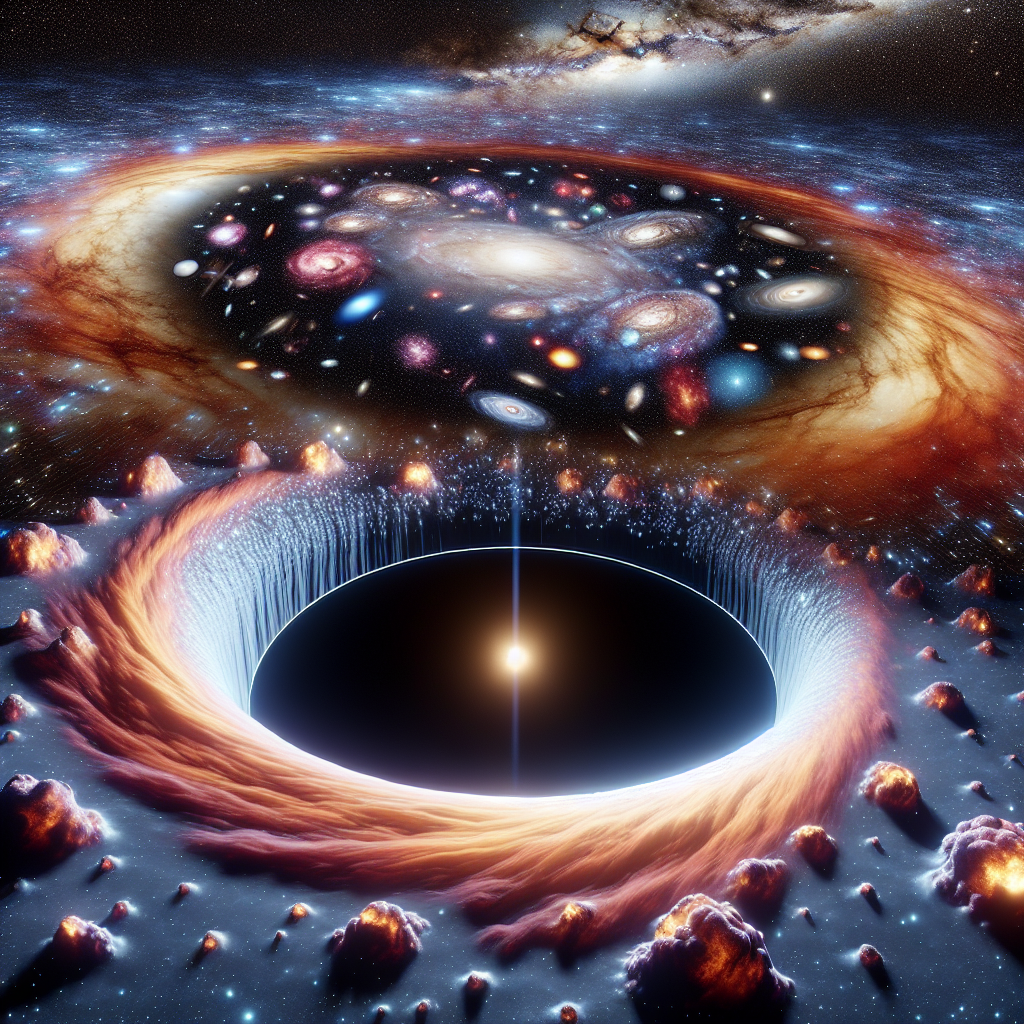
Could We Be Living Inside a Black Hole? New Theory Challenges the Big Bang Model
A groundbreaking theory proposed by a team of physicists led by Professor Enrique Gaztanaga from the Institute of Cosmos Sciences in Barcelona could transform our understanding of the universe and our very existence within it. Published in Physical Review D, the research suggests that instead of originating from a singular explosion known as the Big Bang, our universe may have "bounced" into existence from a black hole embedded in a prior "parent" universe.
This audacious claim ignites speculation: Could it be that everything we know is contained within a black hole? Gaztanaga and his colleagues argue that the Big Bang is not the point of origin, but rather a transitional moment in an ongoing cosmic cycle—one that suggests life and the universe are part of a much larger narrative.
At the heart of this theory is the Pauli exclusion principle, a cornerstone of quantum mechanics that prohibits identical particles from occupying the same state. Gaztanaga’s team posits that as a universe ages and collapses, this principle prevents total gravitational collapse, leading to a "bounce" that creates a new universe—a striking concept that could make us reconsider our place in the cosmos.
What distinguishes this model from countless other speculative physics theories is its groundedness in established principles of general relativity, avoiding reliance on exotic particles or untestable hypotheses. The researchers suggest this cyclical process is not just plausible but observable; they predict a slightly curved universe and a measureable cosmological constant. Such predictions could be verified through upcoming space missions, including the European Space Agency’s Arrakihs satellite.
If verified, this theory would challenge a foundational element of modern physics: the belief that the universe began from a singularity. Instead, it hints at an endless chain of universes—each iteration rising from the ashes of its predecessor.
“We are not witnessing the birth of everything from nothing,” Gaztanaga states. “But rather the continuation of a cosmic cycle.” This resonates with the biblical principle found in Ecclesiastes 3:1 (NIV): “There is a time for everything, and a season for every activity under the heavens.” The cyclical nature of existence suggested by Gaztanaga’s theory echoes the biblical idea of God’s eternal plan, reminding us that time and creation may not be linear as we often perceive.
As we contemplate these cosmic revelations, it’s important to reflect on the deeper spiritual implications. Rather than finding ourselves lost in the vastness of a universe that arose from chaos, we might better appreciate the order and purpose behind it—that each moment and each life is part of a greater design.
In conclusion, whether or not we are truly living inside a black hole, the contemplation of our origins invites us to consider a broader understanding of existence. Let us take the time to reflect on our own journeys within this cosmic tapestry, embracing the interconnectedness of all creation with hope and curiosity. After all, we may all be participants in an ongoing story planned by a Creator who sees each of us as significant parts of His grand narrative.
Explore and dig up answers yourself with our BGodInspired Bible Tools! Be careful – each interaction is like a new treasure hunt… you can get lost for hours 🙂