
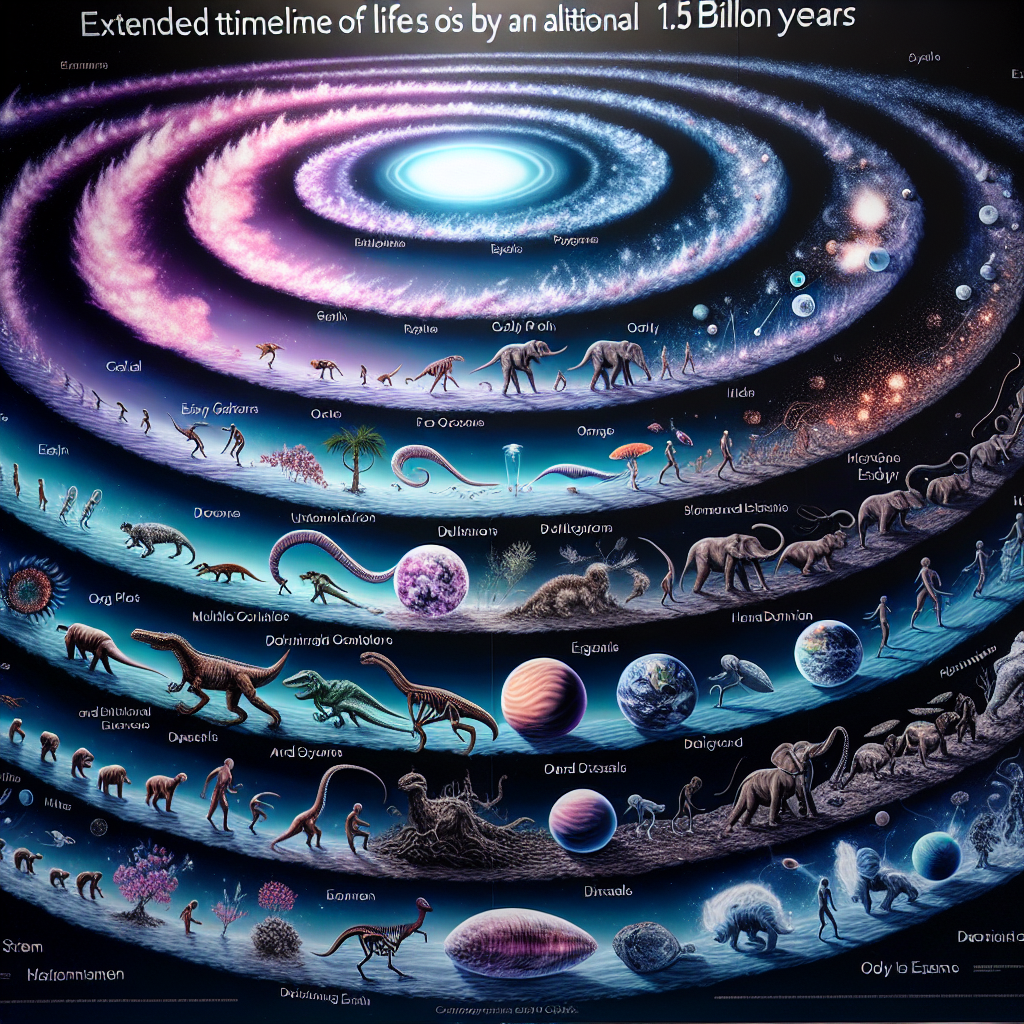
Timeline of Life’s Evolution Extended by Nearly 1.5 Billion Years
In a remarkable study that pushes the boundaries of our understanding of the Earth’s history, researchers at Virginia Tech have unveiled evidence suggesting that life on Earth began evolving nearly 2 billion years ago. This groundbreaking analysis offers a deeper insight into the origins, diversification, and eventual extinction of various species, extending the timeline of life’s history by almost 1.5 billion years.
A Comprehensive Overview of Ancient Life
Led by geobiologist Shuhai Xiao, the team utilized an innovative graphic correlation program to analyze fossil evidence from the Proterozoic Eon, which spans from approximately 2.5 billion to 539 million years ago. During this period, life forms primarily consisted of smaller, softer organisms like sea sponges that lacked the hard parts required for fossilization, making earlier life nearly invisible in the geological record.
“This is the most comprehensive and up-to-date analysis of this period to date,” Xiao stated, emphasizing the significance of the findings. The research offers a high-resolution overview of the global diversity of Proterozoic life and sets the stage for understanding how life evolved on Earth.
Emergence of Complex Life
Throughout the Proterozoic Eon, simple microscopic organisms like bacteria and algae dominated the oceans and played a pivotal role in atmospheric changes. Their photosynthetic activity contributed to an increase in oxygen levels, thus creating an environment conducive to more complex life forms. By the mid-Proterozoic, eukaryotes—cells with a nucleus that form the foundation of all plants and animals—emerged, setting the stage for an explosion of biodiversity in subsequent eons.
Interestingly, this research highlights a period known as the “boring billion,” where evolutionary changes slowed dramatically. For around a billion years, species diversity remained relatively stable, leading scientists to speculate about the underlying causes of this stagnation.
The Role of Catastrophic Events
The dynamics of life shifted dramatically during the “Snowball Earth” events, severe ice ages occurring between 720 million and 635 million years ago. These global glaciations appear to have reset the evolutionary trajectory of many species, fostering rapid diversification and allowing ecosystems to flourish. “The ice ages were a major factor that reset the evolutionary path,” Xiao noted, referring to the essential reset in biodiversity that followed the glacial periods.
In reflecting on these scientific revelations, a connection to biblical principles becomes evident. In Ecclesiastes 3:1, it is written, “To everything there is a season, and a time for every matter under heaven.” Just as the natural world undergoes cycles of emergence, stagnation, and renewal, our lives are marked by seasons of growth, challenges, and transformation.
An Invitation for Reflection
As we examine the evolutionary history of life on Earth and the factors that shaped its course, we can draw parallels to our own spiritual journeys. Just as nature endures cycles, we too experience times of stagnation followed by growth and renewal through faith and perseverance.
In this light, let us take heart in the knowledge that life’s challenges can lead to profound transformation, allowing us to emerge stronger and wiser. Reflecting on the interconnectedness of life and the environments that nurture it can inspire a deeper appreciation of our own spiritual growth.
As you ponder these themes, consider how you can embrace the seasons of your life with hope and faith, trusting in a Creator who guides you through every cycle.
Explore and dig up answers yourself with our BGodInspired Bible Tools! Be careful – each interaction is like a new treasure hunt… you can get lost for hours 🙂


