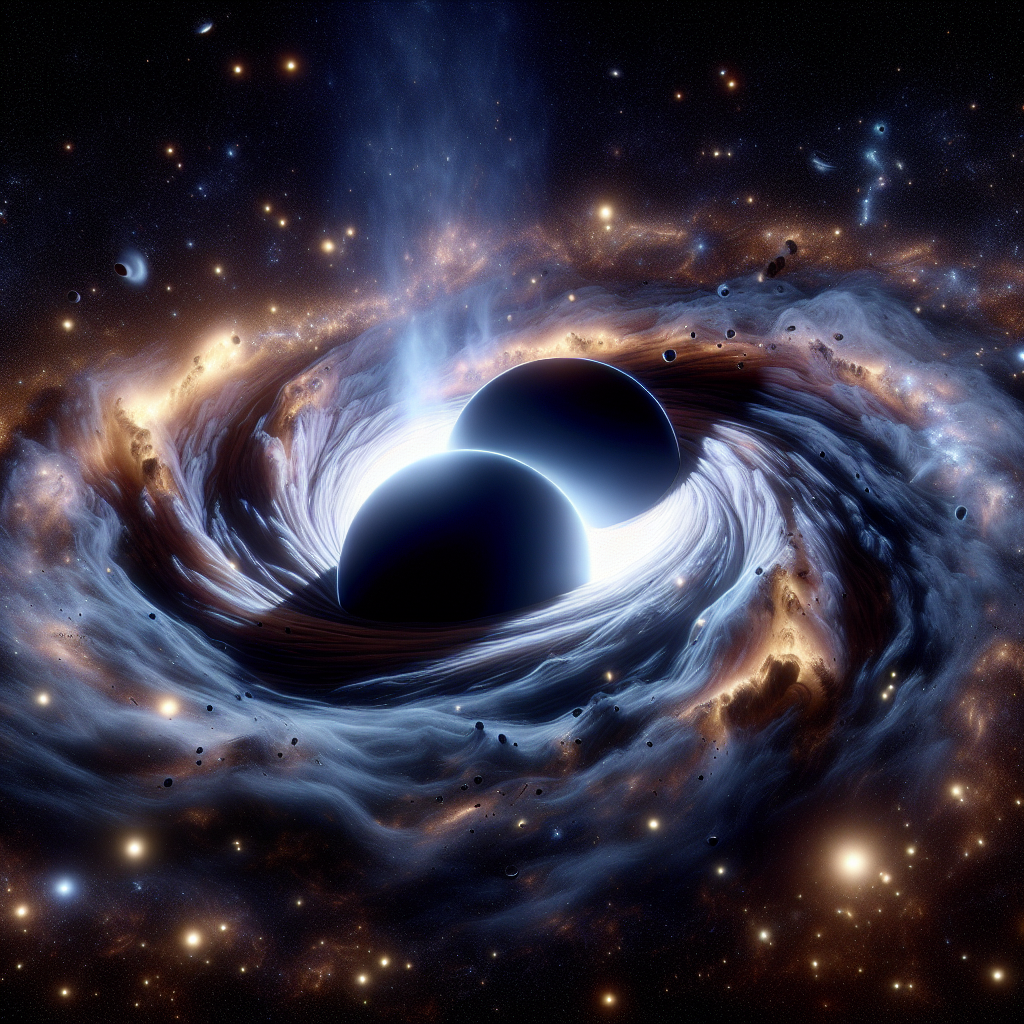
Scientists Solve the Mystery of ‘Impossible’ Black Hole Merger, Revealing New Insights into the Cosmos
In a groundbreaking discovery, researchers have unraveled the perplexing enigma surrounding an "impossible" merger between two black holes, a collision detected through gravitational waves in November 2023. This event, occurring 7 billion light-years from Earth, involved two black holes with masses of 100 and 140 times that of our sun, rotating at nearly the speed of light—conditions previously deemed unattainable.
The black holes’ unexpected existence has baffled scientists for years, as current theories suggest that such massive stellar remnants should not form from normal stellar collapse. Traditionally, stars that become black holes of this magnitude are thought to end their lives in a cataclysmic event known as a "pair-instability supernova," which leaves no remnant behind.
A New Understanding Unfolds
Researchers from the Flatiron Institute’s Center for Computational Astrophysics (CCA) employed sophisticated simulations to investigate the life cycles of the progenitor stars leading to this merger. Their findings highlighted a previously overlooked factor: magnetic fields.
Ore Gottlieb, a leading astrophysicist involved in the study, explained, "No one has considered these systems the way we did; previously, astronomers just took a shortcut and neglected the magnetic fields." By factoring in magnetic influences, the team developed a more accurate model, revealing that these robust magnetic fields could significantly alter the evolutionary path of black holes.
The Shift in Paradigm
The researchers discovered that a massive star, originally 250 times the mass of the sun, could lose half its mass due to the powerful effects of magnetic fields during its collapse. This dramatic loss of material allows for the formation of black holes that fit neatly within the previously deemed "mass-gap"—challenging conventional wisdom.
Gottlieb noted, "The presence of rotation and magnetic fields may fundamentally change the post-collapse evolution of the star, making black hole mass potentially significantly lower than the total mass of the collapsing star." This revelation not only sheds light on the nature of black holes but also poses questions about how interconnected various cosmic phenomena truly are.
A Cosmic Reflection
While the intricacies of black hole mergers may seem distant from daily life, they provoke deeper reflections on the nature of creation and the mysteries of existence. Just as these scientists were willing to question established beliefs in pursuit of truth, we are reminded of the importance of exploration in all areas of life.
This ties closely with biblical principles that encourage curiosity and the pursuit of knowledge. Proverbs 25:2 tells us, “It is the glory of God to conceal a matter; to search out a matter is the glory of kings.” As we strive to understand our universe, we mirror the divine curiosity woven into creation itself.
An Encouraging Takeaway
As we gain new insights about the cosmos, let us also look inward, considering how we can embrace life’s enigmas with courage and an open heart. The journey to understanding might be fraught with challenges, but it is also an opportunity for growth. Just as scientists push the boundaries of knowledge, we too can explore our faith, relationships, and the world around us with the same fervor and wonder.
In doing so, we can find encouragement in seeking truth, reflecting on the greater purpose of our existence, and recognizing the interconnectedness of all things. The unfathomable depths of space echo the mysteries within our own lives, reminding us that every question is part of a larger narrative crafted with intention and love.
Explore and dig up answers yourself with our BGodInspired App. Be careful – each interaction is like a new treasure hunt… you can get lost for hours 🙂