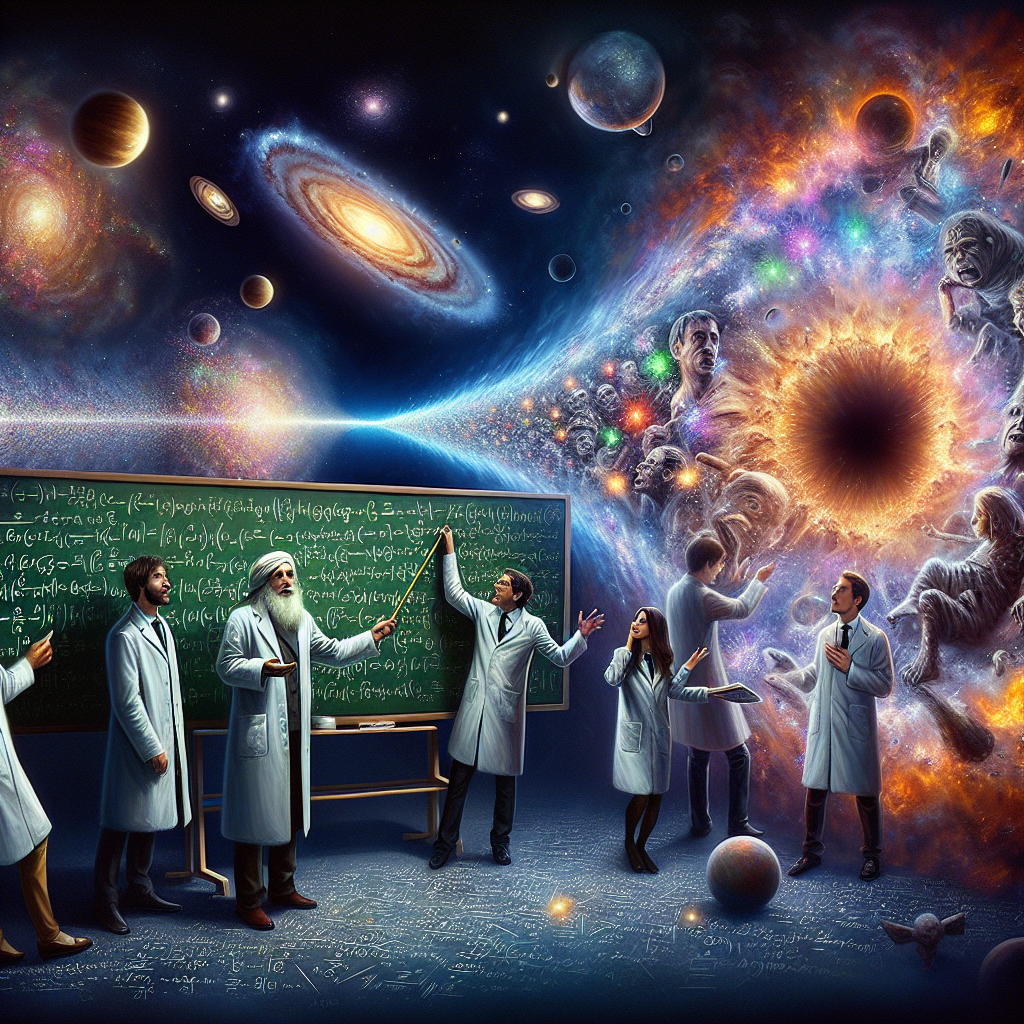
Scientists Propose a Groundbreaking New Model for the Big Bang Theory
In a significant development for cosmology, a team of researchers has proposed a new model for the Big Bang theory that challenges long-held assumptions about the universe’s origins. This innovative approach suggests that gravitational waves—tiny ripples in the fabric of space-time—may have played a crucial role in the creation of galaxies and stars, potentially revolutionizing our understanding of the cosmos.
For decades, the accepted explanation for the universe’s expansion has revolved around the concept of cosmic inflation, which posits that the universe underwent rapid growth immediately after the Big Bang. However, this model has faced criticism due to the lack of knowledge regarding the mysterious "inflaton" particle responsible for this inflationary phase. Enter a new theory published in the Physical Review Journal, titled "Inflation without an inflaton," which aims to provide a more fundamental explanation for the universe’s beginnings without relying on unproven particles.
The researchers propose that gravitational waves could generate the necessary fluctuations in density that led to the formation of galaxies and stars. Their calculations align with astronomical observations and provide a seamless theory for how the universe transitioned from a moment of rapid expansion to the radiation-filled cosmos observed today. This minimalist model not only simplifies previous theories but also raises intriguing questions regarding the very nature of existence.
Shifting focus from traditional cosmology to quantum physics, the research highlights the possibility that the universe’s early instability could end inflation and give rise to the cosmos we know. According to researcher Daniele Bertacca of the University of Padova, “It is precisely the elegance and simplicity of the proposed model, and the absence of free parameters, that are key.”
This new understanding does not merely have scientific implications; it subtly resonates with biblical principles as well. Just as scientists are exploring the hidden complexities of creation, many believe that the universe reflects the handiwork of a Creator who delights in both simplicity and complexity. As noted in the Bible, "For since the creation of the world God’s invisible qualities—his eternal power and divine nature—have been clearly seen, being understood from what has been made" (Romans 1:20, NIV).
As they pursue further observations to confirm their model, the research team expresses hope that this foundational theory will lead to greater revelations about our universe—while acknowledging the importance of faith and evidence in understanding reality. Raúl Jiménez, the study’s lead from the University of Barcelona, emphasizes the model’s minimalist approach, allowing for further testing and exploration. This pattern of discovery aligns closely with the biblical principle of seeking wisdom and knowledge.
As we reflect on this groundbreaking revelation, let us consider how the pursuit of understanding our universe can inspire awe and curiosity in our own lives. "The unfolding of your words gives light; it imparts understanding to the simple" (Psalm 119:130, ESV). In the quest for knowledge, we are reminded of our calling to explore the wonders around us, instilling a sense of wonder that invites reflection and fosters a deeper appreciation for the mysteries of life.
In a world filled with uncertainty, the quest for understanding resonates with our spiritual journey, encouraging us to embrace curiosity and seek deeper truths not just in science, but in our faith and existence.
Explore and dig up answers yourself with our BGodInspired App. Be careful – each interaction is like a new treasure hunt… you can get lost for hours 🙂