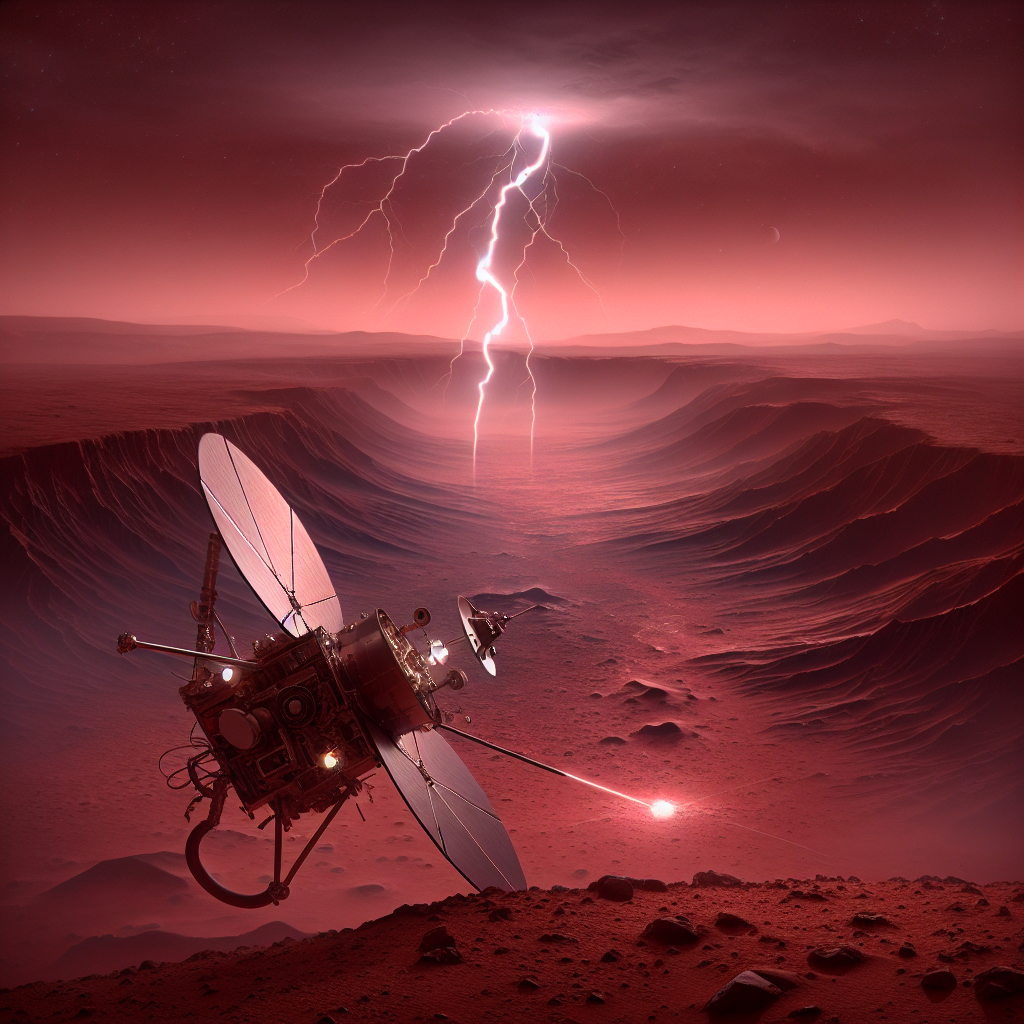
First Evidence of Lightning on Mars: A Cosmic Discovery That Inspires
For decades, the swirling dust storms of Mars captured the imagination of planetary scientists, who speculated whether these powerful phenomena could produce electricity. Now, a breakthrough from the MAVEN (Mars Atmosphere and Volatile EvolutioN) spacecraft has confirmed their suspicions, detecting a form of electrical discharge akin to lightning for the first time.
Researchers had long observed the violent dust storms on Mars, which envelop the planet in clouds of millions of tons of abrasive sands. Yet, despite extensive searches utilizing high-tech instruments, they found little evidence of electrical phenomena—until late 2024.
MAVEN’s Groundbreaking Discovery
A specialized instrument aboard MAVEN, the Langmuir Probe and Waves sensor, began capturing low-frequency electromagnetic waves unique to charged particles in the Martian atmosphere. Under the leadership of Dr. David Andrews from the Swedish Institute of Space Physics, researchers identified a specific signal that indicated the presence of a "lightning whistler." This type of wave, akin to those observed on Earth during lightning strikes, provided clear evidence of electrical activity in the planet’s tumultuous storms.
As the signal was decoded, it revealed a notable characteristic—starting at a higher frequency and then dropping to a lower tone. This "whistler" indicated that electrons were indeed interacting in Mars’ thin atmosphere, offering insights into the electrical processes occurring within these dust storms.
Reimagining Martian Weather
Interestingly, the findings suggest that lightning on Mars may not manifest as the dramatic bolts visible on Earth. Instead, discharges likely occur within the dust storms themselves through a process called triboelectric charging, where dust particles exchange electrons.
Dr. Andrews emphasized that the Martian atmosphere is dramatically thinner than Earth’s—about 100 times less dense—requiring less energy to generate an electrical discharge that, although weak, signals a beautiful complexity in the Martian climate.
This unexpected discovery not only enriches our understanding of Mars but also offers a moment of reflection. Just as Jesus emphasized the intricate care of creation—“Look at the birds of the air; they do not sow or reap or store away in barns, and yet your heavenly Father feeds them” (Matthew
If you want to want to know more about this topic, check out BGodInspired.com or check out specific products/content we’ve created to answer the question at BGodInspired Solutions