Astronomers Detect Most Massive Black Hole Merger to Date: What It Can Teach Us About Creation
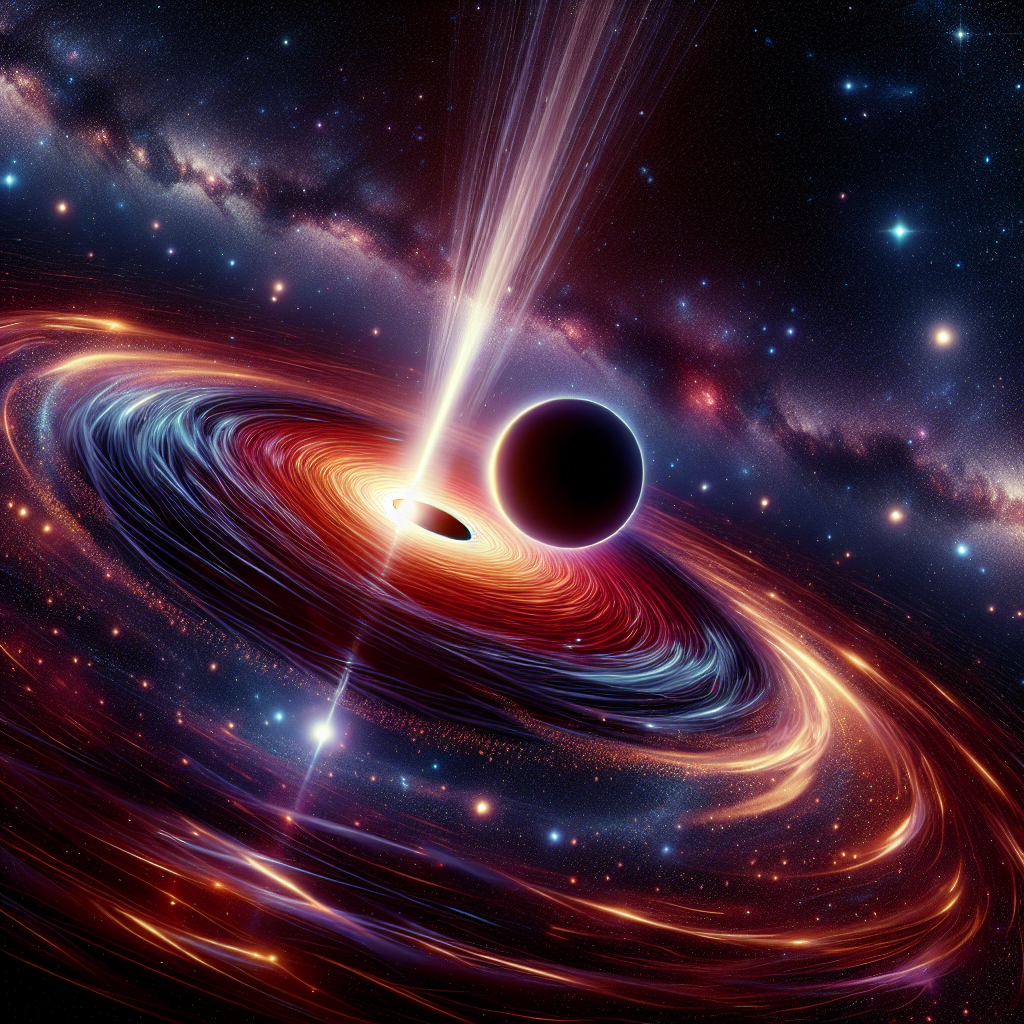
In a groundbreaking discovery, the LIGO-Virgo-KAGRA Collaboration has identified the merger of the most massive black holes ever observed via gravitational waves. This event, designated GW231123, occurred on November 23, 2023, during the collaboration’s fourth observing run (O4). The resultant black hole boasts a staggering mass more than 225 times that of our Sun, highlighting complexities in our understanding of cosmic phenomena.
The black holes involved in this merger had individual masses of approximately 100 and 140 times that of the Sun, both spinning rapidly—an observation that raises intriguing questions about their formation. "This is the most massive black hole binary we’ve observed, and it challenges our understanding of black hole formation," remarked Professor Mark Hannam of Cardiff University. The standard models of stellar evolution suggest such massive black holes shouldn’t exist without prior mergers of smaller ones.
As we probe deeper into the complexities of the universe, we are reminded of the wisdom found in Colossians 1:16, which states, “For in Him all things were created: things in heaven and on earth, visible and invisible.” This verse resonates as we consider the intricate dynamics of these black holes and the remarkable laws of physics at play.
The challenges presented by GW231123 extend beyond just the black holes themselves. Maintaining accuracy in interpretation requires advanced theoretical models that can account for the complex behavior of highly spinning entities. Dr. Charlie Hoy from the University of Portsmouth noted, “The black holes are spinning near the limit allowed by Einstein’s theory of general relativity,” underlining how far our current technology and understanding stretch.
With nearly 300 black hole mergers identified since the dawn of gravitational-wave astronomy, researchers are continuously refining their methods and expanding their models to interpret these cosmic signals. As Dr. Gregorio Carullo from the University of Birmingham states, “Exciting times lie ahead!” This ongoing inquiry illuminates not just the nuances of astrophysical objects but also the broader narrative of creation.
Gravitational-wave detectors like LIGO in the United States, Virgo in Italy, and KAGRA in Japan probe minute distortions in spacetime caused by catastrophic cosmic events. This latest detection pushes the boundaries of what’s possible in astrophysics, demonstrating our ever-expanding grasp of the universe.
What does this remarkable discovery mean for us? It invites us to reflect on the intricate design of creation, echoing the idea that the universe operates through principles that are both understood and mysterious, created by an intelligence far greater than ourselves.
In the hustle of life, it’s easy to lose sight of the extraordinary—be it in the cosmos or within our own lives. As we consider the expansive wonders of the universe, let us also ponder the divine fingerprints that shape it. Just as the cosmos reveals layers of complexity and beauty, so too do our individual experiences reflect a greater purpose.
As we embrace this scientific marvel, let us take away an encouraging thought: Every layer of discovery whispers the assurance that we are part of a grander design, one meant to evoke awe and reflection. May we approach both science and life with wonder, openness, and gratitude.
“The heavens declare the glory of God; the skies proclaim the work of his hands.” —Psalm 19:1.
Let this be an invitation to explore both the universe’s mysteries and the spiritual truths that lie within them.
Explore and dig up answers yourself with our BGodInspired Bible Tools! Be careful – each interaction is like a new treasure hunt… you can get lost for hours 🙂