
Mysterious Cosmic Findings: The Cliff and the Search for Black Hole Stars
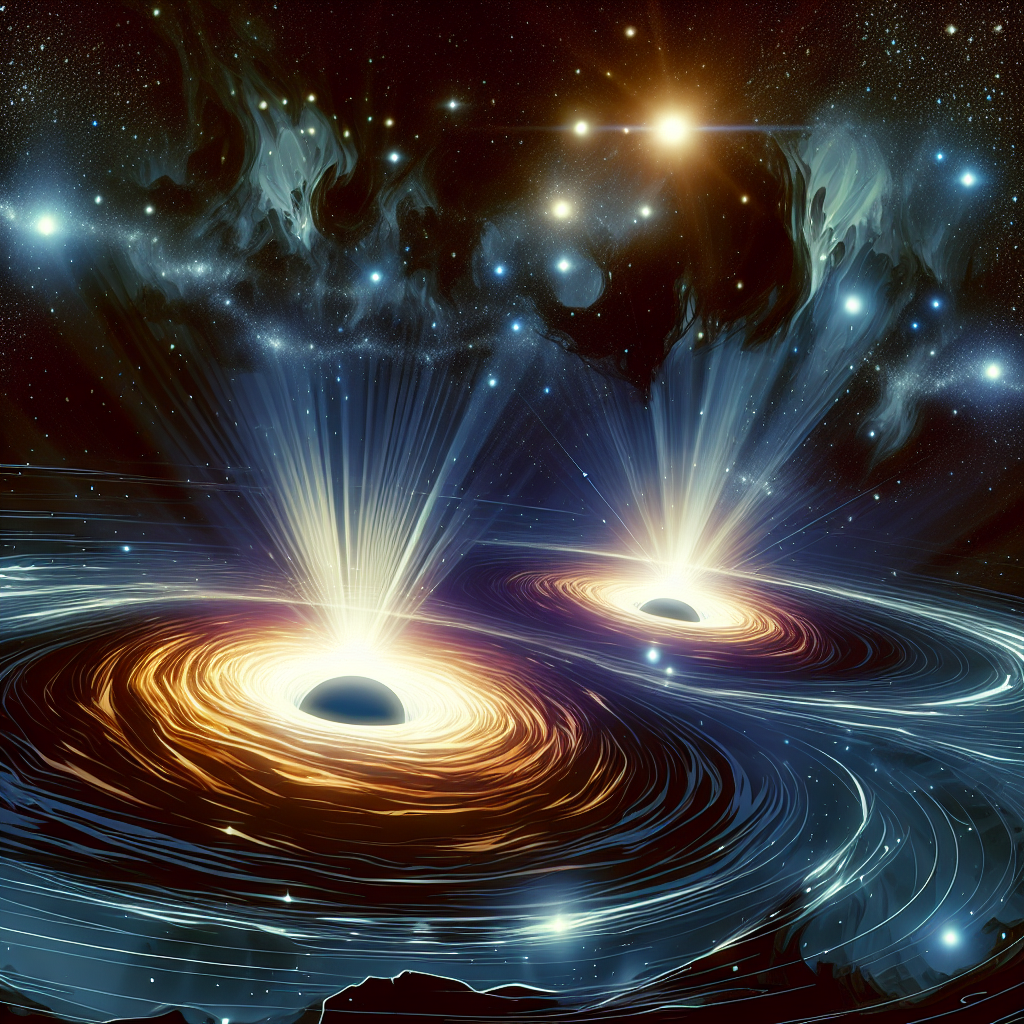
Recent astronomical research has unveiled intriguing possibilities about some of the universe’s earliest flickers of light. These enigmatic pinpricks, particularly one identified as "The Cliff," may be supermassive black holes shrouded in dense clouds of gas—an object not previously documented in our cosmic understanding.
Astronomers have struggled to explain a perplexing phenomenon known as the Balmer break, which suggests these early galaxies appeared older than scientifically feasible. A team from the Max Planck Institute for Astronomy, led by astrophysicist Anna de Graaff, posits that the Balmer break’s characteristics align more closely with a luminous ionizing source rather than a traditional galaxy composed of dominant A-type stars. They argue this model may indicate a "black hole star," a supermassive black hole enveloped in a thick hydrogen gas atmosphere.
The Balmer Break Explained
The Balmer break itself is a distinctive spectral feature observed at ultraviolet wavelengths, caused by the absorption of shorter-wavelength light by hydrogen atoms. The strong Balmer break observed in The Cliff poses significant implications for our understanding of galaxy formation just 600 million years after the Big Bang—a timeline that traditionally suggests galaxies would not yet harbor mature star populations.
As researchers explored the nature of these "little red dots," they considered various possibilities ranging from primordial black holes to seeds of supermassive stars. Yet, the peculiar characteristics of The Cliff, particularly its pronounced Balmer break, spurred the development of an innovative model: a black hole star, an active black hole consuming surrounding gas.
Theological Reflections
While the scientific community delves into these cosmic mysteries, there’s a rich analogy that resonates with biblical principles. The unfolding of creation, much like the exploration of The Cliff, reflects the beauty and complexity of God’s handiwork. As stated in Psalm 19:1, “The heavens declare the glory of God; the skies proclaim the work of his hands.” Just as scientists seek to understand the universe’s assembly, believers are invited to contemplate the divine presence in creation’s awe.
As researchers develop theories to explain these new findings, it is akin to the spiritual journey each individual undertakes in their pursuit of understanding life’s mysteries and divine purpose. Both science and faith encourage inquiry and reflection.
An Encouraging Note
The exploration of The Cliff and its potential implications serves as a reminder that uncharted territories—be they in the cosmos or in our personal spiritual journeys—can lead to profound discoveries. We are called to embrace the unknown with curiosity and faith, trusting that there is a greater design at work in our lives and in the universe.
As you ponder the wonders of creation, reflect on the idea that every discovery can deepen our understanding of both the cosmos and the divine. There’s always more to uncover, both in the universe around us and within ourselves.
By engaging with these stories, we take steps into a deeper appreciation of the intricate connections between science, faith, and the mysteries that lie ahead.
Explore and dig up answers yourself with our BGodInspired App. Be careful – each interaction is like a new treasure hunt… you can get lost for hours 🙂


