 0
0
 0
0
Supermassive Black Hole Caught Fleeing Its Galaxy, Trailing Newborn Stars
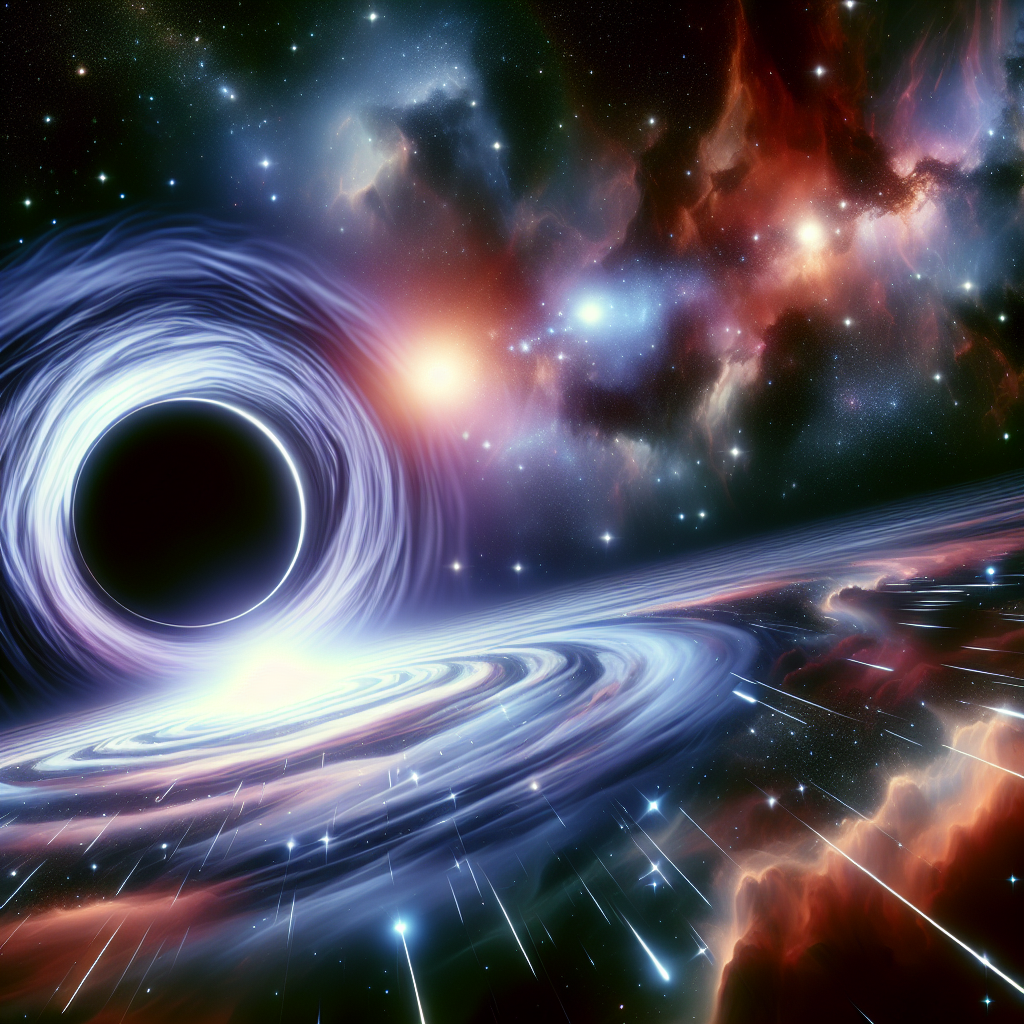
In a remarkable astronomical discovery, scientists may have observed a supermassive black hole in the act of escaping its galaxy, leaving behind an astonishing 200,000-light-year trail of star formation. This finding provides compelling evidence that black holes can be flung from their cosmic homes due to the effects predicted by Einstein’s theory of general relativity.
For years, researchers have speculated that interactions between supermassive black holes—the gigantic entities anchored at the centers of galaxies—can culminate in violent mergers. When two such giants collide, they emit gravitational waves, which can be unevenly dispersed. This disparity generates a powerful kick, potentially expelling the merged black hole from its parent galaxy at speeds that defy our expectations.
The Mechanism of Cosmic Ejection
When galaxies merge, their respective central black holes spiral towards each other, ultimately combining into a single entity. During this cataclysmic event, gravitational waves are released, and if these waves are more intense in one direction, the newlyformed black hole is ejected in the opposite direction. According to researchers, the black hole captured in this study seems to fit this theory.
Current estimates suggest it is traveling at an extraordinary 1,600 kilometers per second, confirming that the escape from the galaxy’s gravitational pull is not just a theoretical possibility.
A Trail of New Beginnings
What separates this finding from past observations is the awe-inspiring structure trailing behind the black hole. This narrow, luminous feature—longer than the diameter of the Milky Way—is interpreted as a wake of star formation, ignited by the black hole’s swift movement through interstellar gas. As it thunders along, the black hole compresses surrounding material, sparking the birth of new stars. At the tip of this stellar trail lies a bright source that is consistent with a supermassive black hole actively consuming surrounding matter.
Notably, the geometry of this trail aligns with predictions made by earlier scientific models, marking a coherent escape route rather than a random streak across the cosmos.
Implications for Galactic Evolution
Supermassive black holes are central to the dynamics of their host galaxies, helping regulate gas flow and influence star formation. Their sudden ejection could dramatically impact galactic structure and function. As noted by researchers, confirming more cases like this could enhance our understanding of the frequency and implications of such cosmic events.
This exploration of the universe invites reflection on the intricate balance and interconnectedness present in creation. It resonates with biblical principles that remind us of the significance of beginnings and transitions.
Ecclesiastes 3:1 states, “To everything, there is a season, and a time for every matter under heaven.” Just as a black hole’s journey sparks the creation of new stars, our lives are continuously shaped by moments of change that lead to new beginnings.
Encouragement for Reflection
This astounding discovery serves as a reminder that even the seemingly chaotic aspects of the universe have a purpose. As we ponder these cosmic events, let us embrace the transitions in our own lives. Like the stars born from the black hole’s wake, we too can find new hopes and opportunities blossoming from every significant change and challenge we face. Embrace and reflect on how each season shapes you into who you are meant to be.
If you want to want to know more about this topic, check out BGodInspired.com or check out specific products/content we’ve created to answer the question at BGodInspired Solutions