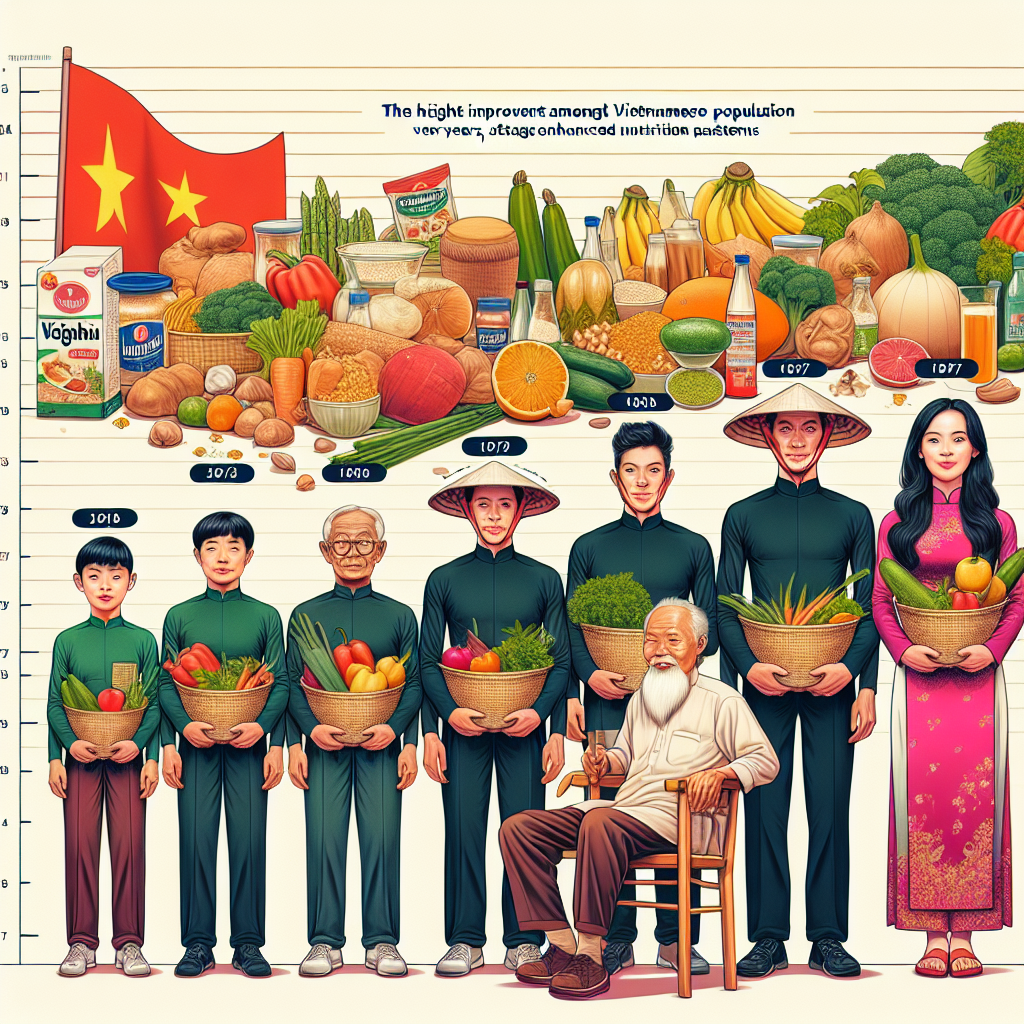
Rising Heights: Vietnam’s Journey to Improved Health and Stature
In recent years, a noticeable transformation has taken place in Vietnam’s youth. For many parents, witnessing children who are significantly taller than themselves is becoming commonplace. Ngoc, a 44-year-old from Hanoi, experienced this firsthand while attending her son’s high school football game. Surrounded by teammates towering between 1.7 and 1.8 meters, she observed how her son, at 1.75 meters, stood well above her own height of 1.52 meters. Such scenes are now frequent, as the average height of Vietnamese youth steadily rises.
Height is more than just a physical attribute; it reflects the broader health and well-being of a population. Professor Dr. Le Danh Tuyen notes that demographic growth isn’t sudden or accidental but a reflection of long-term nutritional strategies and public awareness. Over the last few decades, Vietnam has shifted away from its past, where prolonged conflicts hindered growth, resulting in stagnant heights noted in early nutrition surveys that recorded men averaging only 159.8 cm and women 150.5 cm.
Remarkably, by 2020, those averages rose to 168.1 cm for men and 156.2 cm for women. Experts like Dr. Truong Hong Son attribute this progress to comprehensive strategies focusing on nutrition and healthcare. The National Plan for Physical and Stature Development, initiated in 2011, and recent interventions, including fortifying food with essential micronutrients, have laid the groundwork for this significant leap in stature.
This surge in height is not solely about familial gene pools; it’s also about fostering healthy communities, much like the collective responsibilities encouraged in biblical teachings. Galatians 6:2 states, “Carry each other’s burdens, and in this way you will fulfill the law of Christ.” This principle recognizes that community efforts—be it in nutrition, education, or healthcare—can make a profound difference in each individual’s growth and development.
The current trajectory of Vietnamese heights suggests that by 2030, young men may average 168.5 cm and women 157.5 cm. This goal highlights a nation striving for comprehensive improvement, emphasizing the vital need for nurturing both physical and intellectual health.
However, the message extends beyond mere numbers. Observing how communities band together to elevate the health of their youth can inspire spiritual reflection. The biblical principle of stewardship encourages us to nurture both our physical well-being and our communities. The diligence seen in nutrition campaigns mirrors the care we are called to show toward one another.
As Vietnam reaches for new heights, there lies a powerful lesson for us all. From the heights of our aspirations to the depths of our communal responsibilities, let us recognize how we can foster growth in our own lives and those around us.
Reflect on this: What steps can you take to support and uplift the well-being of those in your community? As you consider your role, remember Philippians 2:4: “Each of you should look not only to your own interests but also to the interests of others.”
In a world where physical growth can serve as a metaphor for spiritual and communal development, let us be encouraged to contribute positively to the health and well-being of our communities, cultivating an environment where everyone can thrive.
Explore and dig up answers yourself with our BGodInspired App. Be careful – each interaction is like a new treasure hunt… you can get lost for hours 🙂