 0
0
 0
0
When Netflix dropped all eight episodes of its new Little House on the Prairie adaptation on July 9, 2026, it didn’t take long to start trending — and not because of a shocking plot twist. It was the dinner scenes. Viewers kept stopping to point out that the meals the Ingalls family treated like a genuine feast would get flagged today as food insecurity. A little cornmeal. A little salt pork. Bread with molasses if they were lucky.
It’s easy to watch that and assume the show is exaggerating for effect — prairie hardship dialed up for streaming drama. It isn’t. Almost everything about what the Ingalls family ate, and how they felt about it, comes directly from Laura Ingalls Wilder’s own memory of her actual childhood. She wasn’t writing historical fiction. She was writing down what happened to her.
The Family Behind the Show Was Real, and So Was the Hunger
Charles and Caroline Ingalls raised their daughters — Mary, Laura, Carrie, and later Grace — across a string of homesteads in Wisconsin, Kansas, Minnesota, and the Dakota Territory through the 1870s and 1880s. They weren’t reenactors or symbols. They were a real family trying to make a living off land that, more often than not, refused to cooperate.
In Walnut Grove, Minnesota, swarms of Rocky Mountain locusts descended so thick they blotted out the sun and stripped entire wheat fields to bare dirt in an afternoon — twice. In De Smet, South Dakota, the winter of 1880–81 buried the town under blizzard after blizzard for months. The trains that carried flour and coal couldn’t get through. The Ingalls family and their neighbors survived by twisting hay into tight sticks to burn for heat and grinding raw wheat kernels by hand in a coffee mill, a few cups at a time, just to have something that resembled bread. That winter is remembered today as simply the Long Winter, and people in De Smet nearly starved waiting for spring.
None of that is show writing. It’s in Wilder’s own account, later published as the autobiography Pioneer Girl, and it’s the direct source material for the “fiction” millions of people grew up reading as Little House in the Big Woods, On the Banks of Plum Creek, and The Long Winter.
What “A Wonderful Christmas” Actually Looked Like
The detail that tends to stop modern readers cold is Wilder’s description of Christmas morning in the Big Woods of Wisconsin. She and her sister Mary each found, in their stockings, a tin cup, a peppermint candy stick, a small heart-shaped cake, and a shiny penny. That was the whole of it. Decades later, writing as an old woman looking back, Wilder called it one of the best Christmases of her life.
It’s tempting to read that as either quaint nostalgia or, worse, as proof that people back then simply expected less and so felt no loss. But that flattens something more interesting that’s actually happening in the text: the family wasn’t grateful because they didn’t know better. They were grateful because they’d paid attention to what they actually had, instead of measuring it against what they didn’t. A tin cup was a genuine gift precisely because it would be used, remembered, and cared for — not because no better cup existed somewhere else.
That distinction matters more now than it did in 1870. Financial anxiety today rarely comes from an empty pantry the way it did for the Ingalls family. It usually comes from comparison — a subscription list that feels thin next to a coworker’s, a house that feels small next to a neighbor’s. If that sounds familiar, the psychology behind spending guilt explains why that gap between “enough” and “behind” so rarely has anything to do with the actual numbers in a bank account.
The Meals Themselves Were the Point
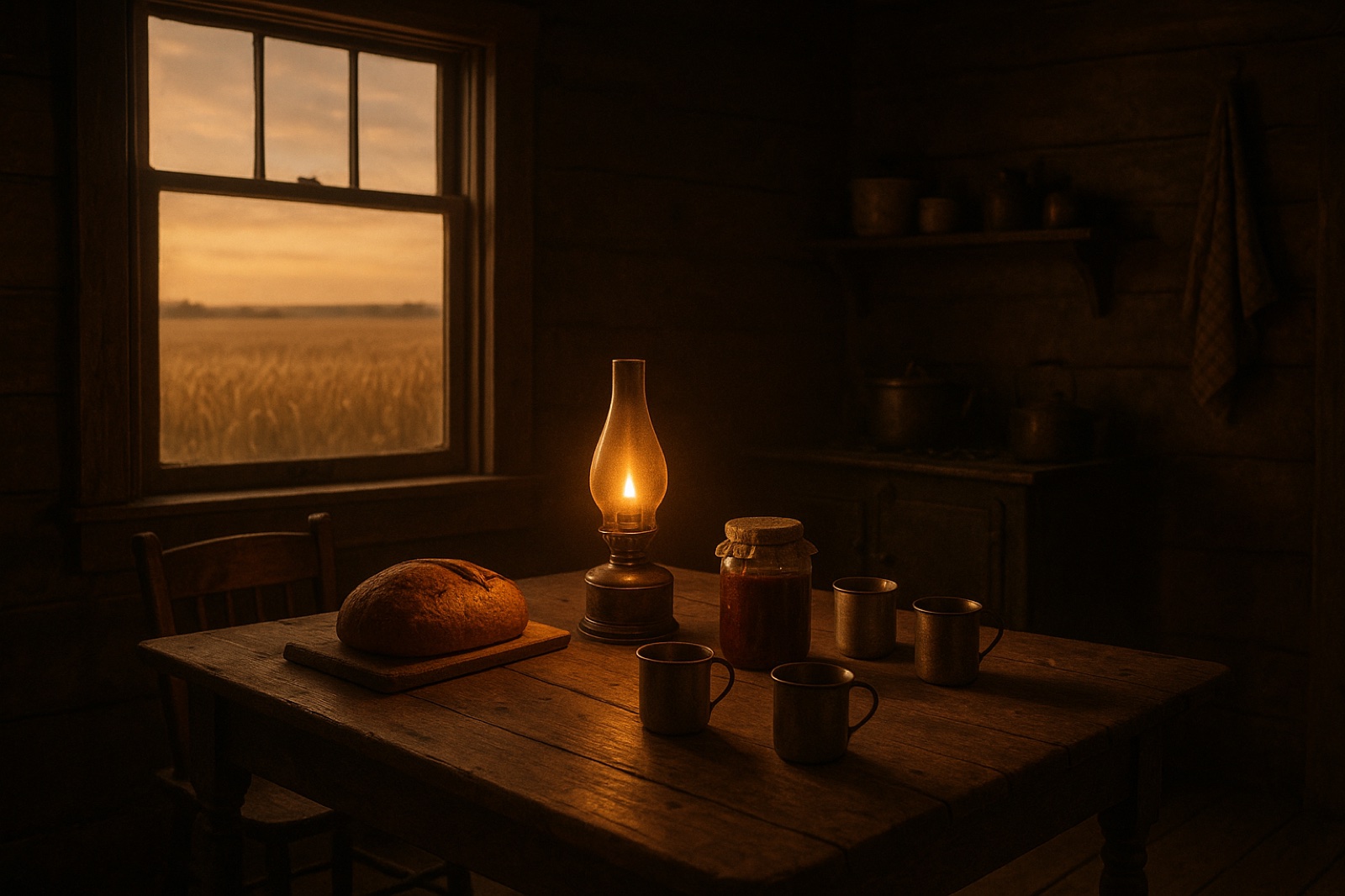
Cornmeal mush, salt pork, and bread with a scrape of molasses weren’t a special hardship menu written for sympathy — they were simply what a family living off a homestead’s own production could reliably put on the table most days. An orange at Christmas was a genuine event, remembered for years, because it had traveled a very long way to reach a very small kitchen. A “cake” that modern readers would recognize as barely sweetened bread was still called a treat, and meant as one, and received as one.
What Wilder’s writing captures — and what the Netflix adaptation is clearly leaning into — is that scarcity and gratitude weren’t in tension for this family. They ran side by side. The family didn’t wait for abundance to start being thankful. The thankfulness showed up first, at the table they already had, and that seems to be exactly what’s resonating with a 2026 audience watching from considerably fuller kitchens.
Why This Is Landing Differently in 2026
Part of the show’s appeal right now isn’t nostalgia for the 1870s — it’s contrast with 2026. Grocery costs, housing, and the general hum of financial unease have a lot of viewers watching the Ingalls family’s version of “getting by” and feeling something closer to envy than pity. Not envy of the hunger, obviously — envy of the apparent ease with which the family seemed to separate what they had from how they felt about what they had.
That’s a skill, not a circumstance. And it’s one that shows up again and again across generations of families who’ve had far less than they needed, right alongside families who’ve had far more than they needed. What actually holds a family together rarely turns out to be what’s on the table — it’s what happens around it.
The Older Idea Underneath It All
There’s a thread running under all of this that’s a lot older than the American prairie. Long before homesteaders were grinding wheat by hand in a coffee mill, ancient wisdom was already making the same observation: contentment was never really about the size of what’s provided. It was about learning to receive whatever arrives — a full harvest or a lean one — with the same open hands. The Ingalls family didn’t invent gratitude in scarcity. They just happened to live it out in a way a camera could later capture.
It’s the same idea behind the old promise of “daily bread” instead of a lifetime’s supply stored up in advance — provision that shows up exactly when it’s needed, in exactly the amount required, no more guaranteed than the next day’s weather. That pattern shows up throughout scripture, long before it showed up in a Minnesota dugout house. Something bigger than any one family seems to have built people to be capable of real gratitude at a nearly empty table — not just a full one.
What This Means for Your Own Table Tonight
Nobody needs to romanticize the Long Winter to take something useful from it. The Ingalls family’s circumstances were genuinely hard, and nothing about this is an argument that scarcity is secretly better than security. But there’s a quieter takeaway sitting underneath the streaming numbers: gratitude was never actually waiting on abundance to show up first. It’s available at whatever table a person already has, tonight, exactly as it is.
That’s worth sitting with the next time dinner feels smaller than it should. Not because the Ingalls family had it worse — plenty of families have — but because they seemed to have found a way to notice what was actually there instead of what wasn’t. That noticing is repeatable. It doesn’t require a homestead, a coffee mill, or a Dakota blizzard to practice.
Discussion Question
If you had to name one small thing on your table tonight — literal or otherwise — that you’ve stopped noticing because it’s just “normal,” what would it be? Drop it in the comments.
Try This
Before your next meal, name one specific thing on the table you’d genuinely miss if it were gone — not the meal in general, but one actual item. Say it out loud if you’re not eating alone. It takes ten seconds and it’s the same move the Ingalls family made with a tin cup and a peppermint stick.
Share This
- “The Netflix Little House on the Prairie reboot is making me realize how much of what I call ‘not enough’ is just comparison in disguise. Wild how a family with basically nothing figured that out first.”
- “Apparently the real Ingalls family’s ‘wonderful Christmas’ was a tin cup, a penny, and a peppermint stick. Meanwhile I’m stressed about which streaming subscriptions to cancel. Perspective, table for one.”
- “Turns out gratitude was never actually waiting on abundance. The Little House on the Prairie family proved that a century before Netflix figured out we’d want to watch it.”
Questions People Are Asking
Was the Ingalls family from Little House on the Prairie a real family?
Yes. Charles and Caroline Ingalls and their daughters Mary, Laura, Carrie, and Grace were a real pioneer family who homesteaded across Wisconsin, Kansas, Minnesota, and the Dakota Territory in the 1870s and 1880s. Laura Ingalls Wilder later turned her childhood memories into the Little House book series, and much of that material also appears in her direct autobiography, Pioneer Girl.
What did the Ingalls family actually eat?
Their everyday diet centered on what the homestead itself produced: cornmeal mush, salt pork, bread, and vegetables from their garden, with molasses as a common sweetener. Store-bought treats like candy or an orange were rare enough to be remembered as major events, especially at Christmas.
What was the Long Winter the show references?
The Long Winter of 1880–81 was a real, historically documented series of blizzards that cut off De Smet, South Dakota, from outside supply trains for months. Families in the town survived on hand-ground wheat and twisted-hay fuel until the trains could finally get through in the spring.
When did the new Little House on the Prairie premiere on Netflix?
Netflix released all eight episodes of the first season globally on July 9, 2026, and the series has already been renewed for a second season.
Why are people connecting this old story to modern financial stress?
Because the show highlights a family that faced genuine scarcity yet consistently expressed gratitude, which contrasts with how modern financial anxiety is often driven less by actual lack and more by comparison to what others appear to have.