 0
0
 0
0
You know the feeling of being the last one anyone thinks to check on. The coworker who leaves early and nobody notices for an hour. The family member who quietly stops showing up to gatherings and it takes three weeks for anyone to ask why. The person going through something hard, alone, in a room full of people who are all too busy with their own lives to look up.
Long before any of that, there was a woman it actually happened to — not as a feeling, but as her whole life. She was property, not family. She was used for a purpose and then discarded when she was no longer convenient. And when she finally ran, she ran into the middle of nowhere with nothing, expecting to disappear the way she always had.
Instead, she became the first person in the entire Bible to give God a name.
Her name was Hagar. And if you have ever wondered who was Hagar in the Bible — and why her story still matters — this is where it starts.
Who Was Hagar, Really?
Hagar shows up in Genesis 16 as Sarai’s Egyptian maidservant — not an employee, but property, likely acquired during Abram and Sarai’s time in Egypt (Genesis 12). She had no say in her own life. So when Sarai remained childless for years despite God’s promise that Abram would father a great nation, Sarai did what was culturally normal in that world: she gave Hagar to Abram to bear a child in her place.
It wasn’t God’s plan. It was Sarai and Abram trying to help God’s promise along on their own timeline, using a woman who had no power to refuse. And it went about as well as you’d expect. Once Hagar was pregnant, Genesis 16:4 says she began to look at Sarai “with contempt” — and Sarai, stung and humiliated, turned on her. Genesis 16:6 puts it plainly: Sarai “dealt hardly with her,” and Hagar fled.
She wasn’t running toward anything. She was running away from the only home she had, pregnant, alone, likely heading back toward Egypt — the road to Shur was the route home.
Found in the Wilderness — Genesis 16:7-8
This is where the story turns from a family conflict into something much bigger.
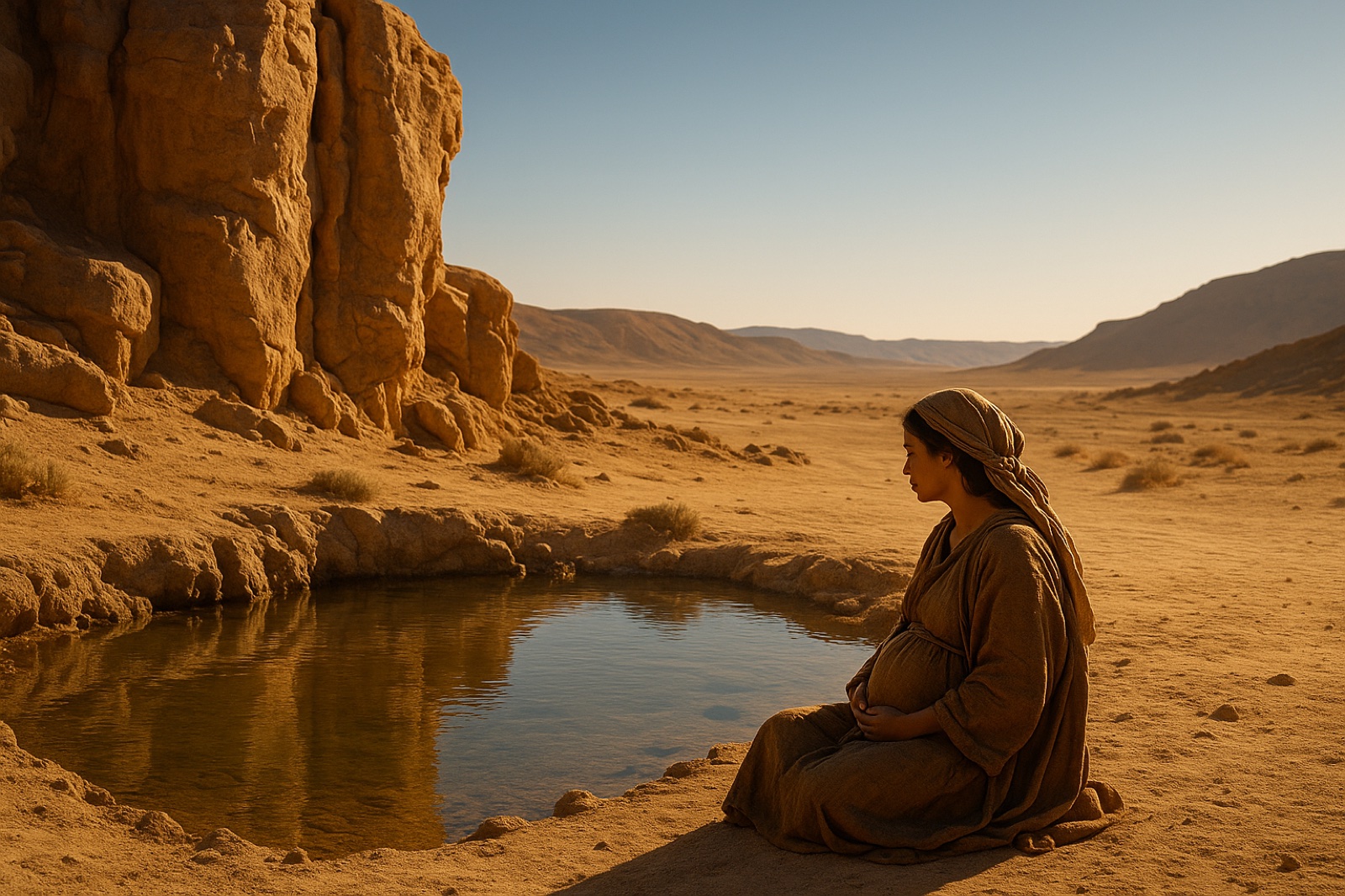
“And the angel of the LORD found her by a fountain of water in the wilderness, by the fountain in the way to Shur. And he said, Hagar, Sarai’s maid, whence camest thou? and whither wilt thou go? And she said, I flee from the face of my mistress Sarai.” (Genesis 16:7-8, KJV)
Notice what happens in that verse. For the entire chapter up to this point, Hagar has only ever been called “the maid” or “her maid” — a title, not a name. Here, for the first time in the narrative, someone speaks to her directly and uses her actual name. Hagar.
The angel of the LORD doesn’t ask where she came from and where she’s going because He doesn’t know. He asks so that she can say it out loud — so that a woman who has been talked about, used, and dismissed her entire life finally gets to be heard.
The Promise and the Name — Genesis 16:9-13
What comes next is hard to sit with. The angel tells Hagar to go back and submit to Sarai (Genesis 16:9) — not an endorsement of the mistreatment, but an instruction for right now, in a world where an unaccompanied pregnant woman had no safety in the wilderness. God meets Hagar in her actual, complicated circumstances — not the ideal ones she wished she had.
But He doesn’t send her back empty-handed. He gives her a promise:
“And the angel of the LORD said unto her, I will multiply thy seed exceedingly, that it shall not be numbered for multitude… Behold, thou art with child, and shalt bear a son, and shalt call his name Ishmael; because the LORD hath heard thy affliction.” (Genesis 16:10-11, KJV)
Ishmael means “God hears.” But it’s what Hagar says next that changes everything:
“And she called the name of the LORD that spake unto her, Thou God seest me: for she said, Have I also here looked after him that seeth me?” (Genesis 16:13, KJV)
She names God El Roi — “the God who sees me.” Not a prophet. Not Abraham. Not a priest at an altar. The very first person in the entire Bible to ever give God a name is an enslaved, pregnant, foreign woman who had just been mistreated by her own family and had nowhere left to go.
The First Person to Ever Name God Wasn’t Who You’d Expect
Here’s the part worth sitting with. If you were picking who gets the honor of naming God for the first time in Scripture, Hagar would not have made anyone’s shortlist. She had no status, no inheritance, no claim to the promise, and — by the world’s accounting — no reason to matter to the story at all.
And that’s exactly the point. If you’ve ever felt invisible, Hagar’s story says God’s attention doesn’t run on the same hierarchy people’s does. He wasn’t found by Hagar going looking for Him in a temple or through a ritual. He came looking for her — to the exact place she ran to hide.
It also means being mistreated or pushed aside by people who should have protected you is not the end of your story any more than it was the end of hers. Sarai — whose own long wait for a promised son is its own remarkable story of faith and patience — failed Hagar badly here. God still met Hagar in the wreckage of that failure and gave her a name for Himself that has outlasted both of their lifetimes by four thousand years.
If you’ve ever assumed God is watching the people who matter and you’re just background noise in someone else’s story — Hagar is proof that’s never how it’s worked.
What To Do With This Today
- Say the name out loud. The next time you feel unseen today, say “El Roi — the God who sees me” as an actual prayer, not just a Bible fact. Write it on a sticky note or your phone lock screen right now. Two minutes.
- Name your own wilderness. Write one honest sentence about the specific situation where you feel most overlooked right now — a job, a relationship, a health scare nobody’s asked about. Naming it turns a vague ache into something you can actually bring to God. Ten minutes.
- Be El Roi for someone else. Send one text right now to someone you suspect feels invisible lately. Not advice — just “thinking of you.” Let them feel seen the way Hagar was.
Questions to Sit With
- Where in your life right now do you feel most like Hagar — used, overlooked, or forgotten by people who should have protected you?
- If God found you today in your own wilderness, what do you think He would ask you first?
- What would actually change this week if you believed, the way Hagar did, that God sees the specific situation you’re in right now — not just “you” in general, but this exact thing?
A Prayer for When You Feel Unseen
God, You saw Hagar in the wilderness when nobody else was looking for her, and I need to believe You see me too. Right now I feel overlooked, and I don’t know if anyone else has noticed. Help me remember that You are El Roi — the God who sees me — even in the exact place I feel most alone. Thank You for being the kind of God who goes looking for people nobody else came looking for. Amen.
Do you think most people in a hard season feel more like Sarai — secure but still striving for something — or more like Hagar — overlooked, but personally found by God? Tell us in the comments.
Share This
- The first person in the entire Bible to ever give God a name wasn’t a prophet or a king. She was a pregnant, runaway slave with nowhere to go. If God saw her, He sees you too. El Roi.
- I used to think God only shows up for people who have it together. Then I read about Hagar — alone in the wilderness, overlooked by everyone who should’ve protected her — and He found her first. Before Abraham. Before anyone.
- El Roi. The God who sees me. That’s the name a runaway slave gave to God thousands of years before I was born — and it’s still true for the exact thing I’m hiding from right now.
Questions & Answers
Who was Hagar in the Bible?
Hagar was an Egyptian servant belonging to Sarai, Abram’s wife. When Sarai remained childless, she gave Hagar to Abram to bear a child on her behalf — a legally accepted practice in that culture. Hagar became the mother of Ishmael, and after fleeing into the wilderness from Sarai’s harsh treatment, she became the first person in the Bible to give God a name: El Roi, “the God who sees me” (Genesis 16).
What does El Roi mean?
El Roi is a Hebrew name meaning “the God who sees me” (Genesis 16:13). Hagar gave God this name after He found her alone in the wilderness and spoke to her personally, showing He had seen her exact affliction.
Why did Hagar run away?
After Hagar became pregnant with Abram’s child, tension grew between her and Sarai. Genesis 16:6 says Sarai “dealt hardly with her” — treated her harshly — so Hagar fled into the wilderness rather than keep enduring it.
What did the angel of the LORD tell Hagar to do?
The angel of the LORD found Hagar by a spring in the wilderness and told her to return to Sarai and submit to her authority (Genesis 16:9). He also promised her that her son would be named Ishmael, meaning “God hears,” because the Lord had heard her affliction (Genesis 16:11).
Is Hagar’s story only in Genesis 16?
No. Hagar and Ishmael appear again in Genesis 21, when Hagar is sent away permanently and God meets her in the wilderness a second time, providing water and reaffirming His promise over her son’s life.