 0
0
 0
0
What Did Jesus Actually Ask Peter Three Times? The Greek Reveals Two Different Words — And the Difference Changes Everything
There’s a specific kind of silence that comes after you’ve failed someone who trusted you.
Not the peaceful kind. The kind where you keep replaying what you said — or didn’t say. The kind where you’re not sure if you’ve broken something permanent. The kind where you wonder whether the person on the other end of that failure still has room for you.
Peter knew that silence.
He had denied knowing Jesus three times. Not once, not in a moment of confusion — three deliberate times, each one sharper than the last, the final one with a curse attached. And now, a few days after the resurrection, he was back on a fishing boat in Galilee, doing what he had done before he ever met Jesus. Maybe because he wasn’t sure where else to go.
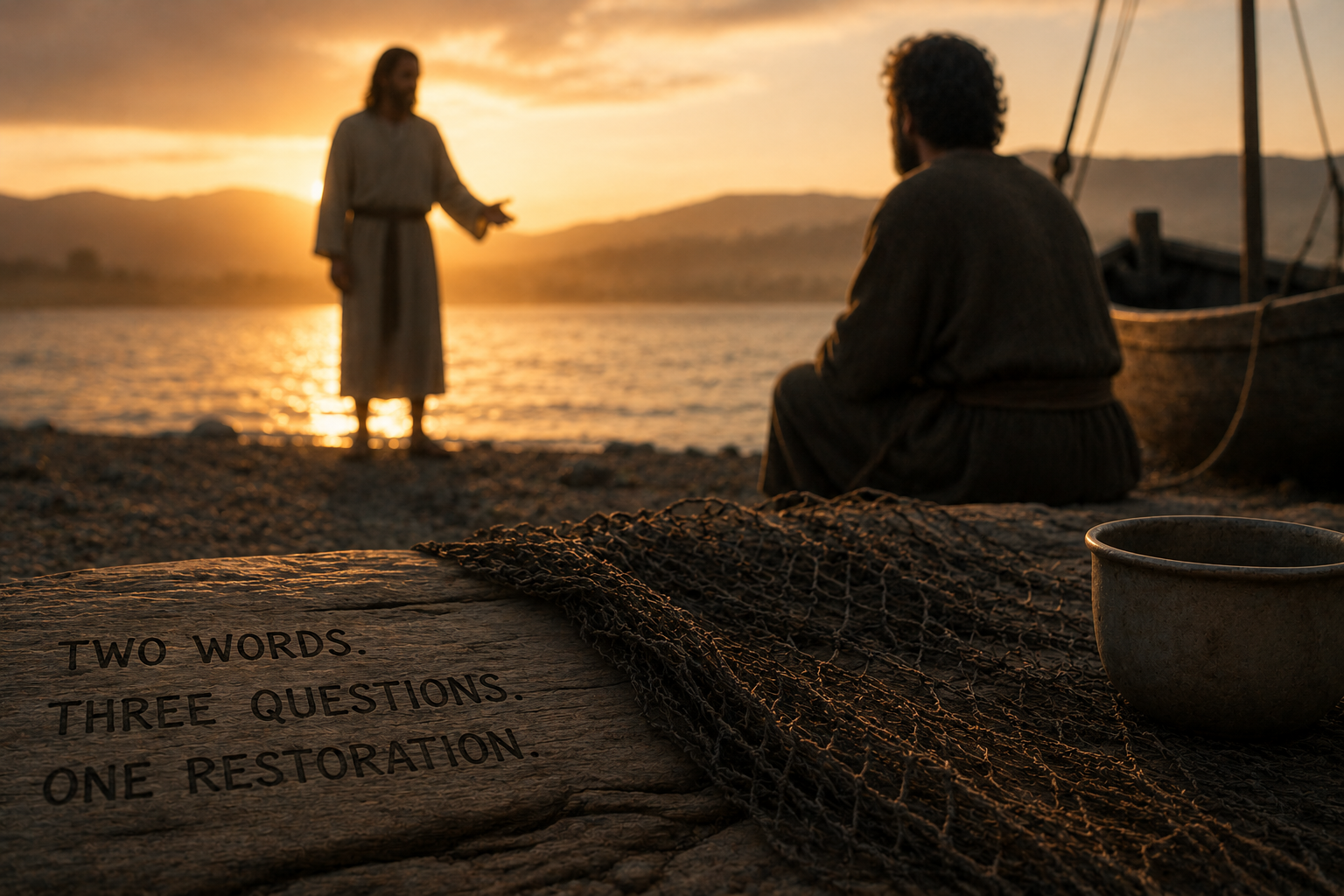
Then Jesus appeared on the shore.
And he asked Peter a question.
But the question is not what most English translations lead us to believe.
The Scene on the Beach
John 21:15-17 records one of the most intimate conversations in the entire New Testament.
It’s early morning. Jesus has been cooking breakfast over a charcoal fire. The detail matters — it’s the same kind of fire Peter warmed himself by when he said the words he could never take back.
After breakfast, Jesus turns to Peter. Three questions follow. Three answers. Three times Peter is sent back into his calling.
Most people know the structure. Three questions for three denials. It’s symmetry. It’s restoration. It’s one of the most remarkable reconciliation scenes ever written.
But here’s what the English translation cannot show you:
The first two questions are not the same as the third.
The Two Greek Words No English Bible Can Fully Capture
In the original Greek, Jesus’s first question uses the word agapao (ἀγαπάω).
“Simon, son of John, do you agapas me?”
Agape — the noun form — appears throughout the New Testament to describe God’s love for humanity. It’s the word Paul uses in 1 Corinthians 13: “Love is patient, love is kind, love never fails.” It’s the love that gives without requiring return. The love that stays when staying is costly. The highest register of love the Greek language has.
Jesus is asking: Do you love me with that kind of love?
Peter answers: “Yes Lord, you know that I phileo you.”
Phileo (φιλέω) is the love between close friends. Warm. Loyal. Genuine. It’s not a lesser word — but it is a different one. It describes the affection of human friendship rather than the covenantal love Jesus just asked about.
Peter cannot say agape. Maybe because he’s being honest. Three days before this conversation, by a charcoal fire, he had looked someone in the eye and said he didn’t know Jesus. Agape is the love that stays. It’s not the love he had shown.
So Peter answers with what he has: the friendship love, the loyal love, the love that’s real even if it isn’t yet whole.
Jesus asks again — a second time — “Simon, do you agapas me?”
Peter answers the same way: “Lord, you know that I phileo you.”
He is not being evasive. He is being precise. He’s offering exactly what he has to offer.
And then something remarkable happens in the Greek text.
The Third Question Is Different
On the third time, Jesus doesn’t ask the same question.
“Simon, do you phileis me?”
He switches from agapao to phileo.
Jesus lowered to meet Peter where he was. He stopped asking for the love Peter couldn’t give and asked instead for the love Peter had.
The text says Peter was grieved because Jesus asked him the third time. Most readers assume Peter’s grief comes from the repetition — three questions for three denials, the weight of that number. But there’s something deeper in the Greek: Peter may have understood that Jesus changed the word. That the question itself changed.
And Jesus’s response to each answer — every single time, regardless of which love Peter offered — was the same:
“Feed my lambs. Tend my sheep. Feed my sheep.”
Not: “Come back when your love is worthy of the calling.”
Not: “Prove to me that this won’t happen again.”
Just: Here is still your assignment. Take care of what I care about.
The Turn: God Doesn’t Wait for Your Love to Be Perfect
For two thousand years, this passage has been read primarily as a test. Did Peter pass? Did he prove himself? Did he earn his way back into the story?
But look at what Jesus actually did.
He didn’t stand on the shore demanding agape before He would speak to Peter. He made breakfast. He called them in. He waited until they had eaten. And then, when He turned to Peter, He started with what Peter had — not what Peter lacked.
And when Peter couldn’t say agape — when all he could honestly offer was phileo — Jesus didn’t reject it. He received it. And He still said: Feed my sheep.
This is not the behavior of someone keeping score.
This is someone who knows the difference between where you are and where you’re going — and who chooses to begin with where you are.
The most common spiritual misconception about restoration is that you have to arrive at the right level before you can come back. You have to feel it deeply enough. Mean it convincingly enough. Prove it thoroughly enough. Only then does the door open again.
But the beach breakfast says something different.
It says God knows the love you have right now. He knows it’s not the biggest love yet. And He starts there anyway.
What This Changes About Your Monday
If you’ve been waiting to “feel ready” to reengage — with God, with your faith, with a person you’ve failed — the beach breakfast has something for you.
Peter didn’t arrive at the shore with a prepared speech. He arrived with what he had. And when Jesus asked him a question he couldn’t fully answer, he answered honestly. He offered the love that was real, not the love that sounded right.
And that was enough to start.
Not enough to finish. But enough to start.
The Greek words in John 21 don’t tell us Peter had it all figured out. They tell us Jesus met him at the exact level where he was standing — and recommissioned him from there.
You don’t have to have the agape version of your love ready before you show up. The phileo version — the friendship love, the loyal love, the “I’m here even though I failed you” love — is a real place to start.
That’s where the beach breakfast begins.
That’s where a lot of things begin.
Actions to Take Today
-
Say the honest thing. In a quiet moment today, tell God exactly where your love is right now — not where you wish it was. Peter didn’t dress up his answer. He said what was true. That’s the starting place.
-
Read John 21:15-17 slowly. Read it once in your usual translation. Then read it again knowing that Jesus uses two different Greek words. Notice what changes when you see that the third question is different.
-
Identify one place you’ve been waiting to “be ready.” Is there a relationship, a conversation, or a return to faith you’ve been postponing until you feel more worthy? The beach breakfast says you don’t have to wait for agape. Phileo is a real place to start.
Journaling Prompts
-
Where in your life have you been waiting to feel like your love or faith is “enough” before you reengage with God or someone you care about? What would it mean to offer what you actually have right now, honestly?
-
Peter answered with phileo — not the highest love, but his true love in that moment. What does “honest offering” look like for you today, as opposed to performed readiness?
A Prayer
Lord, I don’t always have the agape kind of love. Some days I show up with what’s real, not what’s ideal. Like Peter on that beach, I’m here with the love I actually have — not the love I wish I could offer. You already know the difference. What I’m asking is what Peter found that morning: that you receive what’s true, and you start from there. Restore what needs restoring. Use what I have. And let that be enough to begin.
Amen.
Discussion Question
What does it mean to you that Jesus lowered to meet Peter in phileo rather than waiting for Peter to reach agape? Share your thoughts in the comments — I’d love to know.
Share This
-
“Jesus asked Peter the same question three times — except He didn’t. The Greek text shows two different words for love, and the difference changes everything about restoration.” #WJAS #BibleStudy
-
“Peter couldn’t say agape. So Jesus changed the word to phileo and asked for what Peter actually had. God doesn’t wait for your love to be perfect before starting with you.” #JohnChapter21
-
“Didn’t realize Jesus used two different Greek words in John 21 until today. This is one of those things that changes how you read everything else.”
Q&A
Why did Jesus ask Peter three times?
The three questions mirror Peter’s three denials earlier that week — it’s a deliberate act of restoration that directly addresses each denial. But the Greek adds another layer: the third question uses a different word for love than the first two, revealing that Jesus was meeting Peter where he was rather than demanding something Peter couldn’t yet give.
What is the difference between agape and phileo?
Agape (ἀγαπάω) refers to unconditional covenant love — it gives without requiring return, stays when staying is costly, and is the word the New Testament uses for God’s love for humanity. Phileo (φιλέω) refers to warm, loyal friendship love — genuine affection between people who know each other. Neither is lesser. But they are different, and the distinction in John 21 is what makes the passage remarkable.
Did Peter fail by offering phileo instead of agape?
Peter wasn’t corrected. He answered honestly with the love he actually had, and Jesus received it — then sent him back into his calling three times over. The text doesn’t frame Peter’s answer as insufficient. It frames Jesus’s response as sufficient for what Peter offered.
Why did Jesus switch to phileo on the third question?
Scholars have long noticed this and debated it. One interpretation, grounded in the text: Jesus lowered to meet Peter at the level where Peter could honestly stand. He stopped asking for what Peter couldn’t give and asked for what Peter had. It is a pastoral act within the restoration itself — acceptance of what’s real rather than demand for what’s ideal.
What does this passage mean for someone who feels they’ve failed too badly to return?
The beach breakfast says restoration doesn’t wait for your love to be perfect. It begins where your love actually is. Peter offered phileo — honest, loyal, present — and Jesus started there. That’s the door the passage leaves open.
Quote Graphic
“He didn’t wait for your love to be perfect. He asked for what you have.”