 0
0
 0
0
A few days ago, researchers published something that stopped a lot of scientists mid-sentence.
The finding: ancient asteroid impacts — the same class of cosmic events that reshaped continents and triggered mass extinctions — may have been instrumental in starting life on Earth.
Not ending it. Starting it.
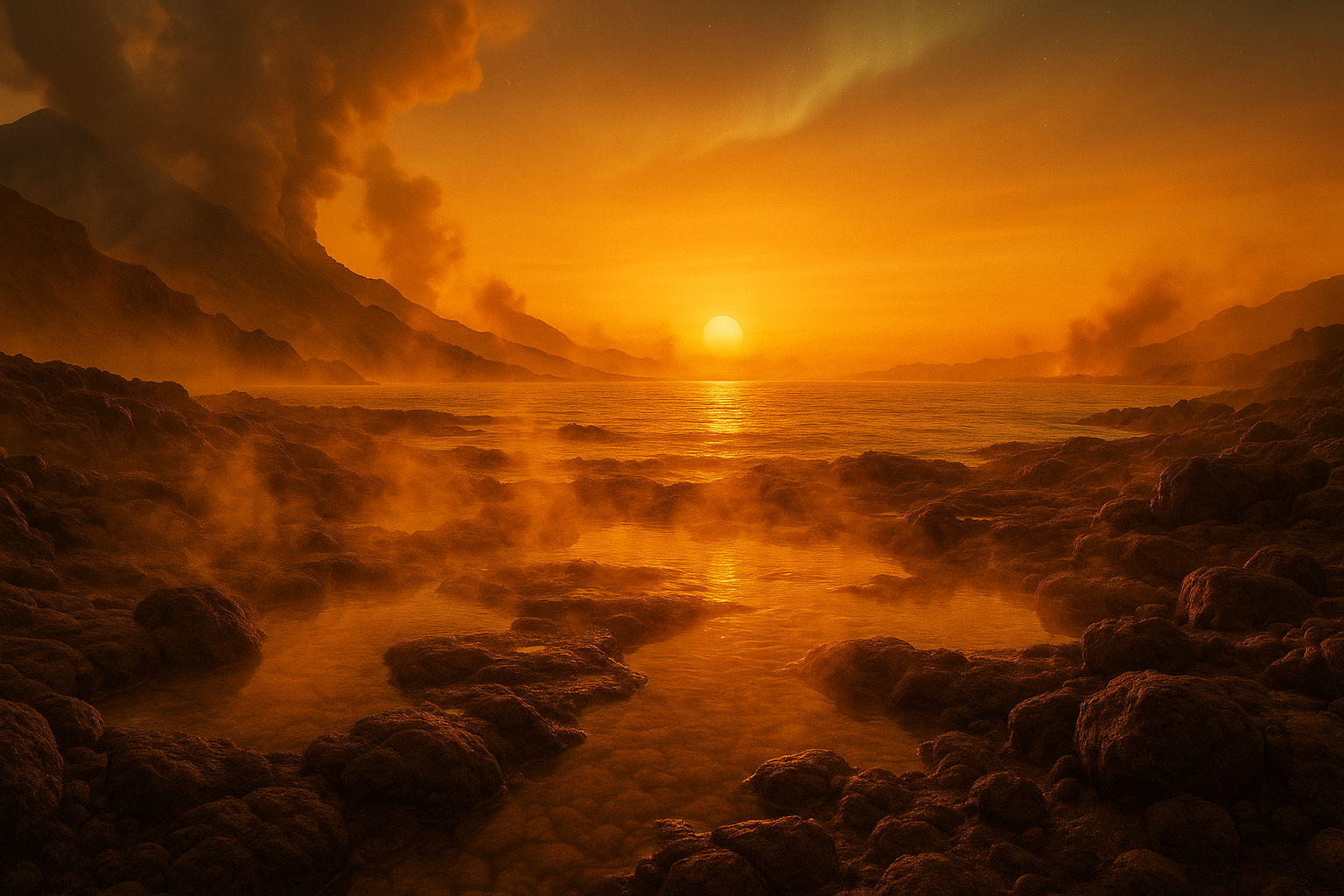
The study, published in ScienceDaily in early July 2026, adds to a growing body of research suggesting that the brutal early period of Earth’s history — a time of constant bombardment, superheated oceans, and an atmosphere that would kill any creature alive today — may have been precisely the conditions that allowed the first chemistry of life to emerge.
The rocks that hit weren’t carrying passengers. They were carrying ingredients.
What the Research Actually Found
For decades, scientists have debated what triggered the leap from chemistry to biology — from dead molecules to the first self-replicating structures that would eventually, over billions of years, become everything alive.
One leading hypothesis: it wasn’t one event. It was a process. A long, violent, seemingly catastrophic process.
The specific argument that keeps gaining traction is this: large asteroid impacts created hydrothermal systems — superheated underwater environments where chemistry runs fast and water cycles intensely. Some researchers believe these hydrothermal fields, energized by the heat of impact, may have concentrated the organic molecules necessary for life’s first chemistry in ways that wouldn’t have happened on a calm, undisturbed planet.
Translation: the violence was the laboratory.
Other studies in the same research thread suggest that some asteroids delivered organic compounds directly — amino acids, nucleobases, the molecular building blocks that life uses. The composition of certain ancient meteorites shows these compounds survive the violence of impact and delivery. They arrive intact.
The origin of life on Earth, in this picture, isn’t a story that begins with peace and steady calm. It begins with catastrophe.
What the Geological Record Shows
Scientists have a name for the violent early chapter of Earth’s history: the Late Heavy Bombardment. Roughly 4.1 to 3.8 billion years ago, the inner solar system experienced a surge of asteroid and comet impacts that pockmarked the Moon, reshaped the continents, and created an early Earth that would be unrecognizable to any creature alive today.
For a long time, this period was understood primarily as a chapter of destruction. Life, it was assumed, had to wait until things calmed down.
But the evidence keeps complicating that story.
The oldest confirmed traces of biological activity — carbon isotope signatures embedded in ancient rock formations — date to roughly 3.7 to 3.8 billion years ago. That’s not long after the bombardment. Not long after the violence. Some of the earliest signs of life appear in rock formations that were still being shaped by the same forces that had been threatening to extinguish any chemistry complex enough to matter.
The timeline doesn’t leave much room for a calm interlude between the chaos and the life.
Some researchers now think there may not have been one.
The Paradox No One Was Expecting
Here is what makes this research genuinely strange.
Everything we intuitively associate with the conditions needed for life — stability, calm, mild temperatures, time — doesn’t fully describe the environment in which life may have actually started.
The beginning appears to have required violence.
Not randomly. Not meaninglessly. But in a way that created the precise conditions — heat, concentration of chemistry, mineral surfaces, energy — that the first self-replicating molecules needed to exist.
Scientists studying origin-of-life chemistry increasingly describe this early phase not as a problem to be explained away, but as a feature of how the process works. Disruption generates gradients. Gradients generate reactions. Reactions, given enough complexity and time, generate life.
The picture that emerges is of a universe in which catastrophe is not simply the enemy of order. In certain conditions, catastrophe appears to be the prerequisite for it.
An Ancient Text Said Something Like This First
Genesis 1:2 — one of the oldest written descriptions of the state of the world before creation began — reads like this:
“The earth was formless and empty, darkness was over the surface of the deep, and the Spirit of God was hovering over the waters.”
Formless. Empty. Darkness. The deep.
That is not a description of peace and stability. That is a description of what scientists now call a prebiotic state — before the conditions for life had fully assembled. Before order. Before structure. Before anything the word ‘alive’ would apply to.
What’s interesting about the Genesis account is not that it predicted the research. It’s that it didn’t flinch from the chaos. It named it directly. Formless and void. Dark and unordered. And then described what happened next: out of that exact state, something began.
The pattern runs through everything that follows in the biblical narrative — and through the broader human story recorded in those texts. Joseph thrown into a pit before he becomes the one who saves a civilization. A people enslaved before they are freed. A King executed before the story is finished. The pattern is always the same: something that looks like the end turns out to be the precondition.
Science is not making a theological claim when it describes asteroid impacts as catalytic for life. It is observing something about how the physical world actually works. But the pattern it’s observing — disruption as prerequisite for emergence — isn’t a new observation.
Someone wrote it down a very long time ago.
What to Do With This
Most people won’t read research about hydrothermal systems and asteroid bombardment looking for personal meaning. They’re reading it because it’s interesting. Because the origin of life on Earth is one of the great unsolved questions, and every new piece of evidence is worth paying attention to.
But if you happen to be in a season where the chaos around you — or inside you — feels like the absence of anything good, it might be worth sitting with this for a moment.
The oldest continuous story of the universe, told across scientific disciplines that didn’t exist when the ancient text was written, keeps arriving at the same observation: the formless and void isn’t where things end. It tends to be where they begin.
You don’t have to resolve that into theology for it to mean something.
Sometimes a pattern is enough.
Discussion Question: The research suggests life may have needed catastrophe to begin — that the very forces that seemed most destructive created the conditions for something entirely new. Have you ever experienced something that looked like destruction turning into the beginning of something unexpected? Leave a comment — I’d genuinely like to read what comes to mind.
Share This:
🪨 Asteroids didn’t just reshape Earth — new research suggests they may have helped start life itself. The chaos wasn’t the enemy of the story. It might have been the opening chapter. → https://bgodinspired.com/index.php/bible-resources/bible-and-science/scientists-think-asteroids-helped-spark-the-origin-of-life-on-earth-an-ancient-text-named-that-pattern-3000-years-earlier/
New research on asteroid impacts and the origin of life on Earth is genuinely strange: the violence may have been the laboratory. And an ancient text noticed something similar about how creation works. → https://bgodinspired.com/index.php/bible-resources/bible-and-science/scientists-think-asteroids-helped-spark-the-origin-of-life-on-earth-an-ancient-text-named-that-pattern-3000-years-earlier/
People Also Ask:
Q: What does the new research say about asteroids and the origin of life on Earth?
A: Recent research published in 2026 adds to a growing body of evidence suggesting that ancient asteroid impacts may have helped create the conditions necessary for life’s first chemistry. Large impacts may have formed hydrothermal systems that concentrated organic molecules, while some asteroids may have delivered the molecular building blocks of life directly to early Earth. The research suggests the violent early period of Earth’s history — rather than being simply destructive — may have been catalytic for life.
Q: Did asteroids bring life to Earth?
A: Scientists don’t claim asteroids brought life itself to Earth, but there is strong evidence that some asteroids delivered organic compounds — amino acids, nucleobases, and other chemical building blocks that life uses. The composition of ancient meteorites shows these compounds can survive the violence of impact and delivery. Combined with the hydrothermal energy created by large impacts, this may have created the right environment for life’s chemistry to begin.
Q: What is the Late Heavy Bombardment?
A: The Late Heavy Bombardment refers to a period roughly 4.1 to 3.8 billion years ago when the inner solar system experienced a surge of asteroid and comet impacts. This period was long understood primarily as a chapter of destruction. But evidence now suggests the earliest traces of biological activity appear in rock formations dating to around this same period — raising the possibility that life didn’t wait for the bombardment to end, but may have begun during or shortly after it.
Q: What does Genesis 1:2 say about the origin of life?
A: Genesis 1:2 describes the state of the world before creation began as “formless and empty, darkness over the surface of the deep” — a description of chaos and absence of order. The text then describes something beginning out of that exact state. While Genesis isn’t making scientific claims, many find it striking that the pattern it describes — order and life emerging from chaos and formlessness — maps onto what origin-of-life research increasingly suggests about how the physical process actually worked.
Q: Is the origin of life on Earth solved?
A: No. How exactly life began on Earth remains one of science’s great unsolved questions. Researchers have identified several plausible mechanisms — hydrothermal vents, asteroid delivery of organic molecules, mineral-catalyzed chemistry — but no single explanation has been confirmed. What has shifted is the understanding of the conditions involved: the evidence increasingly suggests the early violent, chaotic Earth may have been the right environment for life to begin, not an obstacle to it.