 0
0
 0
0
Think of the most powerful person you know personally.
A boss who’s been in the industry for 30 years. A mentor who shaped a generation of people. A pastor who has counseled thousands.
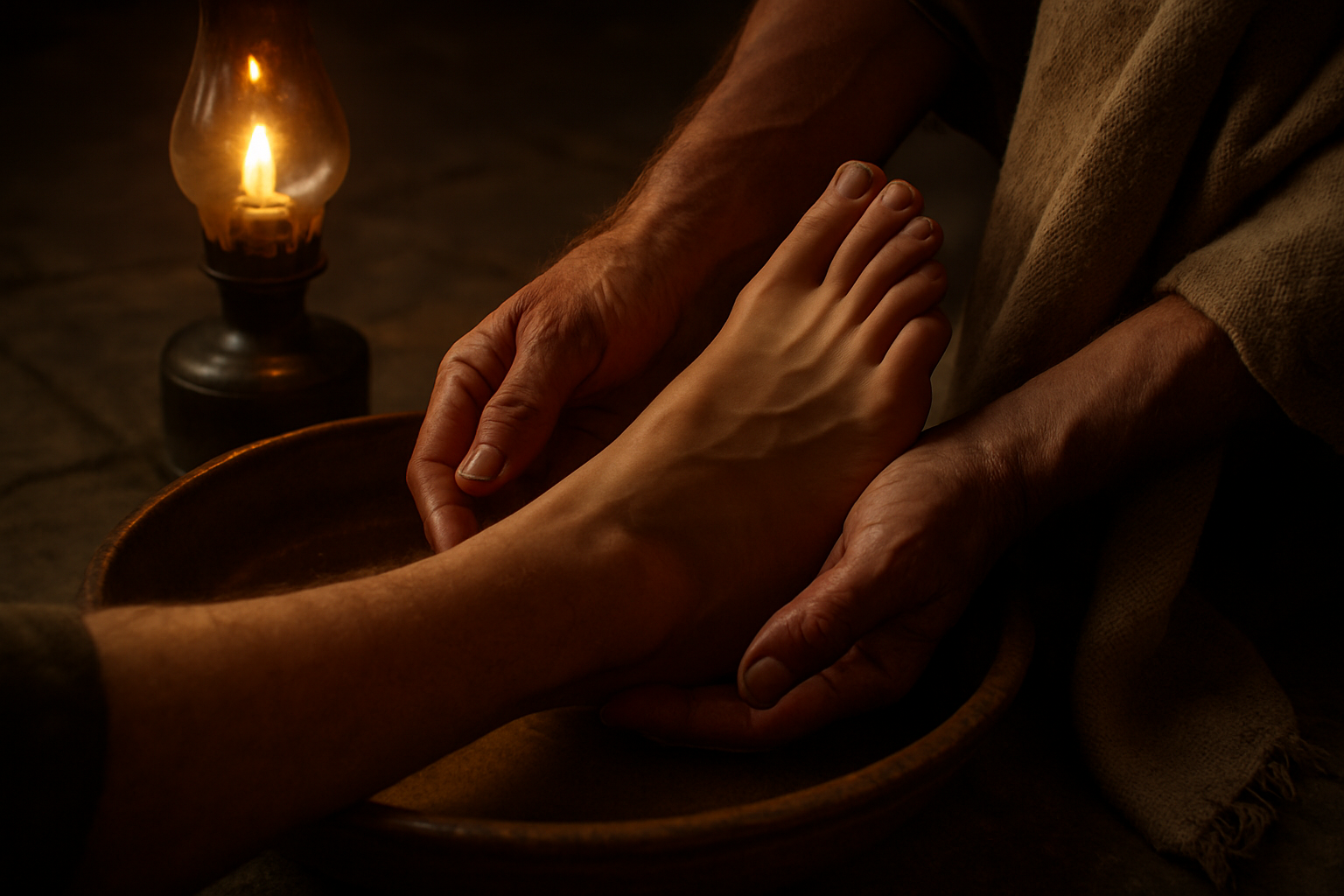
Now picture them on their hands and knees in front of you, holding your feet over a basin of water, washing them one at a time.
That’s not just uncomfortable. It’s disorienting. The whole room would go silent.
That’s what happened in the upper room the night before Jesus died — and it was far more shocking to everyone in that room than it reads to us today. Because we’re missing something about who was supposed to do that job.
The night it happened
It was Passover. Jerusalem was packed. Jesus and his twelve disciples had gathered in a borrowed upper room for a meal they didn’t yet know would be their last together.
John opens the scene with something unusual. He tells us exactly what Jesus knew before he did what he did.
“Jesus knew that the Father had put all things under his power, and that he had come from God and was returning to God; so he got up from the meal, took off his outer clothing, and wrapped a towel around his waist. After that, he poured water into a basin and began to wash his disciples’ feet, drying them with the towel that was wrapped around him.” (John 13:3-5)
Read that again slowly: Jesus knew that the Father had put all things under his power. And then he wrapped a towel around his waist.
He was the most powerful person in that room by any measure anyone in that culture would have used. And he took the lowest job available.
But here’s what most of us miss: that job didn’t just belong to servants. It belonged to a specific kind of servant.
The job even servants didn’t have to do
In the first-century Jewish household, foot washing was assigned to the bottom of the social hierarchy — and it wasn’t just about rank. It was about ethnicity and legal status.
The Talmud, the rabbinic legal commentary compiled during this era, records this explicitly: a Hebrew servant — even a Jewish slave — could not be required to wash feet. That task fell to Gentile servants alone. It was considered beneath the dignity of someone from the covenant people, even if they were a slave.
The rabbis went further. Rabbinic writings note that a student might voluntarily wash his rabbi’s feet as an extreme act of devotion — but the rabbi washing the student’s feet was simply not a thing that happened. The idea didn’t exist because the hierarchy didn’t allow it.
So when Jesus gets up from the table and picks up a basin, the disciples aren’t just surprised that someone important is serving them. They’re watching someone in the highest possible position take the one job that fell below even the lowest legally recognized position in their society.
Peter’s reaction makes more sense now: “Lord, are you going to wash my feet?” (John 13:6)
That’s not just surprise. That’s the sound of a category error. This isn’t supposed to be possible.
The Greek word Jesus used — and the one he didn’t
The Gospel of John uses a specific Greek word for what Jesus was doing: nipto (νίπτω).
Nipto means to wash a specific part of the body — hands, face, feet. It appears 17 times in the New Testament, almost always in the context of practical cleaning or ritual washing of a particular body part. It’s the ordinary, functional word for what’s happening in a basin.
When Peter pushes back — “You shall never wash my feet” — Jesus says something that stops him cold: “Unless I wash you, you have no part with me.” (John 13:8)
Peter, with the intensity he’s famous for, swings completely the other direction: “Then, Lord, not just my feet but my hands and my head as well!”
And here is where Jesus makes a distinction that unlocks the entire scene. He uses a completely different word.
“Those who have had a bath (louo) need only to wash (nipto) their feet; their whole body is clean.” (John 13:10)
Louo (λούω) is a full-body bath. Complete cleansing. It appears only 5 times in the New Testament and always refers to thorough, total washing. Think of stepping out of a shower versus brushing dust off your shoes.
Jesus is drawing a theological line inside a practical moment: you’ve already been made fully clean. You don’t need to start over. But as you walk through the world, dust accumulates. And that needs regular, relational, daily attention.
The louo has already happened. The nipto is what needs tending.
If you want to go deeper into how Jesus used Greek words to say things that English translations can barely hold, we’ve done a similar word study on what He meant by ‘Come to Me’ — and the word He used there changes the entire sentence.
What he said after he finished
Jesus puts his outer garment back on, sits down, and speaks.
“Do you understand what I have done for you? You call me ‘Teacher’ and ‘Lord,’ and rightly so, for that is what I am. Now that I, your Lord and Teacher, have washed your feet, you also should wash one another’s feet. I have set you an example that you should do as I have done for you. Very truly I tell you, no servant is greater than his master, nor is a messenger greater than the one who sent him.” (John 13:12-16)
He doesn’t say: let this inspire you toward humility.
He says: do this. The same way. For each other.
What this actually was
Here’s where the story becomes something bigger than a lesson about being helpful.
In every human society that has ever existed, power flows downward. Authority sits at the top. Service rises up to meet it. The more important you are, the less you handle the dirty work. That’s not just how hierarchies function — it’s what hierarchies are, at the root.
Jesus didn’t just challenge that idea. He enacted its opposite, at the table of his closest followers, on the night of the most important meal in Jewish history, with full awareness of who he was and where he was going.
He took the task that fell below even the legally lowest rung of the social ladder. He did it with a towel and a basin, one person at a time, personally.
And then he said: this is the model.
Not: think about serving when it feels right.
Not: stay humble in your heart.
Not: remember that status isn’t everything.
He said: I’ve shown you how to hold the basin. Now hold it for each other.
The gold nugget in John 13 is this: Jesus didn’t lower himself to demonstrate a virtue. He showed us that the one who holds the basin is the one who actually matters. Greatness doesn’t flow down from a position. It moves toward someone else’s feet.
The same thing that made his act scandalous — the deliberate choice of the position no one wanted — is exactly what made it the definition of authority in his community. He didn’t abandon his power. He used it differently than anyone expected power to be used.
We’ve explored how another Hebrew and Greek word reshapes what we think we already know — shalom doesn’t mean peace the way we typically use that word, and the difference is significant. The same kind of shift is happening here with nipto.
What you do with this
The nipto moment in your own life probably isn’t dramatic. It’s small. It’s specific.
It’s the task in the meeting nobody wanted to take. The conversation you could reasonably skip but don’t. The message that says: I noticed what you did, and I want you to know it mattered. The apology that costs you something. The phone call that runs long because the other person needed it to.
Jesus said you also should wash one another’s feet. The word “also” matters — it means in the same way, with the same deliberateness, toward the same people. Not as a spiritual metaphor. As a practice.
The louo has already happened. You are already clean. What needs daily attention is the dust — and the willingness to kneel for someone else’s.
Actions to Take
- In the next 24 hours, identify one person who has been consistently giving in your work, family, or community. Write or say something that names specifically what they’ve contributed — not “thanks for everything,” but the particular thing they did that mattered.
- This week, volunteer for one task in your workplace, family, or community that’s below your typical station. Don’t announce it. Just do it, and notice what it feels like.
- Read John 13:1-17 slowly. Notice which disciple you identify with most — Peter, who resists; the unnamed ones, who receive quietly; or someone else. Sit with that for a moment.
Journal Prompts
- When have you been on the receiving end of someone performing a service far below what their position required? What did it do to you?
- Is there a “nipto” task in your closest relationships right now — something small and daily that needs tending — that you’ve been treating as optional?
- What would change in how you lead, parent, work, or relate if you understood service not as a sacrifice from your position but as the definition of it?
A Prayer
Lord, I’ve heard this story so many times that it doesn’t surprise me the way it should. Help me feel what was actually happening in that room — the basin, the towel, the silence. I want to understand in my own life what it meant, not just in my mind. Show me today whose feet need washing — not as a metaphor, but as an actual thing I can do for an actual person. And when I’m tempted to believe that some service is beneath me, remind me of the upper room. Amen.
Discussion Question
When you picture servant leadership, what’s the first image that comes to mind — and is it the same thing Jesus was describing in John 13? Share your thoughts below.
Share This
“Jesus didn’t wash his disciples’ feet as a metaphor. He did it as a job description. And then he said: now you do it for each other.”
“There’s a word in John 13 that most English readers miss. The difference between louo and nipto changed everything Peter thought he was asking for.”
“The task Jesus took that night wasn’t just humble — it was the one task even Jewish servants were legally exempt from. He went below servant. Then he called it the model.”
Questions and Answers
Why did Jesus wash his disciples’ feet?
Jesus washed his disciples’ feet as a direct demonstration of servant leadership — but the significance goes deeper than most English readers realize. In first-century Jewish culture, foot washing was assigned to the lowest-ranked servants, specifically those of Gentile origin. Hebrew servants were not required to wash feet by law. Even disciples of rabbis might wash their rabbi’s feet as an extreme act of devotion — but a rabbi washing the disciples’ feet was simply unthinkable. Jesus, whom his disciples called Rabbi and Lord, took the one task that fell below every recognized social position and performed it personally, one disciple at a time. Then he told them to do the same for each other.
What does nipto mean in the Bible?
Nipto (νίπτω) is the Greek word for washing a specific part of the body — hands, face, or feet. It appears 17 times in the New Testament and refers to partial, localized washing rather than full bathing. In John 13, when Jesus says those who have “had a bath” only need their feet washed, he uses a second, different Greek word — louo (λούω) — to describe the full bathing. Louo appears only 5 times in the New Testament and always refers to complete, whole-body cleansing. The distinction Jesus draws between these two words carries a theological point: complete spiritual cleansing has already happened; what needs regular attention is the everyday accumulation of dust from walking through ordinary life.
What does foot washing symbolize in the Bible?
In John 13, foot washing operates on two levels. Practically, it was a hospitality custom in the ancient Near East — travelers arrived with dusty feet from dirt roads, and washing them was a sign of welcome and care. Spiritually, Jesus uses the act to redefine what authority looks like in his community. He says explicitly: “I have set you an example that you should do as I have done for you.” The symbol is servant leadership, but the instruction is literal. Jesus meant: hold the basin for each other — specifically, deliberately, toward actual people.
What does it mean that Jesus said “no servant is greater than his master”?
In John 13:16, after washing his disciples’ feet, Jesus says: “Very truly I tell you, no servant is greater than his master, nor is a messenger greater than the one who sent him.” He’s using the logic in reverse: if the master — Jesus — washed feet, then no one in the room is too important to do the same. The statement closes the door on exceptionalism: “I’m above this” is not a valid position in his community, because the one who held all authority in that room just held the basin.
Is foot washing still practiced by Christians today?
Yes. Many Christian traditions practice a foot washing ceremony, particularly on Maundy Thursday — the Thursday before Easter — which commemorates the Last Supper. The practice is most common in Catholic, Anglican, Anabaptist, and many evangelical communities. Some traditions observe it as a regular sacrament or ordinance alongside baptism and communion. The intent is to enact the posture Jesus described in John 13: voluntary, concrete, personal service toward one another, especially across lines of status or hierarchy.