 0
0
 0
0
Last week, IBM announced something that quietly rewrites the textbooks.
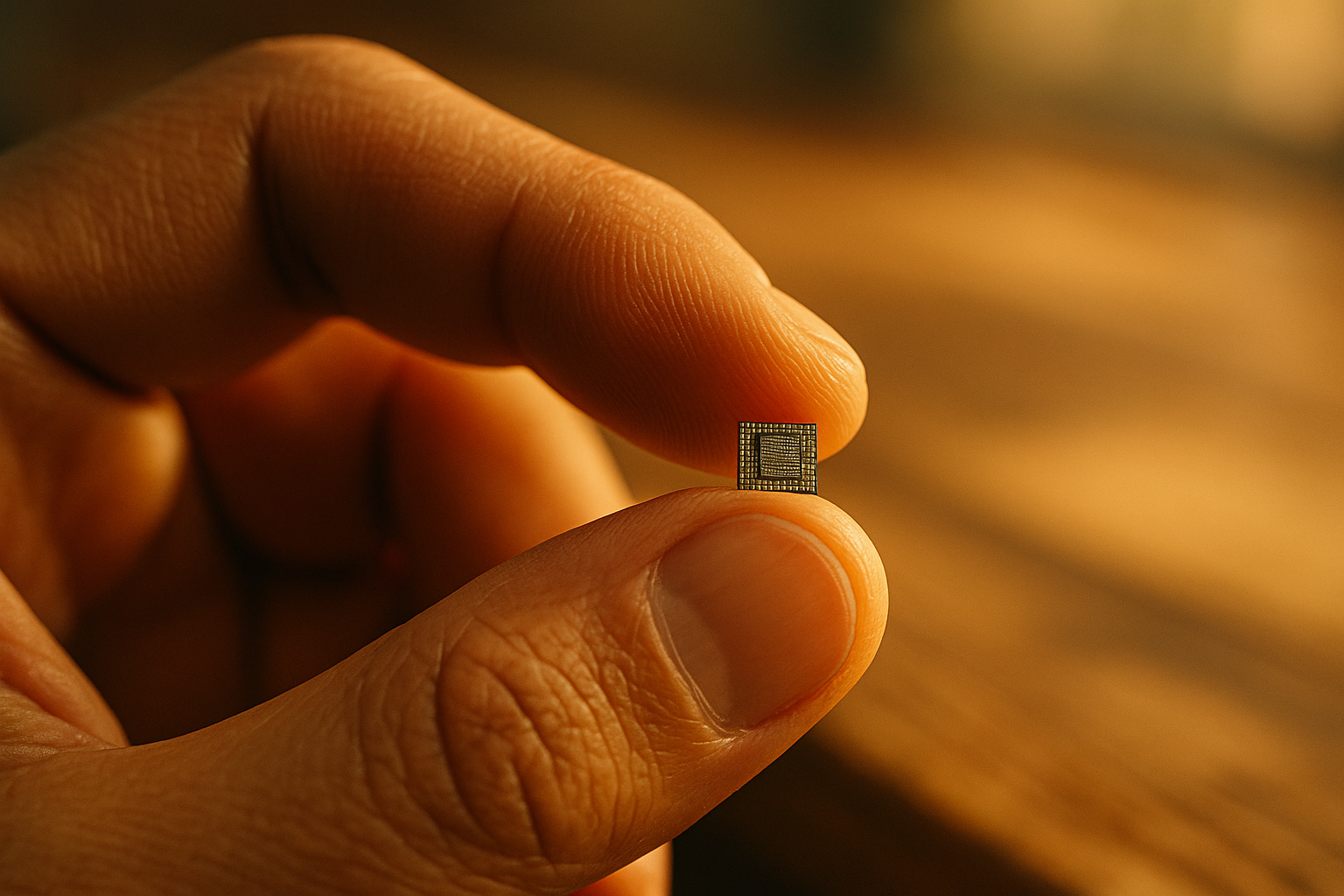
Their new NanoStack chip packs 100 billion transistors into a space roughly the size of a fingernail. That’s the world’s first sub-1 nanometer chip — a manufacturing achievement so precise that individual atoms become a design consideration.
One hundred billion transistors. In a fingernail.
Your brain, for reference, has approximately 86 billion neurons.
IBM just built something with a higher component count than the human brain, and you could lose it in a coat pocket.
What that number actually means
The transistor-to-neuron comparison isn’t perfect. These are different kinds of components doing different kinds of work. A transistor switches electrical signals on and off. A neuron is a biological cell with a staggeringly more complex range of behaviors — firing patterns that shift based on context, history, sleep, and chemistry that no chip has ever needed to replicate.
But the comparison points at something real: in raw architectural count, the gap between silicon and biology has officially closed.
The NanoStack chip can process information at speeds that outpace biological neural transmission by orders of magnitude. It doesn’t get tired. It doesn’t slow down after a long day or a difficult conversation. It doesn’t carry the noise that makes human thinking so gloriously unpredictable.
For AI applications, this is a historic leap. Chips like this are what make language models run in real time, what enable autonomous vehicles to process their environment fast enough to respond before a human could even register the hazard, what allow diagnostic AI to scan thousands of imaging studies and surface the anomaly a human eye might miss on round three of a 12-hour shift.
The progress is real. The capability is genuinely extraordinary.
Then engineers asked the harder question
After the announcement dropped, the natural follow-up started circulating in research circles and comment sections:
If a chip now exceeds the brain’s component count, what does that mean for the gap between machine and human intelligence?
The honest answer from every serious neuroscientist and AI researcher who has been pressed on this is some version of the same thing:
We still don’t know what produces consciousness. We can count neurons. We can watch the brain light up on an fMRI scan in ways that correlate with emotion or memory or decision-making. But we cannot explain why any of that produces the experience of being somewhere — of having a point of view at all.
And here is what no one in the press release wanted to say directly: a chip with 100 billion transistors processes information. It does not experience anything while doing so. Not because it’s missing more transistors — it already has more than you do. Because transistor count was never the thing.
Scientists have been documenting this elsewhere, too. When researchers studied how the brain actually builds itself — through a process that involves neurons literally breaking their own DNA during development — what they found wasn’t a machine optimizing for efficiency. They found something that grows through damage, through difficulty, through being pressed beyond what it can hold.
No chip is built that way. No chip needs to be.
The question the chip can’t answer for itself
Here is what the IBM NanoStack chip cannot do.
It cannot wonder whether it is loved. It cannot feel the particular weight of a grief that has no name yet. It cannot lie awake at 2am with a question it can’t quite formulate. It cannot be stopped by a piece of music or devastated by a betrayal or surprised by the way light comes through a window on a February morning and makes the whole room feel different.
It cannot long for something it has never seen.
The chip processes inputs and produces outputs. Brilliantly. Faster than you. With more consistent precision than you. But it does not want anything. It does not mean anything by what it does. It does not care.
That word — care — is the entire gap.
Researchers studying hunger signals in the brain found something related: the brain treats different kinds of nourishment completely differently at the biological level. What looks like equivalent input on a nutrition label registers entirely differently in the circuitry that governs what we actually need. The brain, it turns out, is not satisfied by the appearance of nourishment. It tracks for what it genuinely needs.
The IBM chip has no hunger signals. Nothing it processes registers as satisfaction or longing or emptiness. It is complete exactly as it runs, every time it runs.
You are not.
An old way of naming the gap
Something in the oldest descriptions of what it means to be human named this before we had transistors to count.
Ancient wisdom traditions — the ones that shaped the foundations of how Western thought approached identity and personhood — made a distinction not between smart and not-smart, not between capable and not-capable, but between things that process and things that long.
The language they used is remarkable in hindsight: human beings were described as made in someone’s image. Not built for a function. Not optimized for a task. Made to reflect something — to carry an identity outward into the world that cannot be measured in processing speed or information throughput.
One ancient collection of poetry described the human body as “fearfully and wonderfully made” — but the awe wasn’t directed at the neuron count. It was directed at the whole — at the fact that all of this biology, all of this architecture, produces something that reaches for what it cannot yet see.
The gap between information and longing wasn’t something those writers saw as a limitation. They saw it as the most remarkable thing about us. The capacity to want something you can’t fully name. The capacity to be moved. The capacity to notice that you exist and find that fact astonishing.
You can read about how the human brain develops from a single cell into something with more connections than stars in the Milky Way — and the numbers are extraordinary. But the numbers aren’t the point. The neuroscientists who study it most closely are the ones most likely to describe something that feels less like engineering and more like emergence.
No one designed you to wonder. You just do.
What the announcement actually tells us
IBM’s NanoStack chip is a genuine achievement. Nobody building it set out to answer any metaphysical question — they set out to push what silicon can do, and they succeeded in a way that will matter for decades.
But the announcement does something unintentional. It clarifies.
When we say a chip has “more neurons than the human brain,” we are measuring one variable and leaving everything else off the spec sheet. We are measuring the thing that can be measured and quietly implying that it’s the whole thing.
It isn’t.
You are not the most efficient information processor in the room — you haven’t been for a while now. You are something else. Something that watches a sunset and feels something shift. Something that misses a person who is no longer there. Something that hopes for things that are not yet real.
A chip with 100 billion transistors just told us that matters more than we had language to say.
The engineers built something impressive. What they actually measured, without meaning to, was the gap.
And the gap is everything.
What do you think is the one thing about human consciousness that technology will never be able to replicate — and why? Drop your answer in the comments — I’d genuinely like to know what you think.
Share this:
- “IBM built a chip with more ‘neurons’ than your brain. Turns out the neuron count was never the point.” #consciousness #AI
- “Scientists just built a chip smarter than your brain in one very specific way. What it can’t do is the whole story.” [bgodinspired.com]
- “The IBM chip has 100 billion transistors. Your brain has ~86 billion neurons. But the chip can’t long for anything. That’s the entire gap.” #ibm #technology
Frequently Asked Questions
How many transistors does the IBM NanoStack chip have?
IBM’s NanoStack chip contains 100 billion transistors in a sub-1 nanometer chip roughly the size of a human fingernail — announced June 26, 2026. For comparison, the human brain contains approximately 86 billion neurons, meaning the chip’s component count exceeds the brain’s neuron count.
Does the IBM chip mean AI is now smarter than the human brain?
Not in the way that matters most. Transistors and neurons work very differently. The chip processes certain types of information faster and more consistently than a human brain. But “smarter” depends on what you’re measuring. The chip has no inner experience, no capacity for longing or grief or wonder. Raw processing count was never the defining gap between human and machine intelligence.
What makes human consciousness different from a computer chip?
Scientists and philosophers have debated this for decades. The current consensus is that we don’t fully understand what produces consciousness — but human consciousness includes subjective experience, emotional depth, the capacity for grief and wonder and longing, and the ability to care about meaning in ways that appear entirely absent in even the most advanced computing systems. A chip can process information about loss. It cannot miss anyone.
Why can’t a chip replicate human longing or emotion?
Because longing and emotion aren’t produced by information processing speed — they emerge from something that is still not fully explained. Adding more transistors doesn’t add inner life. The architecture of a chip is optimized for output, while human consciousness includes something that reaches inward and outward simultaneously — toward connection, toward meaning, toward what is not yet present.
What does the IBM NanoStack chip mean for the future of AI?
The chip represents a significant leap in raw processing capacity, which will accelerate AI capabilities in diagnostics, autonomous systems, language modeling, and scientific computation. It does not close the philosophical gap between computation and consciousness — which most researchers believe is not primarily a hardware problem at all.