 0
0
 0
0
On June 21, scientists published something that deserved a lot more attention than it got.
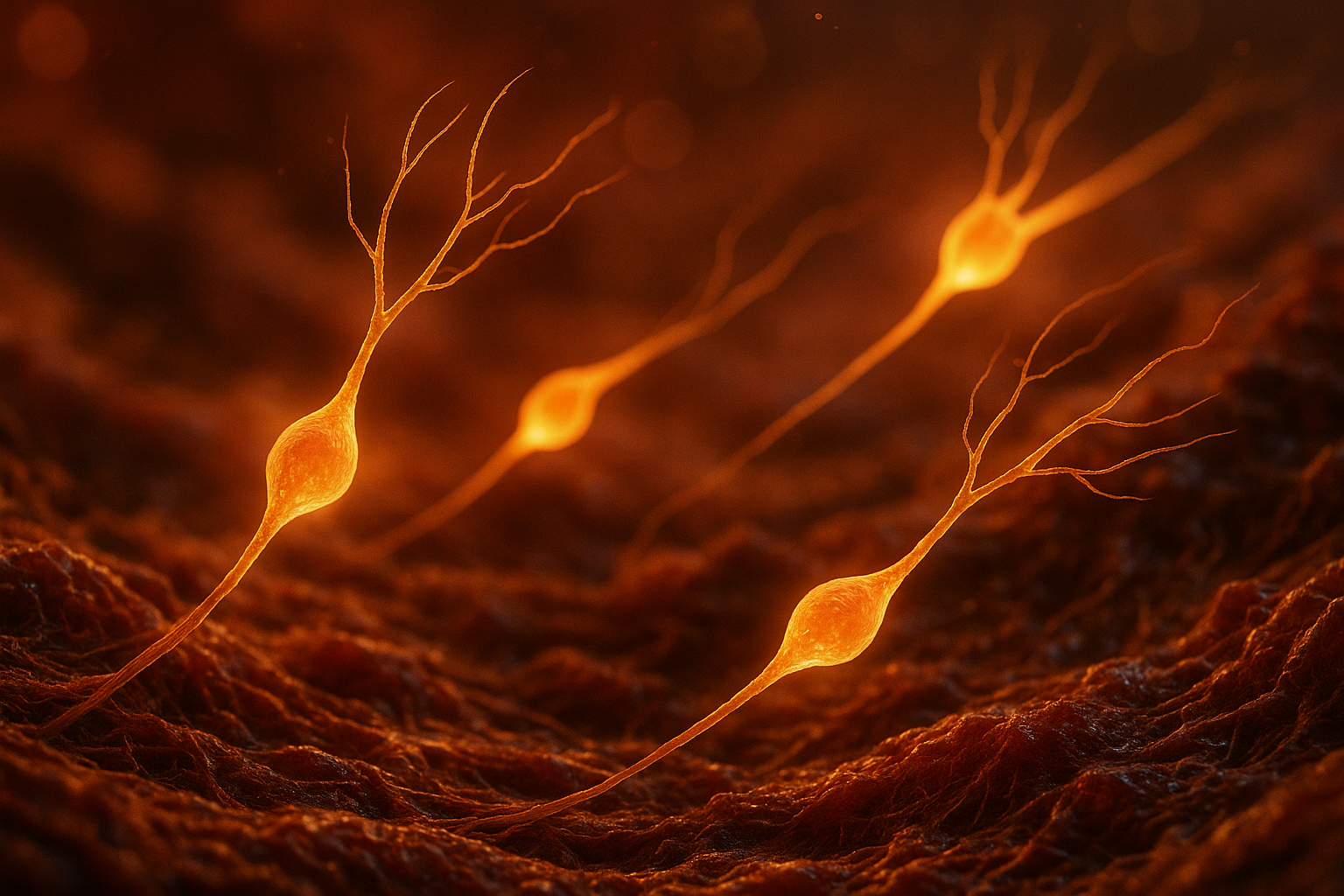
Researchers studying how the brain forms during development found something unexpected: as newborn neurons migrate from where they’re born to where they need to go, the journey itself causes damage. Specifically, the mechanical compression of squeezing through tight tissue in the developing brain routinely causes double-strand DNA breaks — among the most severe forms of cellular damage known to biology.
This is the kind of thing that, in any other context, would qualify as a catastrophic failure.
Instead, it appears to be the mechanism.
What the neurons found out
Your brain has roughly 86 billion neurons. Most of them don’t start where they end up.
During early brain development, newly formed neurons have to travel — sometimes hundreds of times their own body length — from where they were created to where they’ll spend the rest of your life functioning. The path involves squeezing through densely packed tissue, navigating cellular terrain so tight that the journey exerts real mechanical pressure on the cell itself.
That pressure fractures DNA.
The researchers found that this isn’t incidental — it’s apparently essential. The DNA breaks trigger specific repair mechanisms that appear to be part of how the neurons survive, integrate, and ultimately function. Remove the difficulty of the journey and something in the developmental process doesn’t complete correctly. The stress isn’t a side effect of migration. It may be a required condition for what the neuron becomes.
Your brain — the organ behind everything you think, feel, remember, and imagine — was not assembled in comfortable conditions. It was forged in them.
Why does growth require suffering? The science of building through difficulty
This is not the only place biology uses damage as a building mechanism.
Resistance training works by creating micro-tears in muscle fibers. During rest, those tears are repaired with additional protein — and the muscle comes back denser than it was before. The damage doesn’t prevent the growth. The damage triggers it. The repair is the growth. You don’t build a stronger muscle by doing something easy over and over. You build it by asking more than it currently has, which breaks it slightly, which signals the body to rebuild it with more capacity.
Memory consolidation has a similar pattern. Research on learning shows that effortful retrieval — where you have to struggle to pull information back out of memory — produces stronger long-term retention than smooth, uninterrupted review. The difficulty of recall appears to signal the brain that this information is worth encoding more deeply. Forgetting and re-learning is, counterintuitively, a better learning strategy than never losing the thread in the first place.
Bone responds to mechanical stress by becoming denser in the direction of that stress. Which is why astronauts who spend extended time in low gravity come back with measurably weaker bones — the absence of resistance, over time, removes the signal to maintain density. It’s not just that stress makes bone stronger. It’s that the absence of stress allows it to weaken. The stress is part of the maintenance signal.
In each case, the pattern is the same: difficulty isn’t what you endure on the way to becoming stronger. Difficulty is the mechanism by which strength is built into you. This isn’t a motivational slogan. It’s structural. It appears to be the way living systems work.
The people who never had to
There’s a pattern worth noticing in people who were shielded from difficulty too early.
Not children who were neglected or abused — that damage is obvious and its effects are well documented. The subtler case is the highly capable person who, when they finally encounter something they genuinely can’t manage cleanly, has no internal framework for it. They’ve never developed the capacity for navigating real difficulty while staying intact. Not because they’re weak, but because they were never asked to. The architecture never formed because the stress never came.
Psychologists who study resilience have noted for decades that the ability to recover from hard things isn’t a fixed trait you’re born with in finite quantity. It’s developed. It requires exposure to manageable difficulty — failure you survive, loss you recover from, pressure you hold without collapsing. The clinical term is “stress inoculation.” Small, survivable difficulty builds the capacity to handle larger difficulty later.
Forests of trees grown in completely still air produce what are called greenhouse trees — tall and fast-growing, but structurally weak. Without the mechanical stress of wind to trigger strengthening of the trunk and root system, the trees can’t support their own height when they’re finally exposed to it. Wind, it turns out, is not what they endure to grow. Wind is part of what they need to grow.
Something in the design of living systems seems to require adversity to build capacity. Not adversity without limit. Not suffering as a moral good in itself. But difficulty as signal — the trigger that initiates the process of becoming capable of what comes next. The mechanism doesn’t change just because the scale changes. What’s true in neurons appears to be true in muscles, in memory, in trees, in people.
This raises a harder question: what does it mean for the difficulty you’re currently in?
An ancient letter from a Roman prison
About 2,000 years ago, a man sitting in a Roman prison wrote a letter that described this sequence with unusual precision.
He wasn’t a neuroscientist. He didn’t know about double-strand DNA breaks. But he had been shipwrecked three times, beaten with rods five times, stoned once and left for dead, imprisoned repeatedly, and was — at the moment of writing — awaiting trial for his life. He had more firsthand data on what sustained difficulty does to a person than almost anyone living in the comfortable first-century Mediterranean world.
His observation, written from that cell, was almost clinical in its structure: suffering produces something he called endurance — the capacity to remain functional under sustained pressure without losing what’s essentially you. Endurance, in turn, produces what he called character — a refined, tested quality of personhood that couldn’t have been formed in easier conditions. Character, in turn, produces hope — not wishful optimism or desperate hoping, but a settled expectation built on the evidence of what has already been survived.
The sequence matters as much as the destination.
You cannot shortcut from suffering to hope by skipping endurance and character. The endurance is what shapes the character. The character is what gives the hope weight. Strip either middle step and what’s left isn’t hope — it’s just wishing. The man who wrote this wasn’t offering comfort from a safe distance. He was describing a mechanism he had tested in his own body and history, and found to hold.
It matches what the neurons found. The journey breaks something. The repair builds something that the breaking made possible. You don’t arrive where you’re supposed to go without the passage costing you. That’s not a punishment. That may be the architecture.
If you’re in a season of waiting through difficulty, you might also find this reflection on why God’s timing isn’t slow — and what the ancient Greek word for waiting actually means worth reading.
What this means for what you’re carrying right now
If you’re in something hard — not a minor inconvenience, but something real — the neuroscience and the letter are pointing at the same thing.
This may feel like damage. It may be damage, in the very literal sense that your neurons experienced damage. Those two things are not mutually exclusive from it also being the mechanism of something forming in you that couldn’t form in easier conditions.
The neurons that traveled farthest, through the tightest spaces, under the most mechanical stress — those are the neurons that arrived where they were supposed to go. The journey wasn’t incidental to what they became. The journey shaped what they needed to be to function once they got there.
You are not simply enduring something. Something may be forming. The difficulty may be doing exactly what difficulty does, at every scale we’ve been able to measure — triggering the repair processes that produce something denser, more stable, more capable of what comes next than what was there before the pressure began.
That is not the same as saying the hard thing is good, or that you should feel grateful for it, or that it will all make sense one day. Some things are just loss. Some things are just unfair and they stay that way. The neuroscience doesn’t erase that.
But it does suggest that the story of growth — in neurons, in muscle, in memory, in the experience of becoming more fully who you actually are — is not a story of comfort leading somewhere. It’s a story of movement leading somewhere. And movement, at any scale, involves friction. The ancient writer in the prison cell wasn’t telling you to be grateful for pain. He was telling you something he’d tested: what comes out the other side is real. It has weight. It can hold.
Something in you may be being built right now. Even if — especially if — it doesn’t feel like it yet.
If you’ve ever wondered whether the pattern of struggle-then-something-stronger is universal or just coincidence, science suggests it’s something closer to structural. And so does a discovery about the way unwanted thoughts work that landed in the same territory from a completely different direction.
What about you?
When you look back at the hardest season you’ve lived through — what did you discover you were capable of that you couldn’t have known without it? Leave a comment below.
Share this with someone in the middle of something hard:
- Scientists found that neurons literally break their DNA migrating through your developing brain. The damage isn’t a malfunction — it’s the mechanism. An ancient letter from a Roman prison described this same pattern 2,000 years ago. bgodinspired.com/scientists-brain-built-through-damage-paul-romans-5
- Why does growth require suffering? Biology may have a structural answer. And it matches something written from a Roman prison that most people have never read carefully. bgodinspired.com/scientists-brain-built-through-damage-paul-romans-5
- Your brain was forged, not assembled. The neurons that built it had to break their own DNA to get where they were going. There’s an ancient sequence that describes exactly why. bgodinspired.com/scientists-brain-built-through-damage-paul-romans-5
People also ask
Why does growth require suffering?
New research on how neurons migrate during brain development offers one structural answer: as neurons travel through developing brain tissue, the mechanical compression causes double-strand DNA breaks — the most severe form of cellular damage. The damage appears to trigger repair mechanisms essential to how neurons function. The same pattern shows up in muscle development (micro-tears repaired as stronger tissue), memory consolidation (effortful recall produces deeper encoding), and bone density (mechanical stress maintains strength). Growth may not merely accompany difficulty — difficulty may be the mechanism that initiates the processes producing it.
What did Paul say about suffering producing growth?
In Romans 5:3-4, Paul writes that suffering produces perseverance, perseverance produces character, and character produces hope. Writing from a Roman prison, after surviving shipwrecks, beatings, and imprisonment, Paul described this not as consolation but as a sequence he had tested and found to hold. The structure matters: each step produces what the next step requires. Endurance shapes character. Character gives hope its weight. You cannot shortcut from suffering to hope by skipping the middle steps.
What happens to neurons as the brain develops?
During brain development, newly formed neurons migrate from where they are born to where they will function for the rest of your life. This journey requires squeezing through densely packed tissue, sometimes hundreds of times the neuron’s own body length. The mechanical compression causes double-strand DNA breaks. Researchers found this damage appears to trigger repair processes essential to neuronal survival and function — suggesting the stress of migration is not incidental to development but part of the mechanism of it.
Is there neuroscience that explains why hard times make you stronger?
Several lines of research point in this direction. Resistance training builds muscle through micro-tears repaired as denser tissue. Memory research shows that struggling to recall something produces stronger long-term retention than smooth review. Bone density is maintained through mechanical load — astronauts in low gravity lose density because the stress signal is absent. And the June 2026 neuroscience study on developing neurons found that DNA damage from migration appears essential to how those neurons function. The pattern across these systems suggests difficulty may not just accompany strength-building — it may initiate the processes that produce it.
How does resilience develop?
Psychologists who study resilience describe it as a developed capacity rather than a fixed trait — built through exposure to manageable difficulty. The concept of stress inoculation describes how small, survivable challenges build the internal architecture to handle larger challenges later. Trees grown in still air develop weak trunks because they lack the mechanical stress of wind that triggers trunk strengthening. The same principle appears across biology: the capacity to withstand pressure is built by experiencing pressure within survivable limits, not by avoiding it.