 0
0
 0
0
You eat lunch. A reasonable lunch — not a salad, not a punishment, something that should be enough. And an hour later you’re standing in front of the refrigerator again, door open, not even sure what you’re looking for.
You’re not imagining it. And you’re not weak-willed.
A study published last week in the journal Cell Metabolism may have finally explained what’s been happening in your brain — and the answer has nothing to do with your discipline or your stomach capacity. It has everything to do with what your brain considers real nourishment.
Two sugars. Same calories. Completely different answers.
Researchers at Yale School of Medicine gave study participants two different drinks: one sweetened with glucose, one with fructose. Same calories. Same sweetness. Same volume. Then they watched what happened in the brain.
What they found was striking. When participants drank the glucose version, their hypothalamus — the region of the brain responsible for regulating hunger — responded exactly as it should. Satiety signals fired. The brain registered: nourishment received, hunger resolved.
When they drank the fructose version, something different happened. The hypothalamus didn’t light up the same way. The satiety signals were muted. The brain received the calories but didn’t register them as nourishment.
In other words: the fructose drink didn’t answer the brain’s question. And so the brain kept asking it.
The brain has a very specific question it’s trying to answer
Here’s what makes this finding more than a nutrition footnote.
We’ve known for years that fructose and glucose are metabolized differently. Fructose bypasses certain enzymatic processes that glucose goes through. It doesn’t stimulate insulin or leptin (the satiety hormone) the same way. Nutritionists have noted this for decades.
But what this study showed is that the effect is neurological, not just metabolic. It’s not just that fructose metabolizes differently — it’s that the brain perceives it differently. At the level of neural response, fructose looks like something that arrived without answering the fundamental question the brain was asking.
The question isn’t whether calories arrived. The question is: was that real food?
And your brain, it turns out, has an extraordinarily sophisticated system for distinguishing between the two. When you eat something that qualifies as genuine nourishment by the brain’s criteria — real glucose, complex carbohydrates that break down into it — specific neural circuits fire, leptin rises, ghrelin (the hunger hormone) falls. The system resolves.
When you eat something that looks like nourishment — same label, same calories, same taste — but doesn’t meet the brain’s biological criteria, the system doesn’t resolve. The brain keeps the question open. And that open question is what you experience as hunger an hour after a meal that should have been enough.
Why this matters beyond the nutrition label
High-fructose corn syrup was introduced at scale into the American food supply in the 1970s, partly because it was cheaper than sucrose and partly because it was sweeter. By the 1990s it was in almost everything — sodas, bread, yogurt, condiments, packaged snacks. The argument was: a calorie is a calorie.
The argument turns out to have missed something important.
A calorie, from the brain’s perspective, is not always a calorie. The form matters. Where it comes from matters. How it arrives and what signals it triggers — all of it matters. The brain doesn’t count grams and call it done. It asks a more complex question than that. And the answer determines whether you feel satisfied or whether you’re standing at the refrigerator again forty-five minutes later, not quite sure what you want.
The research team noted something else worth sitting with: the suppression of satiety signals from fructose wasn’t just short-term. In participants who consumed fructose regularly, the brain’s hunger-regulation system appeared to recalibrate over time — not toward less hunger, but toward more. Regular fructose consumption seemed to make the satiety system less responsive overall, not more.
Which is to say: a diet built around substitutes doesn’t just leave you unsatisfied in the moment. It may gradually make you harder to satisfy.
Something worth noticing
There’s a detail in this research that keeps pulling at me — and it might pull at you too.
Your brain has a built-in system specifically designed to distinguish real nourishment from something that merely looks like it. You didn’t develop this ability consciously. You can’t turn it off deliberately. It operates below the level of your choices and your preferences and your discipline — it’s written into the architecture of the hypothalamus itself.
The implication is this: you can consume something that satisfies all the surface criteria for food — same calories, same sweetness, same label — and your brain will still know the difference. Not intellectually. Neurologically. The body, it seems, is not easily fooled about what it actually needs.
And here is where the science points, quietly, toward something older.
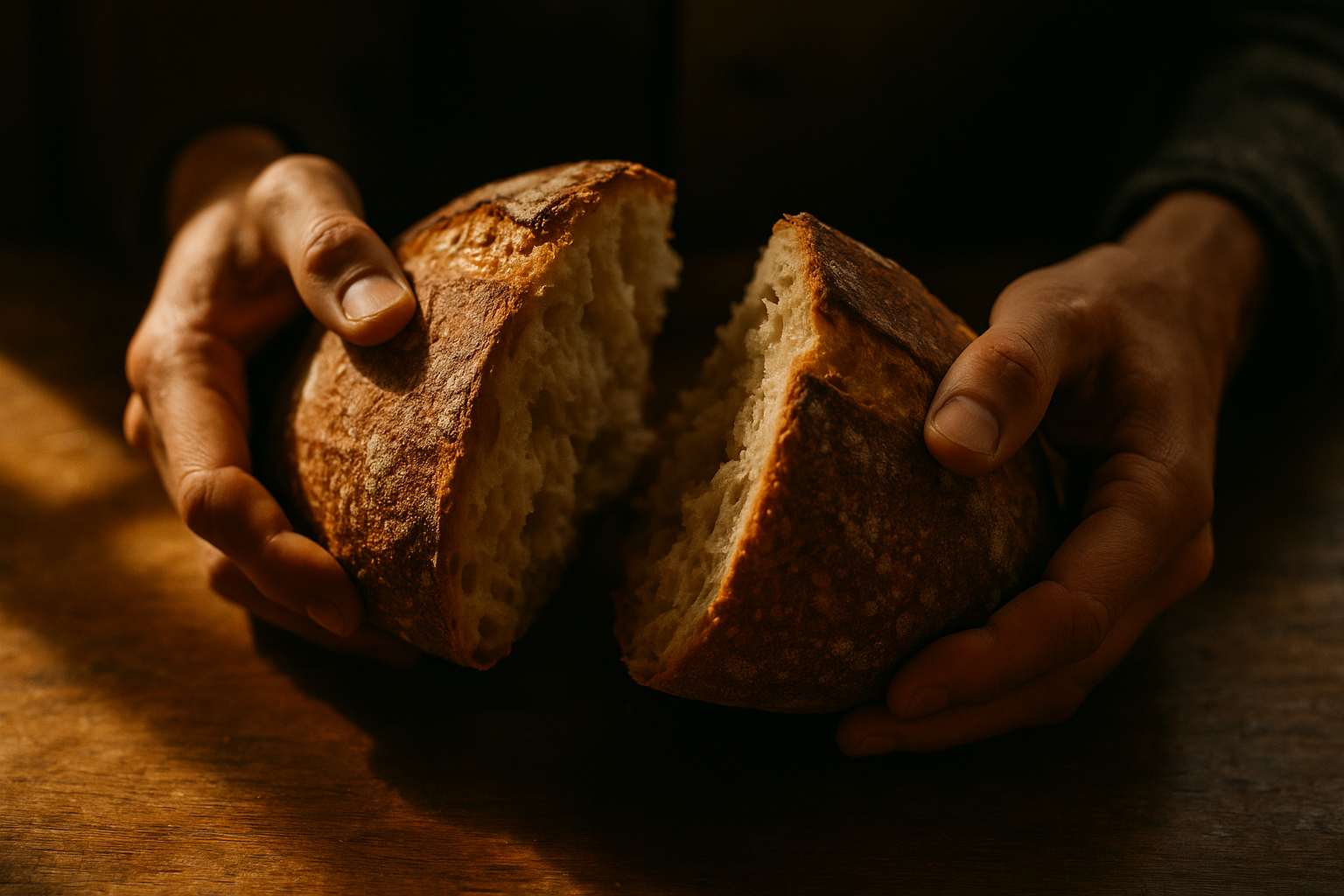
Two thousand years ago, in the middle of a conversation about bread — actual bread, the kind that had just fed thousands of people on a hillside — there was a teacher who made one of the most startling claims in the ancient record. He said, in effect, that human beings carry a second kind of hunger. That the soul has appetite the same way the body does. That just as the body can be given something that looks like nourishment without being nourished, a person can fill their life with things that look satisfying without the underlying hunger ever resolving.
He called himself the bread of life. He said whoever came to him would never go hungry again.
Whatever you do with that claim, the framing of it is worth noticing. He didn’t say people were broken, or that their hunger was a flaw to be managed. He treated the hunger as real — as a signal pointing somewhere, toward something specific that the substitutes weren’t satisfying.
The neuroscientists at Yale would recognize the logic. The brain’s satiety system doesn’t fire because you filled it. It fires because you gave it what it was actually looking for.
The hunger that keeps asking
If you’ve ever noticed that the things you reached for when you were running low — the scrolling, the buying, the eating when you weren’t really hungry, the busyness you maintained just to keep moving — never quite resolved anything, this might be part of why.
They may have been fructose.
They may have looked like what you needed, checked the surface boxes, arrived with the right number of calories — and still left the question open. Still left you standing in front of the refrigerator of your own life, not quite sure what you were looking for.
The brain keeps asking until it gets a real answer. It’s built that way.
Maybe the rest of us is, too.
Discussion Question
The study suggests the brain distinguishes between real nourishment and substitutes — even when the labels look identical. Have you ever experienced that in a non-food area of your life? Something you thought would satisfy a deeper need — and noticed when it didn’t?
Drop your answer in the comments — I’d genuinely like to hear what you’re thinking.
Share This
“Your brain can literally tell the difference between real food and a substitute — even when the calories are identical. And the science points somewhere much older than nutrition labels.” — bgodinspired.com
“Scientists just explained why some foods never satisfy. The answer has less to do with willpower than you’d think — and a lot to do with what your brain considers real.” — bgodinspired.com
Questions People Ask
Why am I always hungry even after eating?
One significant reason is the type of sugar your brain receives. A June 2026 study found that fructose — common in processed foods and sodas — doesn’t trigger the same satiety signals in the brain that glucose does. So even if the calories are identical, your brain may not register fructose as nourishment, leaving the hunger signal active. High-fructose corn syrup, now found in many packaged foods, may be a key factor in why meals leave some people unsatisfied.
Does fructose make you hungrier than glucose?
Yes — according to recent neurological research. The hypothalamus, which regulates hunger, responds differently to fructose and glucose. Glucose triggers leptin release and suppresses ghrelin (the hunger hormone), resolving the satiety question. Fructose doesn’t trigger the same response, which can leave the hunger signal active even after consuming the same number of calories.
What foods cause fake hunger?
Foods high in high-fructose corn syrup are the main culprits — sodas, many packaged snacks, flavored yogurts, condiments, and processed bread. These deliver calories without fully triggering the brain’s satiety response, leading to continued hunger signals despite caloric intake. Whole foods with natural glucose or complex carbohydrates tend to resolve hunger more effectively.
Is it possible to feel full without really being satisfied?
Yes, and the distinction matters neurologically. Fullness (stomach capacity) and satiety (the brain’s hunger signal being resolved) are different systems. You can fill your stomach with fructose-heavy foods and still have an active hunger signal neurologically — which explains why some meals feel incomplete even when you’ve technically eaten enough volume.
What does it mean when nothing satisfies your hunger?
Physically, it can point to the type of carbohydrates in your diet — particularly high fructose intake that bypasses the brain’s satiety system. But there’s also a broader dimension worth considering. Many people describe a hunger that isn’t resolved by food, by achievement, or by the things they thought would fill it. That kind of hunger has been named and addressed in human wisdom traditions going back thousands of years — and may point toward something the body’s satiety system alone cannot resolve.