 0
0
 0
0
There’s a specific kind of grief that nobody warns you about.
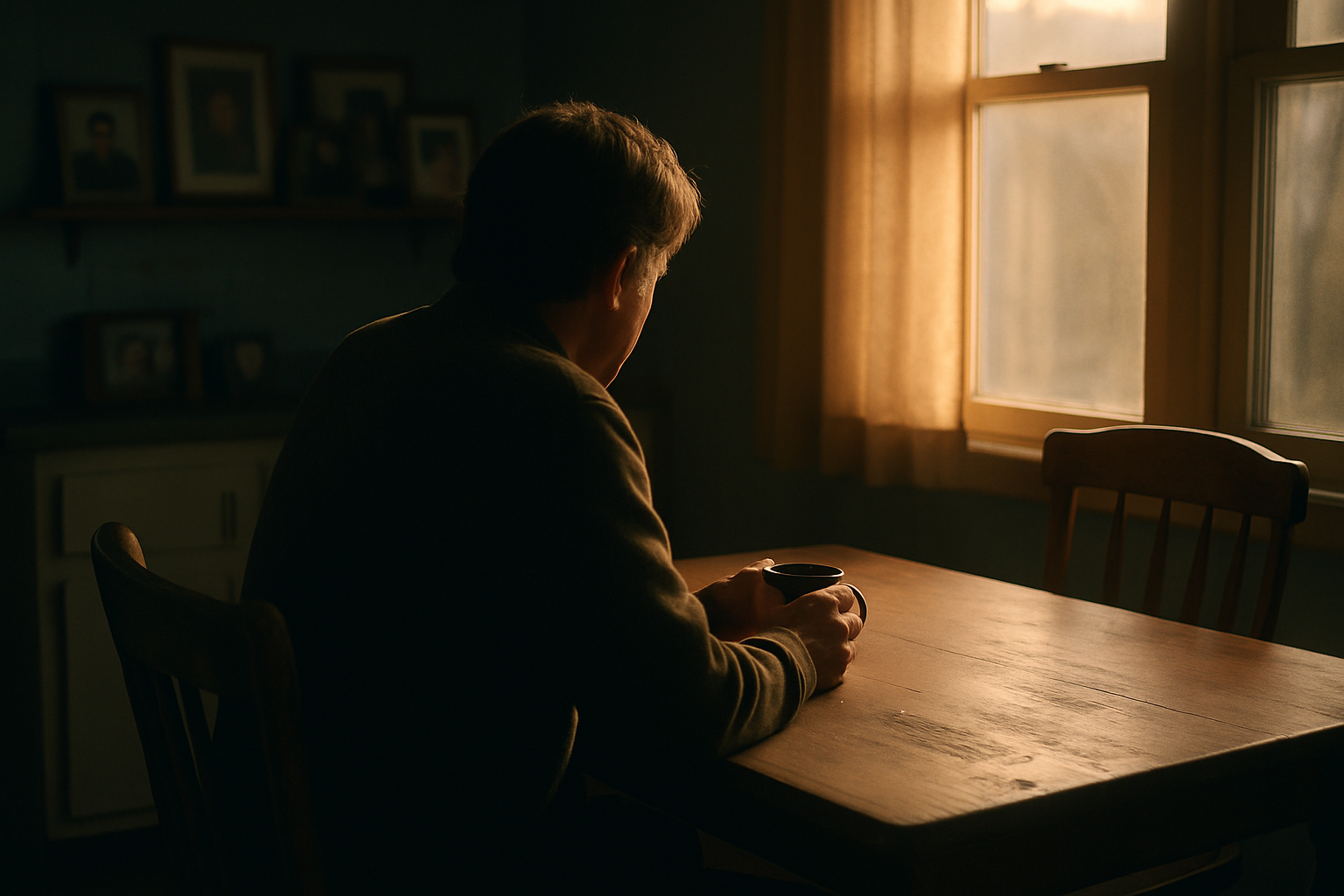
It doesn’t come from death. It comes from watching someone change so completely — through dementia, or addiction, or estrangement, or a brain injury, or a mental illness that arrived one day and never left — that the person you loved is simply no longer there. Their body is present. Their name hasn’t changed. They may still be in the same house, sitting in the same chair, eating at the same table.
But the person you knew is gone in every way that actually matters.
You’re grieving someone who’s still alive.
If you’ve experienced this, you know how strange it is. You can’t quite explain it to people. You can’t put it in an obituary. The rituals that typically accompany loss — the funeral, the condolence cards, the permission to fall apart publicly — none of them apply. Because from the outside, nothing has actually happened. The person is still there.
And yet everything has changed.
What Therapists Finally Named in 1999
In 1999, a family therapist at the University of Minnesota named Dr. Pauline Boss gave this experience a clinical name: ambiguous loss.
She had spent decades working with families of soldiers listed as missing in action during the Vietnam War — people who had no body, no funeral, no certainty, and therefore no clear endpoint to their grief. What she noticed was striking: the families of the missing were often more psychologically distressed over time than families of confirmed casualties. The families who buried a soldier could grieve and eventually move forward. The families who didn’t know couldn’t.
The uncertainty wasn’t kinder. It was harder.
Boss identified two distinct types of ambiguous loss:
Type 1: Physical absence with psychological presence. The person is physically gone but remains present in the mind and heart — a missing child whose parents can’t stop searching, a soldier still listed as MIA, an adopted person’s biological parent who exists somewhere but is unreachable.
Type 2: Physical presence with psychological absence. This is the one most people don’t have a name for. The person is right there — in the house, at the dinner table, on the other end of the phone — but something essential is missing. Dementia takes a parent and leaves behind someone who shares their face but not their memory of you. Addiction takes a sibling and leaves behind someone who calls when they need money, not when they need you. Estrangement happens slowly and then all at once, and you find yourself grieving a version of your child or parent or spouse that no longer exists in the relationship you once had.
This second type of loss is, by Boss’s research, often harder to process than conventional grief — precisely because it has no socially recognized endpoint and no permission structure around it.
Why It Doesn’t Follow the Rules
Conventional grief has a script. People know what to say. There are stages, rituals, cultural acknowledgment. There’s an arc — even when it’s painful, even when it takes years, there’s a recognized beginning and an expected movement toward something like forward.
Ambiguous loss has none of that.
The grief starts, and then it just continues — shapeshifting. Good days when you think maybe things are getting better. Bad days that arrive without warning when something small pulls the floor out from under you. A song they used to sing. A phrase they used to use. A moment when you see them and for a fraction of a second you forget, and then you remember, and the loss is fresh all over again.
And underneath all of it: the guilt. Because they’re still alive. How can you be grieving someone who’s sitting in the next room?
Boss found that this guilt is one of the most damaging dimensions of ambiguous loss. Society doesn’t validate it. There’s no language for it in most circles. So you find yourself trying to explain to people why you’re so exhausted, why you can’t articulate exactly what’s wrong, why you’re mourning someone who is still breathing. And most people — even people who love you — don’t quite know how to hold that.
So you carry it quietly.
Research on ambiguous loss in dementia caregivers specifically has found that this kind of grief — the ongoing loss of the person inside the body that is still present — is associated with higher rates of depression, anxiety, and caregiver burnout than many other caregiving situations. It’s not because these caregivers are weaker. It’s because the grief never gets to complete itself.
What You’re Actually Carrying
There is no stage five for ambiguous loss. No moment where you’ve processed it and it’s behind you. The grief exists in layers, and new layers arrive as the loss deepens or changes. The parent who stops recognizing your name. The sibling who relapses again. The child who goes from distant to unreachable. The relationship that keeps dying in new ways.
Boss describes this as needing to hold two contradictory truths simultaneously: the person is gone and the person is still here. Both are true. Neither cancels the other. And the human psyche, which is wired to seek resolution, finds this extraordinarily hard to do.
The clinical recommendation isn’t to find closure — because there isn’t any. It’s to find a way to carry the grief while still living. To acknowledge that the loss is real even when it has no ceremony. To allow yourself to mourn a person who is still alive without feeling like you’ve betrayed them or failed them.
That turns out to be harder than it sounds.
The Poem That Ends in the Dark
There’s an ancient collection of poems — some of the oldest human writing that survives, compiled over centuries and still read by hundreds of millions of people today — where people brought exactly these kinds of experiences and gave them language.
Most of the 150 poems in that collection follow a recognizable arc. Darkness, struggle, a turn toward trust, and eventually some form of resolution. Even the ones that begin in anguish typically find their way to something like: but I know you are still present. Even the ones that sound like pure complaint eventually arrive at something like gratitude or renewed faith.
Except one.
The 88th poem in the collection begins in darkness and ends in darkness. Completely. The writer describes being brought to the threshold of death, being forgotten, being cut off from the people he loves. He says he’s cried out repeatedly and heard nothing. He catalogs his suffering in detail. And then — the poem simply ends. No turn toward hope. No reassurance. The last line is this: “Darkness is my closest friend.”
That’s it. The poem ends there.
This poem wasn’t removed from the collection. It wasn’t edited to add a resolution. It wasn’t marked as a spiritual failure or included as a cautionary example. It was placed there — right in the middle of one of the most widely read collections of human expression in all of history — because the people who assembled it understood something that Dr. Pauline Boss confirmed in 1999:
Some grief doesn’t resolve. Some loss is legitimately open-ended. Some suffering doesn’t come with a turn toward the light at the end.
And the most honest, most caring thing anyone can do is give that experience a permanent place — not as a problem to fix, but as a reality to witness.
The 88th poem exists to say: this kind of suffering is real. You are allowed to be here.
You’re Not Failing
If you’re carrying an ambiguous loss — if you’re grieving someone who is still alive — you are not broken for still carrying it. You are not spiritually failing because you haven’t found peace with it. You are not doing grief wrong because you don’t feel resolution coming.
You are carrying something that doesn’t resolve on a schedule. That has no ceremony. That the people around you often don’t have the language to acknowledge.
That is genuinely one of the hardest things a person can carry.
The therapists gave it a name in 1999. The ancient writers had already made room for it thousands of years earlier, in a poem that ended in the dark — on purpose, without apology — because sometimes that’s exactly where you are.
And being there doesn’t mean you’re lost. It means you’re honest about what you’re carrying.
That honesty is not a small thing. Sometimes it’s the only thing that keeps you standing.
What do you think genuinely helps?
When someone is going through an ambiguous loss — grieving a person who’s still alive — what actually seems to make a difference? Not what should help, but what genuinely does. Share your thoughts in the comments.
If this found you at the right moment, share it:
“There’s a kind of grief that nobody warns you about — the kind that comes from watching someone you love disappear while they’re still alive. Therapists gave it a name in 1999. The oldest human writing already had a place for it thousands of years earlier.” — [link]
“Grieving someone who’s still alive — dementia, addiction, estrangement, brain injury — is one of the loneliest kinds of loss because there’s no funeral, no script, and nobody knows what to say. Here’s why it’s so hard, and why it makes complete sense.” — [link]
Questions people ask about grieving someone who is still alive:
What is ambiguous loss?
Ambiguous loss is a term coined by family therapist Dr. Pauline Boss in 1999 to describe grief that has no clear resolution because the loss itself is unclear or ongoing. It comes in two forms: physical absence with psychological presence (a missing person, an estranged family member who exists somewhere but is unreachable) and physical presence with psychological absence (a parent with dementia, a spouse changed by illness or addiction, a relationship where the person is there but the person you knew is not). Research shows ambiguous loss is often more psychologically difficult to process than conventional grief because it has no socially recognized endpoint and no permission structure around it.
Why is grieving someone who is still alive so difficult?
Several things make this kind of grief uniquely hard. First, society has no script for it — there’s no funeral, no ceremony, no culturally recognized endpoint, which means the people around you often don’t know how to respond. Second, the grief is ongoing and unpredictable — good days alternate with devastating moments, and there’s no stage where you move on. Third, many people carrying this kind of loss feel guilty about grieving someone who is still alive. Research by Dr. Pauline Boss found that families of missing persons — the classic ambiguous loss situation — often experience more long-term distress than families of confirmed casualties, precisely because the uncertainty prevents normal grief processing.
Is it normal to grieve someone with dementia while they’re still living?
Yes. Grief for someone with dementia while they’re still alive is a recognized form of ambiguous loss. You may be grieving the loss of the relationship, the loss of the future you expected, and the loss of the person’s recognition of you. This is sometimes called anticipatory grief or pre-death grief, and it is a legitimate form of mourning that doesn’t require apology or explanation. Caregivers of people with dementia show higher rates of grief-related depression than many other populations because the loss is ongoing and never fully resolved.
How do you cope with grieving someone who is still alive?
Therapists who specialize in ambiguous loss point to a few things that seem to help: naming the loss explicitly — saying out loud “I am grieving this person, and it is real” — tends to reduce guilt and isolation. Finding others who have experienced the same kind of loss provides the validation that social networks often fail to offer. Releasing the expectation of closure can paradoxically reduce suffering. The goal isn’t to be over it — it’s to carry it without it destroying everything else. And giving yourself permission to grieve without a ceremony, without an endpoint, and without guilt turns out to be a significant part of surviving it.
Did the Bible address grief with no resolution?
The collection of poems known as the Psalms includes one — the 88th — that stands distinctly apart from the others because it begins in darkness and ends in darkness, with no turn toward hope or reassurance. Most psalms, even the most anguished ones, eventually arrive at some expression of trust or gratitude. Psalm 88 doesn’t. It ends: “Darkness is my closest friend.” This poem was preserved, not edited out of the collection — suggesting that the people who assembled these writings understood that some grief is legitimately open-ended and deserves to be witnessed without being resolved.