 0
0
 0
0
You have probably heard the verse read at a wedding. The officiant pauses, the room goes quiet, and the words float out over two people in their best clothes:
“Where you go I will go, and where you stay I will stay. Your people will be my people and your God my God.”
It lands beautifully. People nod. Someone gets a little teary. It feels exactly right for two people beginning their lives together.
The only problem is that those words were never said at a wedding. They were not said by a bride to a groom. They were said by a foreign widow to her grieving, bitter mother-in-law — a woman who had just told her to go home.
And the real story is more powerful than the wedding version ever was.
What Was Actually Happening in Ruth 1:16
To understand what Ruth was doing when she said these words, you need to understand what Naomi’s life looked like at that moment.
Naomi had left Bethlehem years earlier with her husband Elimelech and their two sons during a famine. They settled in Moab — foreign territory, not Israel’s homeland. Her sons married Moabite women: one married Orpah, one married Ruth.
Then Elimelech died. Then both sons died.
Naomi was left in a foreign country with no husband, no sons, no financial security, and no obvious future. In the ancient world, a woman without a husband or sons was genuinely vulnerable. There were no social safety nets. What Naomi had was emptiness and grief and the long road home to Bethlehem.
She told both daughters-in-law to go back to their own families. Go home. Find new husbands. Start over. You owe me nothing.
Orpah kissed her and went back. It was the reasonable thing to do.
Ruth stayed.
Naomi pushed back: “Look, your sister-in-law has gone back to her people and her gods. Go back with her.” (Ruth 1:15)
And then Ruth said the thing that has been read at weddings ever since:
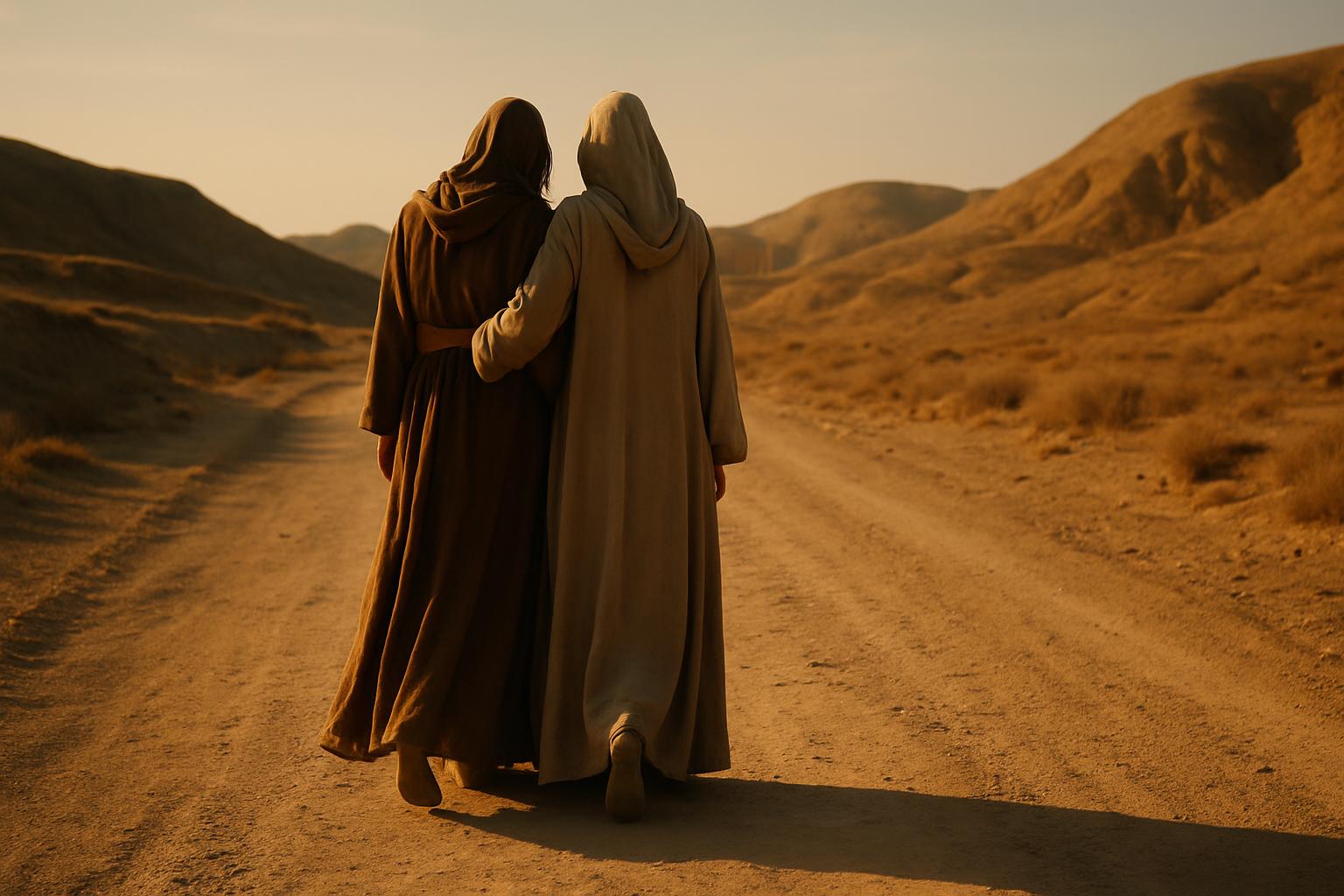
“Don’t urge me to leave you or to turn back from you. Where you go I will go, and where you stay I will stay. Your people will be my people and your God my God. Where you die I will die, and there I will be buried. May the Lord deal with me, be it ever so severely, if even death separates you and me.” (Ruth 1:16-17)
Who Ruth Was — and Why This Is Extraordinary
Ruth was a Moabite. This matters more than it might sound.
Moab was not a friendly neighboring nation. Moabites and Israelites had a complicated, historically tense relationship. A Moabite woman following a destitute Israelite widow back to Bethlehem was not a neutral cultural act. Ruth was moving from her homeland to a place where she would be a foreigner. She was abandoning her own family, her own community, her own gods, and any reasonable prospect of remarriage.
She had no legal obligation to Naomi. Their shared connection — Naomi’s son — was dead. Ruth was technically free. More than free — she was actively encouraged to leave.
There is a Hebrew word the text uses in Ruth 1:14 to describe what Ruth did when Naomi told her to go: dabaq. It means to cling, to hold fast, to be bonded. It is the same word used in Genesis 2:24 — “A man leaves his father and mother and is united [dabaq] to his wife.” It is a covenant word. The kind of word you use for what holds two lives together.
Ruth used the covenant action before she said the covenant words.
The Woman She Was Saying It To
Here is the part the wedding version quietly leaves out: Naomi at this moment was not someone you would call a romantic model for loyalty.
She was broken. She was bitter. She said so herself.
When she arrived back in Bethlehem, the women of the town recognized her and called out her name. Naomi’s answer is one of the most honest things anyone says in Scripture:
“Don’t call me Naomi,” she told them. “Call me Mara, because the Almighty has made my life very bitter. I went away full, but the Lord has brought me back empty.” (Ruth 1:20-21)
Naomi means pleasant. Mara means bitter.
She was not at her best. She was not someone radiating warmth and hope. She had run out of pleasant. She had arrived at bitter, and she was not hiding it.
Ruth had watched all of this — the grief, the self-described emptiness, the public bitterness — and had still said: where you go, I go.
The most famous loyalty verse in the Bible was spoken not to someone standing at an altar in their finest moment, but to someone crouched under the weight of her worst one.
The Turn
Naomi thought she was empty. She thought God had made her life bitter and she had nothing left.
What she did not know — what she could not see from where she was standing — is that Ruth was the answer she did not know to ask for.
Because of Ruth’s faithfulness, they made it back to Bethlehem. Because of Ruth’s willingness to work, she went out to glean in the fields. Because of that, she ended up in the field of a man named Boaz — a relative of Naomi’s, a man of standing, a man the Lord had arranged to be there. The story that began in loss ended in redemption so complete it barely seems possible.
Ruth married Boaz. They had a son named Obed. Obed became the father of Jesse. Jesse became the father of David.
The Moabite widow who chose a bitter, broken woman with nothing left — the one who used a covenant word before she said a covenant vow — is in the genealogy of King David. And she is in the genealogy of Jesus. Matthew 1:5 names her by name in the lineage of the Son of God.
Naomi called herself Mara. She believed the chapter had closed badly. God was writing something she could not read yet.
And Ruth was the person He placed right next to her.
What This Verse Is Actually About
When you hear Ruth 1:16 read at a wedding, the assumption is that it describes choosing someone at their best — the radiant moment, the beautiful beginning, the promise made while everything is full of possibility.
But the verse comes from choosing someone at their worst. It comes from staying when you were given every reasonable excuse to leave. It comes from seeing someone empty, bitter, and actively trying to push you away — and deciding that none of that changes your answer.
That is not a lesser version of loyalty. That is what loyalty actually is.
The Bible does not present Ruth and Naomi as a romantic relationship or a family obligation fulfilled out of duty. The text describes Ruth’s commitment as a choice freely made, at real personal cost, toward someone who had nothing left to give. It is the most honest picture of covenant loyalty in Scripture.
Which is why it still stops people cold, thousands of years later, even when they’re hearing it at a wedding and don’t know the story. Something in it lands true. Because it is. Just not in the way they thought.
If you want to read the story that produced these words — the full account of two women, a barley harvest, a field at night, and a redemption that changed the entire lineage of history — the Book of Ruth is four chapters and takes about twenty minutes. It is worth every one of them. And it connects to a thread that runs all the way back to Genesis 2 and the first covenant between two people.
What to Do With This
Ruth’s story is not just something to admire from a distance. It asks something of us.
Actions to Take:
- Write out Ruth 1:16-17 by hand. Read it slowly, knowing who said it and who they said it to. It takes three minutes and changes how you hear every word.
- Think of one person in your life who is in a Mara season — bitter, empty, not at their best, maybe pushing people away. Send them a message today. Not to fix them. Just to say: I’m still here.
- Read the Book of Ruth in one sitting. Four chapters. Twenty minutes. One of the most complete stories of faithfulness in all of Scripture — and it ends with a genealogy that will make you stop breathing for a moment.
Journaling Prompts
- Have you ever had someone stay when they had every reason to leave? What did that do to you?
- Is there someone in your life right now who is in a Mara season — empty, bitter, hard to love? What would it look like to show up for them the way Ruth showed up for Naomi?
- Naomi was honest with God about her bitterness — she didn’t pretend. What does that tell you about what’s allowed in an honest conversation with God?
A Prayer
Lord, thank you for the Book of Ruth. For a story about faithfulness that didn’t come from anyone having it all together. Ruth chose someone broken, and You used that choice to write something neither of them could see coming. Help me see the people around me who are in their Mara seasons — empty, bitter, sure they have nothing left. Give me the courage to stay, like Ruth did — not because it’s easy, but because that’s what love actually looks like. And when I’m the one who is Naomi, when I’m the one who has run out of pleasant — remind me that You might have already placed someone right next to me. Amen.
Discussion Question
Ruth chose to stay with Naomi even after Naomi told her twice to go. Have you ever loved someone through a season where they were actively hard to love — and what did you learn from that? Share in the comments below.
Share This
Everyone quotes “Where you go I will go” at weddings. But Ruth said it to a bitter widow who told her to leave and had nothing to offer. The real story is even better.
Ruth 1:16 wasn’t a wedding vow. It was a woman choosing someone who had run out of reasons anyone would choose her. #Ruth #Bible #Loyalty
The most beautiful loyalty declaration in Scripture was made to someone at their absolute worst. Not to inspire them. Not because they deserved it. Just because that’s what real loyalty does.
Questions About Ruth 1:16
What is Ruth 1:16 actually about?
Ruth 1:16 is a declaration of covenant loyalty made by Ruth, a Moabite widow, to her mother-in-law Naomi after both of Naomi’s sons had died. Naomi was returning to Bethlehem in grief and bitterness, and she urged Ruth to go back to her own family. Ruth refused and pledged to stay with Naomi regardless of where she went or what it cost her.
Why is Ruth 1:16 read at weddings?
The verse’s language of permanent loyalty and shared future — “where you go I will go, where you stay I will stay” — sounds like a wedding vow, and over time it became popular in wedding ceremonies. But it was not written as a romantic declaration. It was a covenantal pledge of loyalty between two women, one of whom was being told she had no reason to stay.
Who was Naomi in the Bible?
Naomi was an Israelite woman who had moved to Moab with her husband Elimelech during a famine. After her husband and both sons died in Moab, she returned to Bethlehem as a widow with nothing — her own word for herself was “bitter” (Mara). She arrived back empty and grief-stricken, with Ruth as her only companion.
What does “where you go I will go” mean in its original context?
In its original context, the phrase describes Ruth voluntarily surrendering her homeland, her family, her gods, and her future security to follow a broken, grieving woman home. It is a covenant declaration — Ruth is committing herself to Naomi as fully as any marriage covenant would commit two people to each other. The Hebrew word used when Ruth “clung” to Naomi (dabaq) is the same word used in Genesis 2:24 for a husband clinging to his wife.
What happened after Ruth said this to Naomi?
Ruth and Naomi traveled to Bethlehem together, where Ruth worked as a gleaner in the fields. Through a series of events she could not have planned, she ended up working in the field of Boaz, a kinsman-redeemer related to Naomi’s family. Boaz and Ruth eventually married. Their son Obed became the grandfather of King David — and Ruth is listed by name in the genealogy of Jesus in Matthew 1:5.