 0
0
 0
0
Scientists Seek Elusive Intermediate-Mass Black Holes: A Step Closer to Unlocking Cosmic Mysteries
Astrophysicists have long categorized black holes into a hierarchy based on their mass, from the colossal supermassive black holes (SMBHs) at the centers of galaxies to smaller stellar-mass black holes birthed from collapsing stars. However, the presence of intermediate-mass black holes (IMBHs)—the seemingly missing middle tier—remains a tantalizing mystery in the cosmos, one that researchers are striving to unravel.
The IMBHs, theorized to possess masses ranging from 100 to 100,000 times that of our Sun, were first hinted at in 2008 through observations in the globular cluster Omega Centauri. Yet, subsequent studies have cast doubt on those findings, leaving the existence of IMBHs unconfirmed. Compounding the enigma is their role in understanding gravitational phenomena and the fabric of space-time, where extreme gravitational forces cause significant warping.
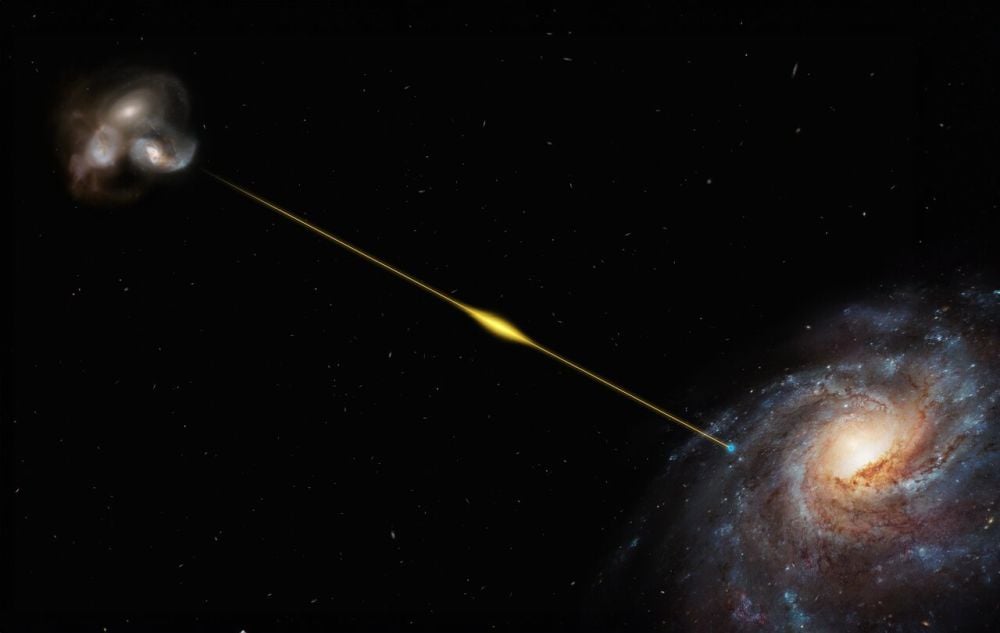
In recent research, titled Evidence for Intermediate-Mass Black Holes From Microlensing Signatures in CHIME/FRB Catalog 2, lead author Huan Zhou and his team suggest a breakthrough method—utilizing gravitational microlensing of Fast Radio Bursts (FRBs) to detect these elusive black holes. FRBs are brief, intense bursts of radio waves generated by mysterious processes that have yet to be fully understood. The researchers propose that the light curve of microlensed FRBs, when analyzed, might unveil signatures of IMBHs, bridging a crucial gap in cosmic understanding.
“We believe that microlensing can serve as an effective and straightforward approach to uncovering these elusive black holes,” Zhou stated. As they analyzed the CHIME catalog of FRBs, they identified two potential microlensing events, estimated to be between 539 and 2,571 solar masses—well within the IMBH range.
Interestingly, the existence of these black holes could provide insights into the nature of dark matter; they may constitute up to 4% of it. This notion not only deepens our understanding of the universe but also aligns with a spiritual perspective. In the same way that researchers pursue knowledge of the cosmos, seeking out that which is hidden, believers are reminded of the divine call to seek wisdom and understanding.
Matthew 7:7 reminds us, “Ask, and it will be given to you; seek, and you will find; knock, and it will be opened to you.” Just as the quest for IMBHs is a reminder that there is much we do not yet know about our universe, it is also an invitation for each of us to explore deeper truths in our lives—both scientifically and spiritually.
As scientists strive to confirm the existence of IMBHs and unlock the secrets of the universe, we are called in our own journeys to remain inquisitive and open-hearted, ready to embrace new knowledge and experiences.
In a world replete with mysteries, let the pursuit of knowledge inspire you not only to explore the cosmos but also to grow in understanding of the profound spiritual truths that surround us. As we seek, may we remember the larger picture—the interconnectedness of all creation and our place within it.
If you want to want to know more about this topic, check out BGodInspired.com or check out specific products/content we’ve created to answer the question at BGodInspired Solutions
If positive Biblical wisdom matters to you, I’d love your support of the mission
Q&A about
Where can I find more information about intermediate mass black holes?
Scientists are actively researching these mysterious entities, suggesting that their existence may be uncovered through phenomena like microlensing and fast radio bursts. As believers, we can reflect on Romans 1:20, which speaks of God’s invisible qualities being evident through creation, including the vast universe filled with wonders waiting to be understood.
Are there any theories about why we can’t find these black holes?
One theory suggests that they might be elusive because they don’t interact with light the way other celestial objects do. This reminds us of 1 Corinthians 13:12, where it describes how we see things imperfectly now; just as we strive for understanding, God’s plan is often beyond our current grasp, reminding us to trust in His greater wisdom.
How does the study of black holes connect to faith and God’s creation?
The intricacies of black holes can lead us to marvel at God’s creation and His infinite wisdom in designing such complex systems. As Colossians 1:16 says, all things were created through Him and for Him, encouraging us to explore and appreciate the mysteries of the universe as a reflection of His glory.
Can exploring black holes strengthen my faith?
Absolutely! Engaging with the wonders of the universe can deepen our understanding of God’s majesty and power. As Psalm 19:1 states, "The heavens declare the glory of God," and every discovery, even about things like black holes, can lead us to worship the Creator who holds the cosmos in His hands.