 0
0
 0
0
Astronomers Uncover Cosmic Anomaly: A Galaxy Dominated by Dark Matter
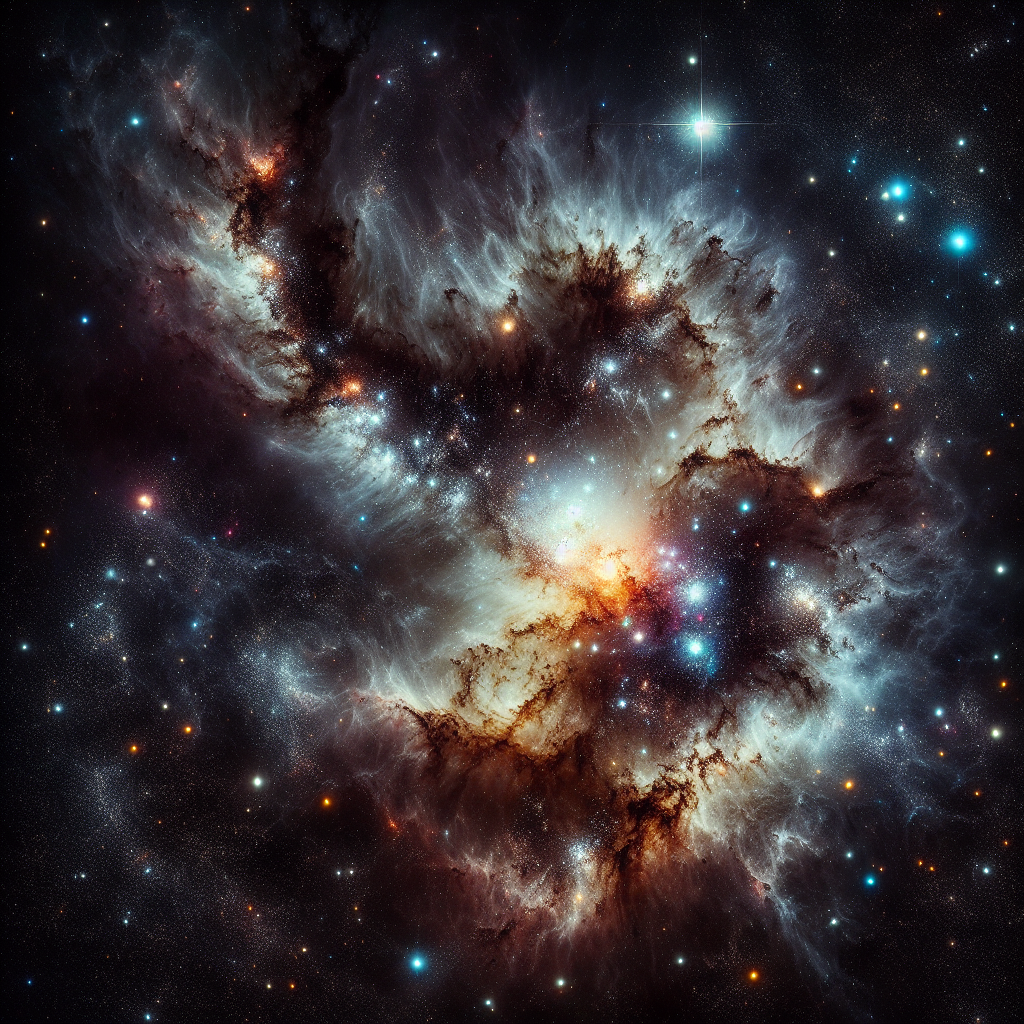
In a groundbreaking discovery, astronomers have identified a cosmic anomaly that could reshape our understanding of the universe. A faint galaxy, named Candidate Dark Galaxy-2 (CDG-2), has been discovered with a staggering 99.9 percent of its mass composed of dark matter, leaving only a mere 0.1 percent attributed to conventional matter. This galaxy, located approximately 300 million light-years away within the Perseus cluster, is nearly invisible to conventional telescopes, revealing itself only through four globular clusters that stand out like islands in a cosmic sea.
For years, these globular clusters were believed to be independent entities. However, a recent study published in The Astrophysical Journal Letters presents compelling evidence that they are part of a larger, gravitationally bound system dominated by dark matter. Combining data from the Hubble, Euclid, and Subaru telescopes, researchers observed a faint glow surrounding these clusters, indicating the presence of CDG-2 — a galaxy so dim that it eluded detection individually.
The intriguing aspect of CDG-2 is its luminosity, which is equivalent to about 6 million suns. Remarkably, the four globular clusters contribute approximately 16 percent of that brightness, hinting at an extraordinarily dense dark matter halo enveloping the galaxy. Astronomers estimate that this invisible structure accounts for an astounding 99.94 to 99.98 percent of CDG-2’s total mass.
While dark matter constitutes roughly 27 percent of the universe’s total energy density — and about 85 percent of its matter — its precise nature remains elusive. Scientists have long inferred its existence from gravitational effects, given that dark matter neither emits nor reflects light. This cosmic shadow plays a vital role in stabilizing galaxies such as our Milky Way, which is believed to harbor a dark matter halo composed of about 90 percent dark matter.
The unfolding narrative of CDG-2 serves as a reminder of the wonders of creation, echoing the biblical principle found in Hebrews 11:3: "By faith we understand that the universe was formed at God’s command, so that what is seen was not made out of what was visible." Just as astronomers are unveiling the hidden structures of the universe, we are reminded of the importance of faith in recognizing the profound truths that often lie beyond human comprehension.
As the exploration of dark galaxies continues, the knowledge gleaned from such cosmic discoveries poses significant implications for our understanding of galaxy formation, dark matter, and the universe’s intricate design. These cosmic phenomena encourage us to embrace a spirit of inquiry and awe, enhancing our appreciation for the Creator who fashioned the heavens.
In our own lives, as we navigate through the often hidden challenges of existence, it’s essential to remember the encouragement found in 2 Corinthians 4:18: "So we fix our eyes not on what is seen, but on what is unseen, since what is seen is temporary, but what is unseen is eternal."
The discovery of CDG-2 invites us not only to contemplate the vastness of the universe but also to reflect on our inner lives. Let’s approach the mysteries of our existence, trusting that just like the dark matter that shapes galaxies, unseen forces in our lives can lead to profound growth and understanding. Each of us, in our uniqueness, contributes to the greater tapestry of creation, reminding us that there’s often more than meets the eye.
If you want to want to know more about this topic, check out BGodInspired.com or check out specific products/content we’ve created to answer the question at BGodInspired Solutions