 0
0
 0
0
Discovery of a Red Light from the Early Universe May Unravel Black Hole Origins
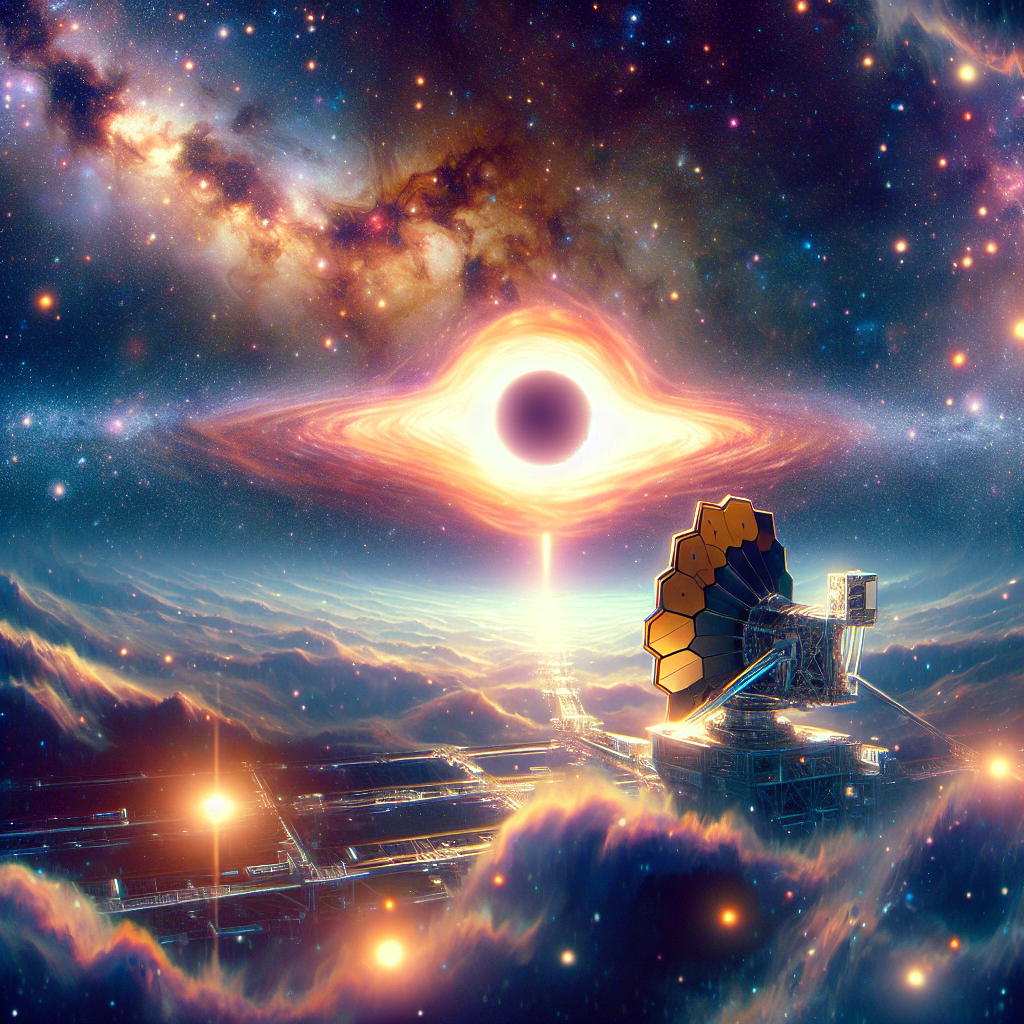
In a groundbreaking revelation, an international team of astrophysicists, led by Ignas Juodžbalis of the University of Cambridge, has identified a mysterious blob of red light, now designated as QSO1, that may represent the first concrete evidence for the formation of supermassive black holes shortly after the Big Bang. This discovery, stemming from observations made by the James Webb Space Telescope (JWST), could reshape our understanding of cosmic evolution and the origins of black holes.
The findings suggest that QSO1 has a mass equivalent to 50 million Suns, implying its nature as a primordial black hole—a significant development in the field of astrophysics. The research indicates that this ancient black hole might have formed just 600 million years post-Big Bang, during what is known as the Epoch of Reionization, when light from the first stars began to illuminate the previously opaque Universe.
"We always expected JWST to reveal unknown aspects of the early Universe," said Juodžbalis and his colleagues, emphasizing the telescope’s unrivaled ability to explore the cosmos’ infancy. The study of QSO1 not only reflects a scientific advancement but also invites contemplation on the very fabric of creation—how stars and galaxies formed amidst the darkness, echoing the biblical narrative of Genesis where light emerged from void.
The characteristics of QSO1 are intriguing. It exhibits characteristics inconsistent with the notion of a star cluster, suggesting it is indeed a black hole. The team’s analysis of the light reveals a rotating mass that aligns well with estimates of the black hole’s mass, reinforcing theories about how galaxies may have coalesced around such massive entities early in cosmic history.
As we reflect on this discovery, we are reminded of the wisdom found in Proverbs 25:2: "It is the glory of God to conceal a matter; to search out a matter is the glory of kings." The pursuit of understanding the Universe can be seen as an echo of this biblical principle—encouraging humanity to seek wisdom and truth in the mysteries around us.
While this research is not without its challenges, requiring further validation and exploration, it emphasizes the symbiotic relationship between faith and knowledge. The unfolding nature of the cosmos holds many mysteries, urging us to ponder our existence and place in this grand narrative.
As we await peer review and further validation of these extraordinary claims, we are reminded of the potential for greater insights into creation itself. This discovery inspires us to reflect on the beauty of the universe that surrounds us, inviting deeper contemplation about our own beginnings and the divine narrative that interweaves science and spirituality.
In a world brimming with uncertainty, let this cosmic revelation serve as a beacon of hope and curiosity. Just as light emerged in the primordial darkness, we too are illuminated by the truths we diligently seek.
Explore and dig up answers yourself with our BGodInspired App. Be careful – each interaction is like a new treasure hunt… you can get lost for hours 🙂